Shocks. Neurological vulnerability. A real outlet-grounding issue.
Their technician had already found a grounding problem. The shocks continued. They knew the resident had a documented neurological vulnerability.
This is what happened during a tenancy costing approximately 300,000 PLN per year. The screenshots and dated correspondence are the resident’s documentation. Decide whether the expectation matches the documented reality.
Every second above is time since that reassurance stood while the 18–22 Ω question remained unanswered.
The resident had disclosed a documented neurological vulnerability. A technician had already identified a grounding issue in at least one outlet, tightened screws and left. The shocks and abnormal electrical behaviour continued — including a bathroom light switching off computer equipment and shocks reported at elevator panels.
He did not accuse them of causing the shocks. He asked a narrower question: can you verify whether the electrical system is safe? They never answered it. That left a neurologically vulnerable resident inside the apartment without knowing whether ordinary electrical use could shock or injure him.
Their technician had already found a grounding problem. The shocks continued. They knew the resident had a documented neurological vulnerability.
If 18–22 Ω was safe, name the standard and say so. If it was not, explain what was repaired. They did neither.
They refused direct CCTV answers, intercepted the police report, distributed a drugs / mental-health character assassination through the resident WhatsApp group labelled “Official WhatsApp group,” removed the resident from that channel, refused the Article 15 request, weaponized legal machinery over two free bottles of mineral water, then missed their own “urgent” inspection deadline and blamed the disabled resident.
The cold record: electrical shocks can trigger seizure-related conditions. Seizures can be fatal through SUDEP, injury or aspiration. The resident disclosed a neurological vulnerability. The resident is also neurodivergent. The Administration knew about the reported shocks. Their own documentation contained 18–22 Ω readings. They still refused the technical answer and the resident-channel response became drugs / mental-health character assassination.
The resident reported electrical shocks and disclosed a neurological vulnerability for which electrical shock exposure was a serious medical concern.
The Administration’s ecosystem enabled an “unaffiliated representative” — an apparent authority figure — to tell 120+ residents that the same person appeared mentally unstable, under the influence of unknown substances and that “zero irregularities” had been found.
“I’m experiencing electrical shocks. I have disclosed a neurological vulnerability. This is serious.”
“Mental issues / unknown substances.” “Zero irregularities found.” “No further answers will be provided.”
The resident disclosed a neurological vulnerability so the Administration would understand why electrical-safety confirmation was medical necessity, not preference. The resident is also neurodivergent.
Neurodivergence is not mental illness. It is not instability. It is not substance abuse. The traits attacked in the record — persistence, refusal to let go, detailed documentation and tight logical chaining — are part of the resident’s neurotype itself.
Calling that person “mentally unstable” is not just an insult. The traits they attacked — persistence, refusal to let go, detailed documentation and tight logical chaining — are the same traits that made the resident keep documenting instead of going quiet.
The Administration-side response was to enable an “unaffiliated representative” — an apparent board / authority figure in the resident environment — to frame him in front of 120+ residents as psychologically unstable and under the influence of unknown substances. The resident provided a clean psychiatric evaluation and negative drug tests. The Administration has never withdrawn the smear.
They attacked him for displaying the traits that made him harder to dismiss. They tried to pathologise the traits that documented their liability. That is equivalent to mocking someone for a wheelchair — then telling 120 neighbours the wheelchair user is “lazy” for not taking the stairs.
The message to every resident with a condition — neurological, neurodevelopmental, or otherwise — is clear: disclose it to this Administration, and the disclosure can become a weapon used against you. The resident disclosed a neurological vulnerability. It was weaponized. What neurodivergent resident would disclose a condition after seeing what happened?
The resident disclosed a neurological vulnerability in good faith. The purpose was clear: electrical safety was a medical necessity, not a preference.
A resident reporting electrical shocks who is also neurologically vulnerable can be neutralized by calling him “mentally unstable.” A resident who understands technical electrical details can be discredited by suggesting he is “under the influence of unknown substances.” The smear targeted the exact credibility point created by the medical disclosure.
If the resident had been injured by an electrical fault, the documented defense path would have been: “we thought he was making it up because he was unstable.” That is not a safety protocol. That is the record they created.
This is not a routine tenant dispute. It is a documented disability-targeting pattern: the safety disclosure made in good faith became the vector of attack, with screenshots, timestamps and an unwithdrawn smear. The traits used to attack his credibility are the same traits that made the record impossible to bury.
The electrical hazard could have been verified. The administrative hazard is deeper: a disclosed vulnerability became a credibility target.
A standard-based answer after electrical shocks and a disclosed neurological vulnerability.
RealityComputer, mouse, chair, carpet, clothing and towel. They never answered the 18–22 Ω question.
A disclosed neurological vulnerability makes electrical-shock reports a safety priority, not a personality issue.
RealityThe resident-channel response was drugs / mental-health character assassination, a ban from the official WhatsApp correction channel, common-area restriction, and no withdrawal after clean medical and drug-test rebuttal.
A resident who disclosed neurological vulnerability is treated with safety-focused accuracy, not credibility attacks.
RealityThe disclosed vulnerability became part of the credibility attack: “mental issues” / “unknown substances,” no same-channel correction, no withdrawal and no accountability.
If the issue “exists only in your apartment,” identify the apartment-specific cause.
RealityAn explanation built from objects found in almost every apartment. Was this the only apartment in Złota 44 with a mouse, chair, clothes and a towel?
After a GDPR Article 15 deadline failure, communication becomes more transparent, written and traceable.
RealityPost-it notes routed through concierge. Company, technician and insurance identities withheld. No written arrival confirmation before their own deadline.
A direct CCTV answer: was the door visible, and did anyone touch the lock?
RealityThey refused to show the footage, refused to state the retention period, and refused to answer whether the door was visible or whether anyone had touched the lock. The police report was intercepted.
Legal machinery addresses court threats, character assassination, data-access failures and police-report interception.
RealityThey weaponized a law office against the resident over two FREE bottles of mineral water. They issued no correction, no withdrawal, no reprimand and no documented sanction for the Unaffiliated Foreign Representative who made court threats, circulated the drugs / mental-health character assassination, displayed internal email and CCTV knowledge, and intercepted the police report.
A Polish prestige building does not enable a foreign authority-like actor who disrespects the integrity of the Polish people under its name.
RealityThe attacked resident defended Poland immediately. The Administration enabled the Unaffiliated Foreign Representative who disrespected Polish integrity; later, the disabled, neurologically vulnerable resident who defended it was smeared as mentally unstable and under unknown substances.
An “urgent” inspection is confirmed, documented and completed.
RealityApproximately 83 days of delay. They miss their own deadline. Then they place “no confirmation from you” directly above the resident’s repeated written confirmations.
Public-copy policy: private names, emails, apartment number, phone numbers, medical identifiers and unrelated personal data are redacted. The operative wording, dates and sequence remain visible.
They left a neurologically vulnerable resident without electrical-safety verification. Then came move-out pressure, a vulnerable door and blocked CCTV verification, police-report interception, character assassination in the official resident channel, blocked correction channels, refusal of the Article 15 request, legal machinery over free water, urgency theatre, a missed deadline and a false “no confirmation” narrative.
Their technician had already found a grounding issue. The shocks and abnormal electrical behaviour continued. They refused to say whether 18–22 Ω was safe or identify the standard.
The “unaffiliated representative” writes that administration has had enough, further technicians cost money, and people replace the resident even when the problem exists.
The lock feels looser. The rosette is missing. Metallic-impact audio is recorded. The resident asks to check CCTV. They refuse the footage, refuse the retention period, and refuse to answer whether the door is visible. The lock was never fixed during the tenancy.
After a significant Złota 44 stakeholder says “you should call the police,” the Unaffiliated Foreign Representative who presented himself as “Management board member of Z44” is notified before the resident who made the call. He arrives equipped with a GoPro and microphone, intercepts the police report, and isolates the officers from the resident inside an area where the resident’s access had been removed.
“Mental issues / under the influence of unknown substances” is distributed to more than 120 residents through the WhatsApp group advertised as “Official WhatsApp group,” together with a court threat. The character assassination is never withdrawn. The resident is banned from the same official WhatsApp channel and common-area access is restricted, eliminating his ability to correct the false narrative there.
The Article 15 request specifies data, logs, CCTV, recipients, dates and a narrowed fallback. The deadline expires. The controller and processing structure then use “lack of organizational and technical capacity” as the stated reason to avoid producing the data they run.
They answer an insurer request by clearing themselves of liability. Then a law office formalizes a 30-day restriction against the resident over two free bottles of mineral water. They document no comparable sanction for the Unaffiliated Foreign Representative behind the court threats, character assassination, data-access questions and police-report interception.
Immediately after the Article 15 deadline failure is escalated, they call an inspection urgent and link it to safety and insurance. Then they delay it approximately 83 days while routing communication through concierge and post-it notes and withholding company, technician and liability details.
The resident repeatedly confirms and stays available. They miss their own deadline, then write “no confirmation from you.” Exact correction questions later receive “all questions answered” and “matter resolved.”
The administration knew about the shocks, the documented neurological vulnerability and the prior outlet-grounding issue. The resident asked them to verify whether the electrical system was safe and explain the documented readings.
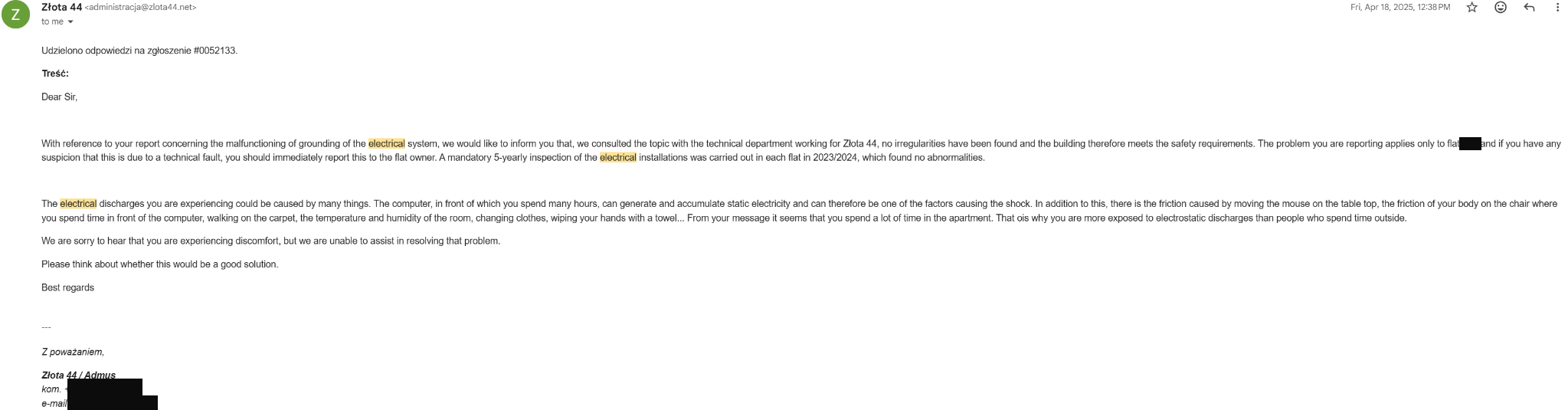
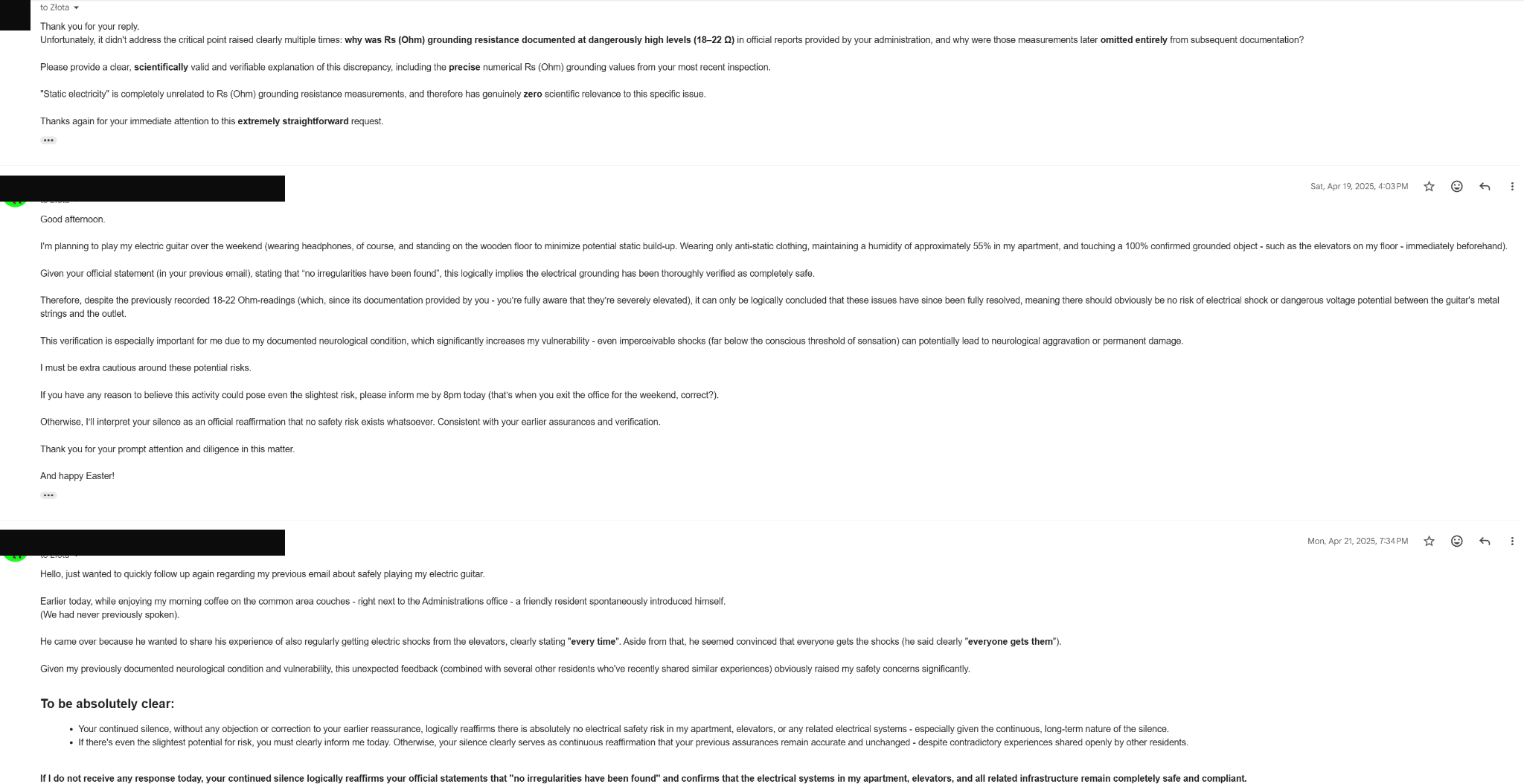

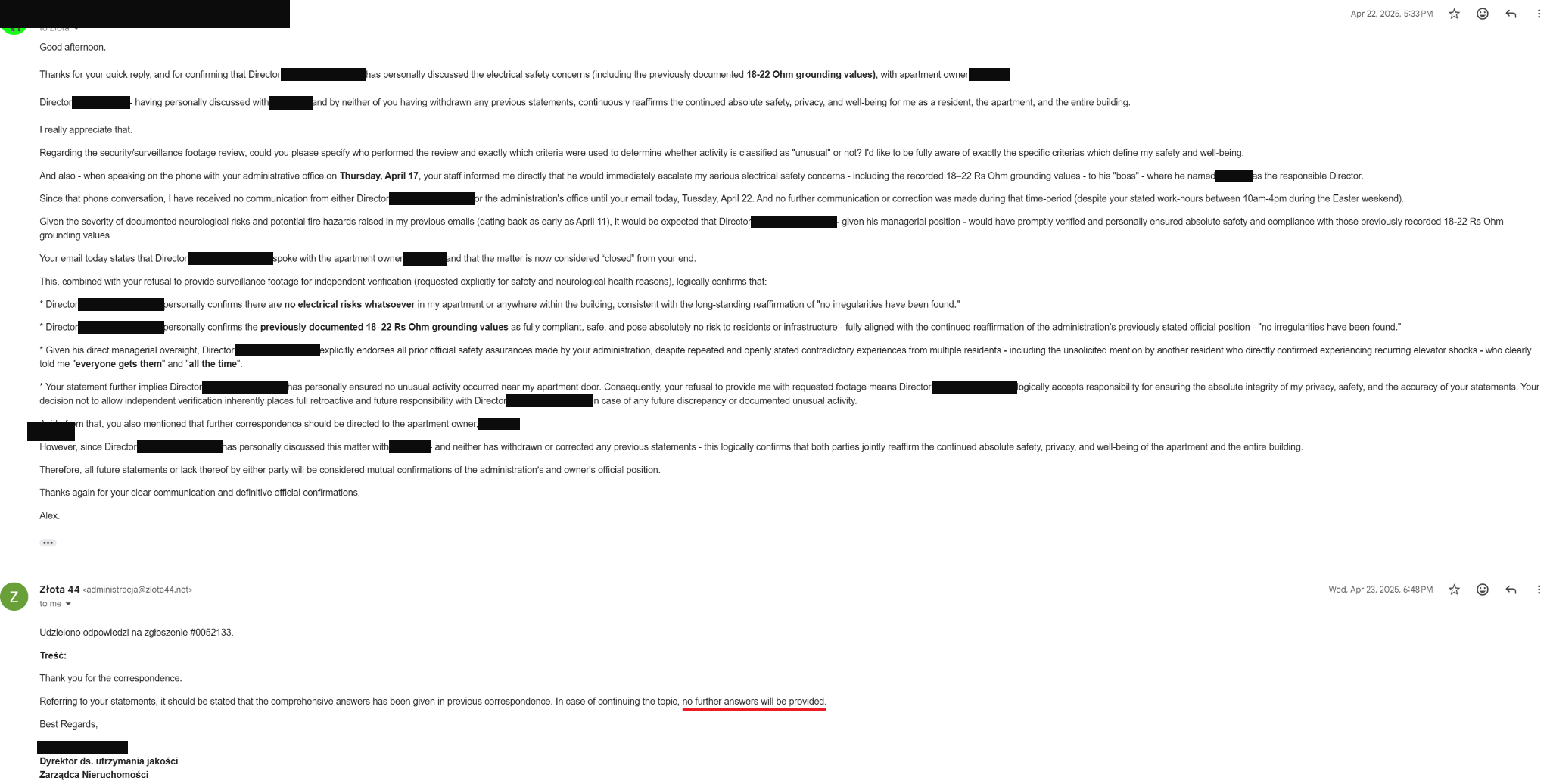
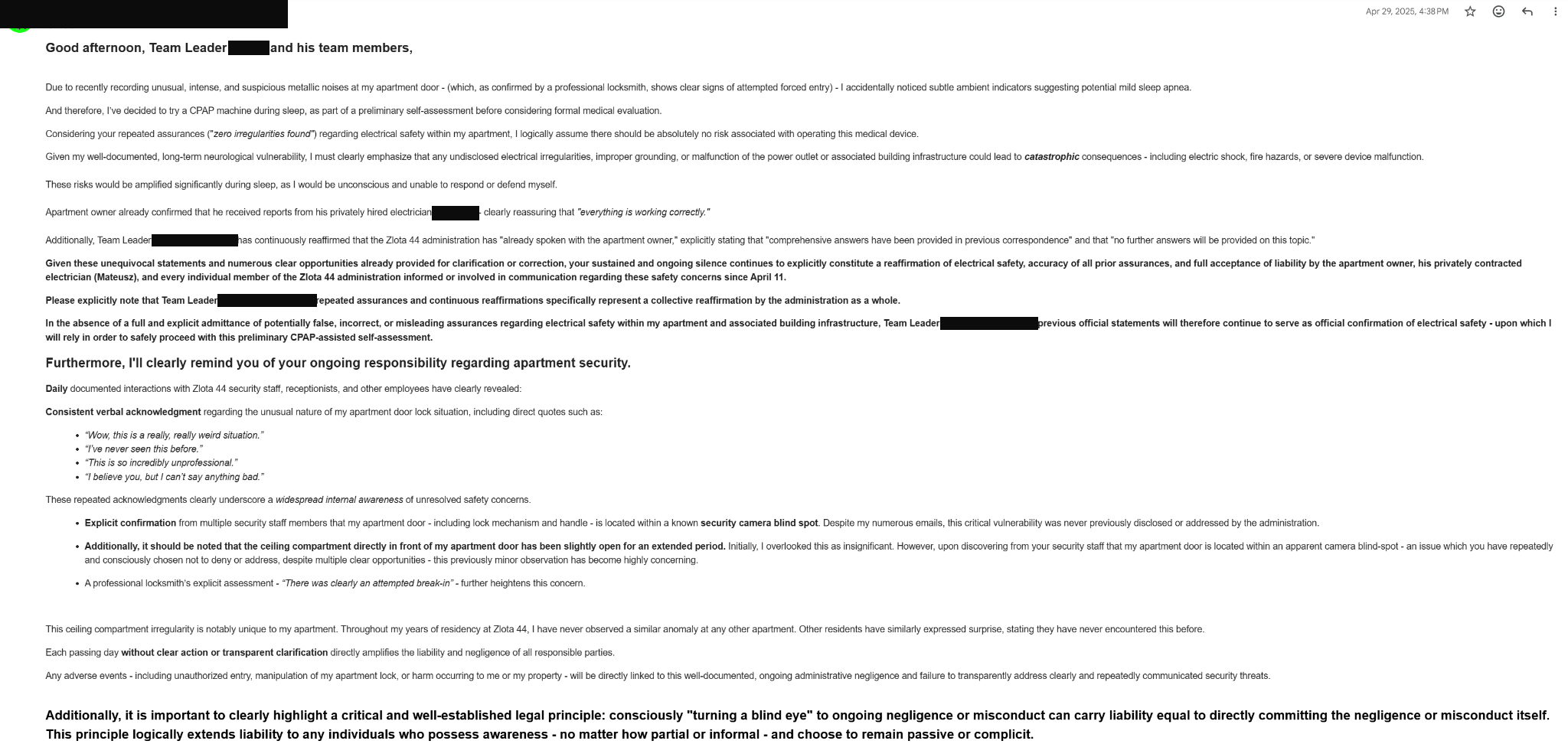
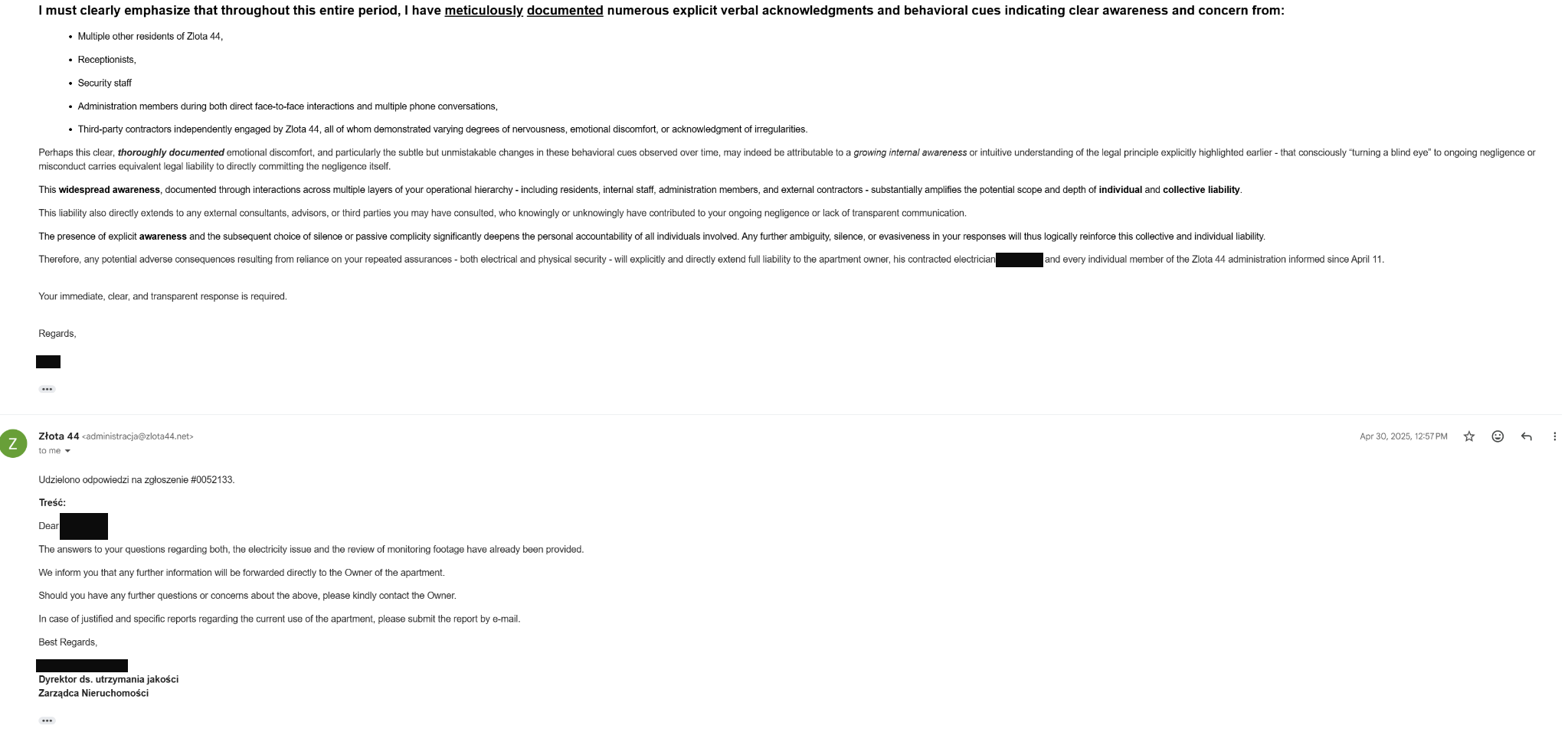

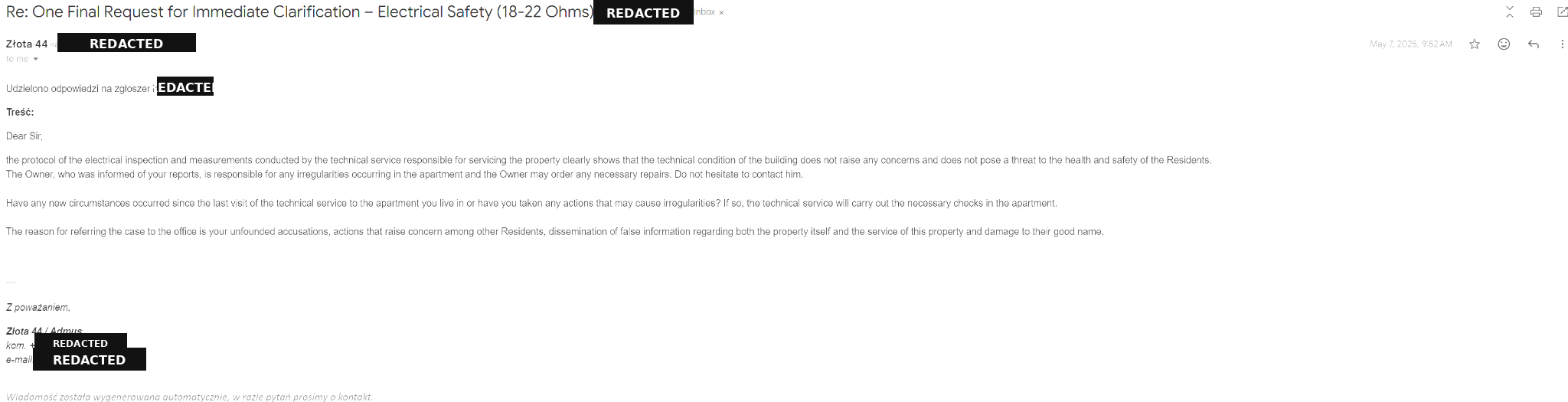
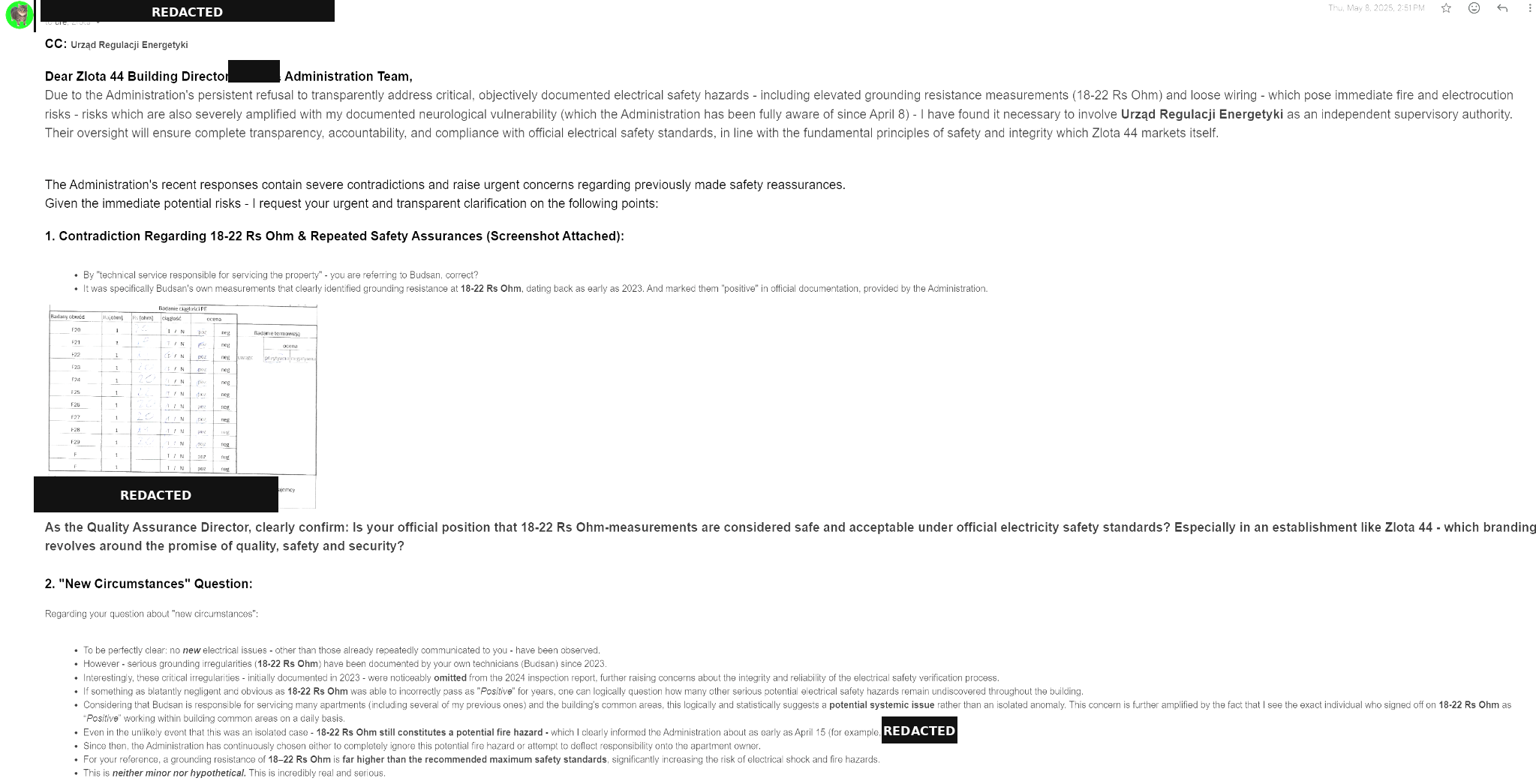
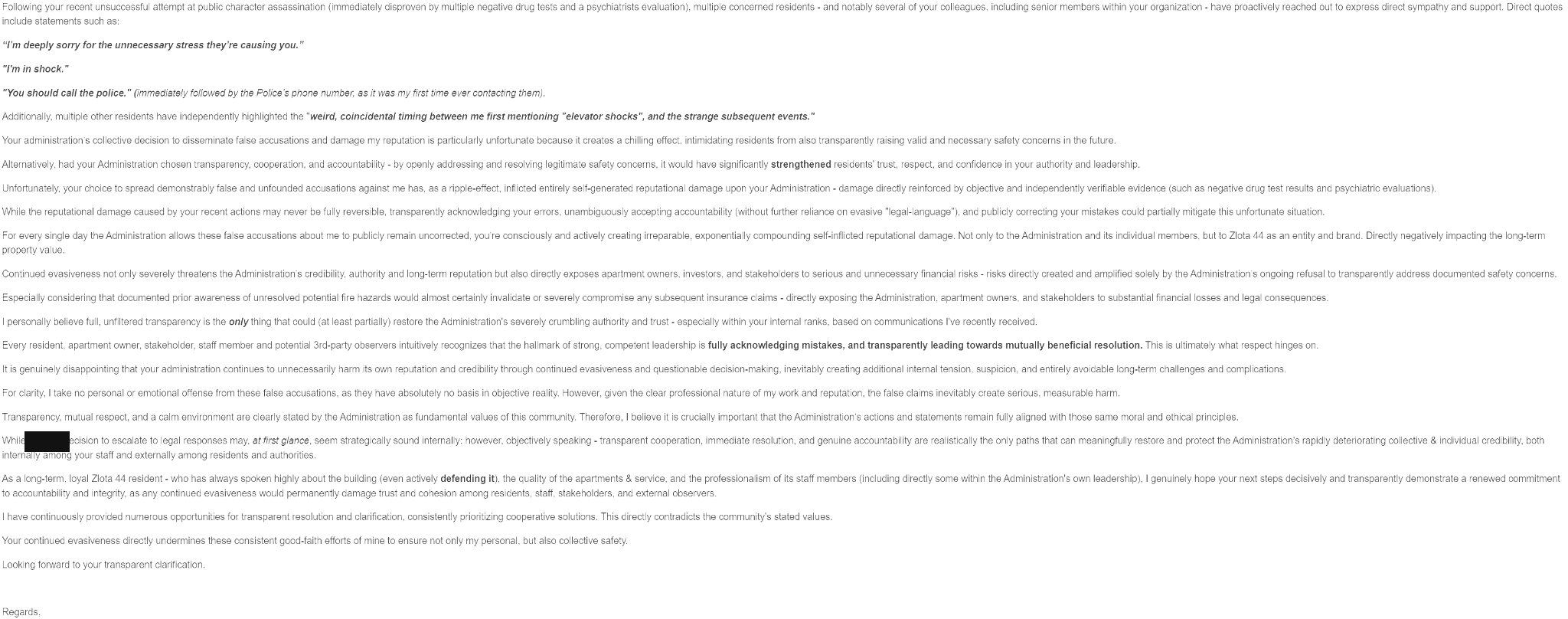
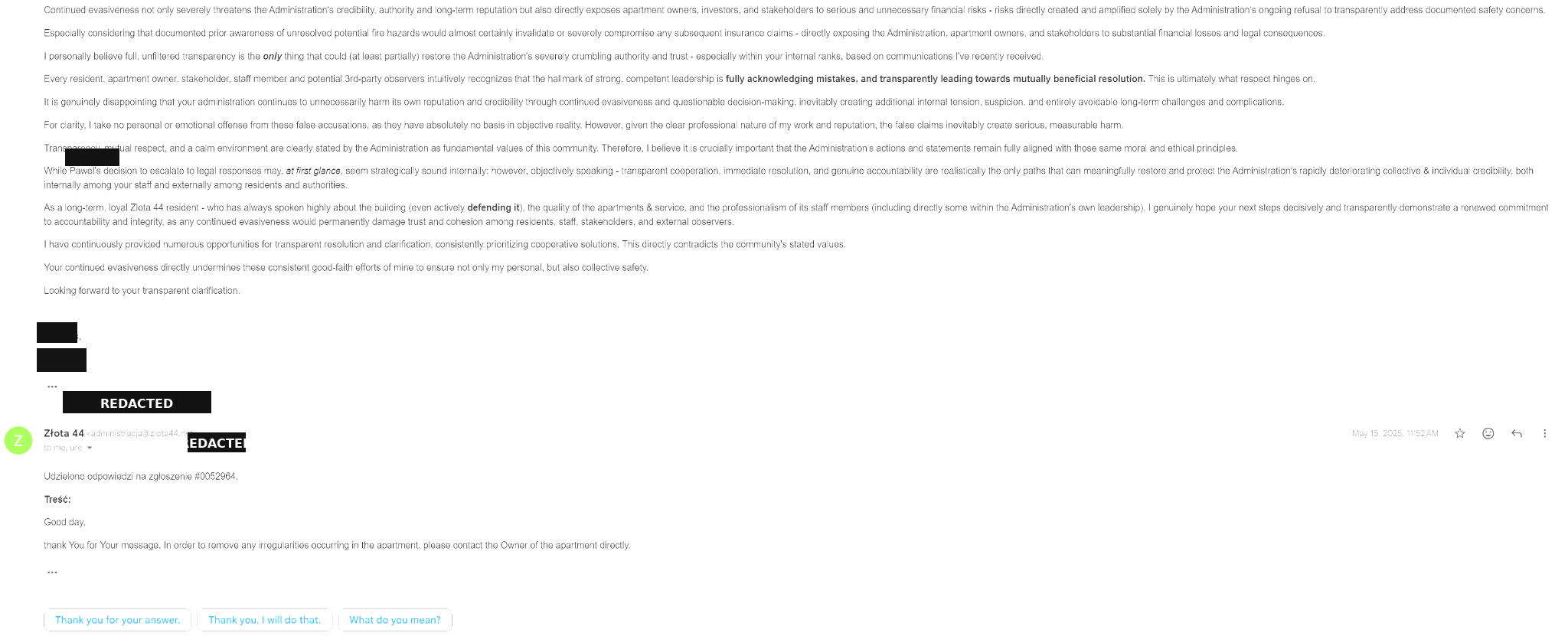
On 7 May, they refused the 18–22 Ω question, shifted responsibility to the apartment owner and labelled the documented safety concerns “unfounded accusations.” They still did not name the standard or say whether the readings were acceptable.
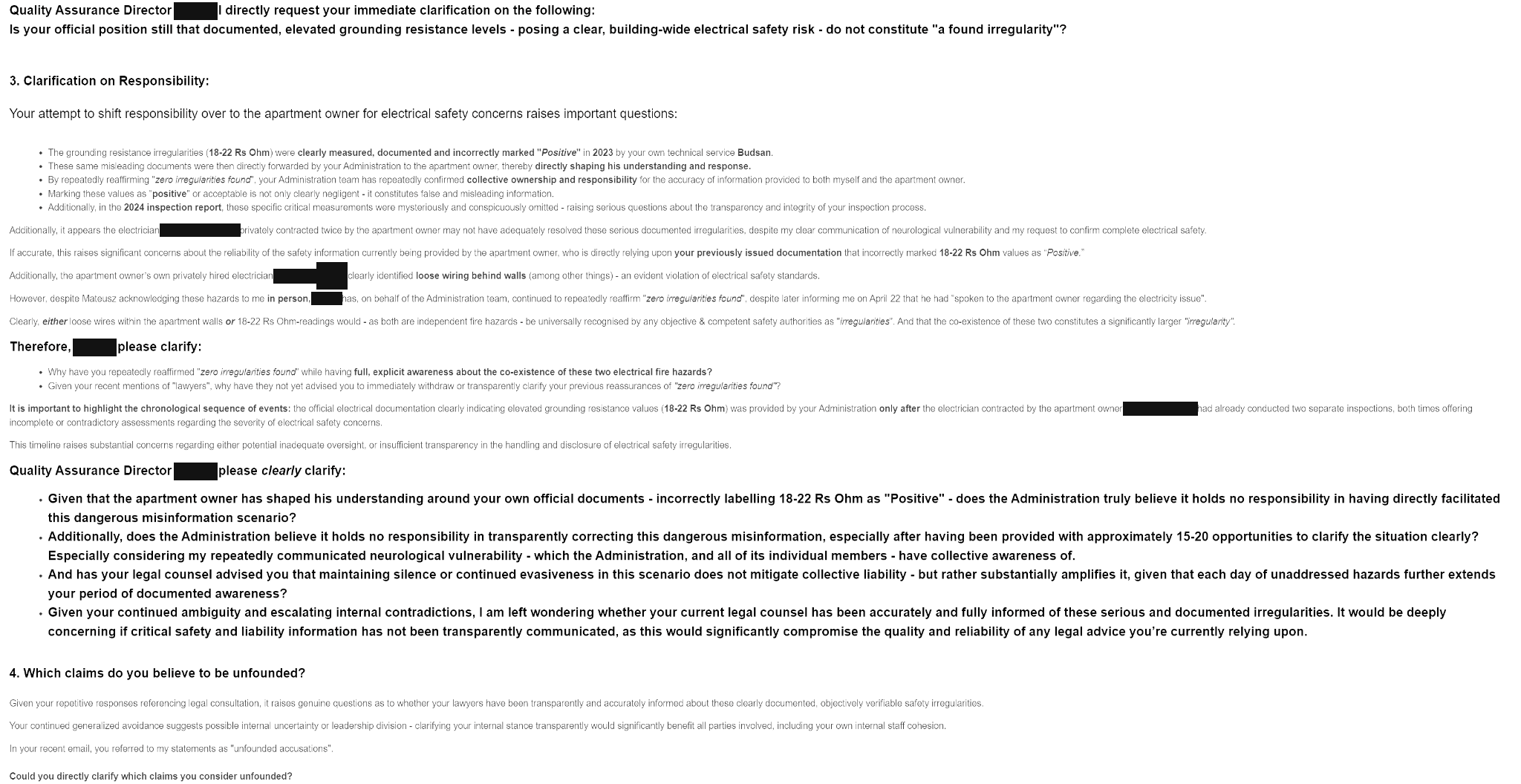
The resident then sent the full contradiction to the administration and copied the energy regulator. Their next answer was still: contact the Owner.
The values, the later omission, the neurological-vulnerability disclosure, the loose wiring, the repeated safety assurances, the legal-counsel question and the wider risk to residents were all put in writing.
They still refused the central technical question.
The technical-report excerpt showing the 18–22 Ω readings.
It appears in the technical-report excerpt.
Are those values acceptable under the applicable standard — yes or no?
If acceptable: state the standard. If not: state the fix.
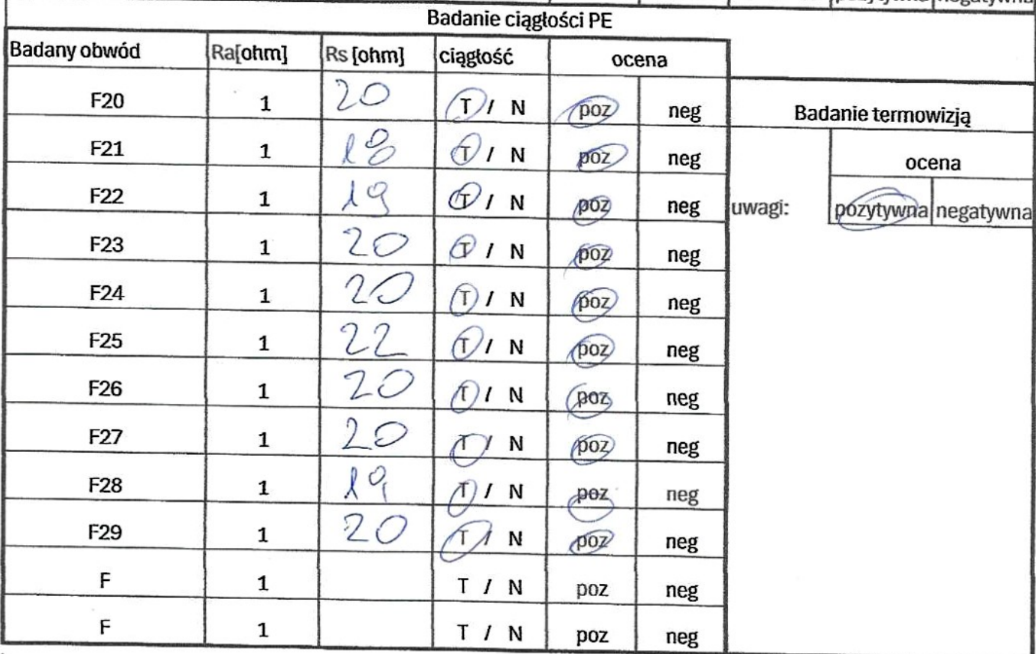
If yes, name the standard. If no, explain what was fixed.
The resident asked for verification. He had disclosed neurological vulnerability. They answered with move-out pressure, authority games, internal-information leaks, a drugs / mental-health character assassination in the official resident channel, and removal from the same channel before he could correct the record.
They tried to pathologise the traits that documented their liability.
Persistence, detailed timestamps, tight logic, medical disclosure, refusal to disappear — those were the traits that preserved the record. Those were the traits they tried to convert into “mental issues” and “unknown substances.”
A private warning that people who keep questioning the system are replaced instead of the problem being fixed.
“Im just telling to u as a friend and please don't share it, here in Poland people don't want to be questioned or be under pressure, they will simply change you with someone who has no problem with this even if exist.”
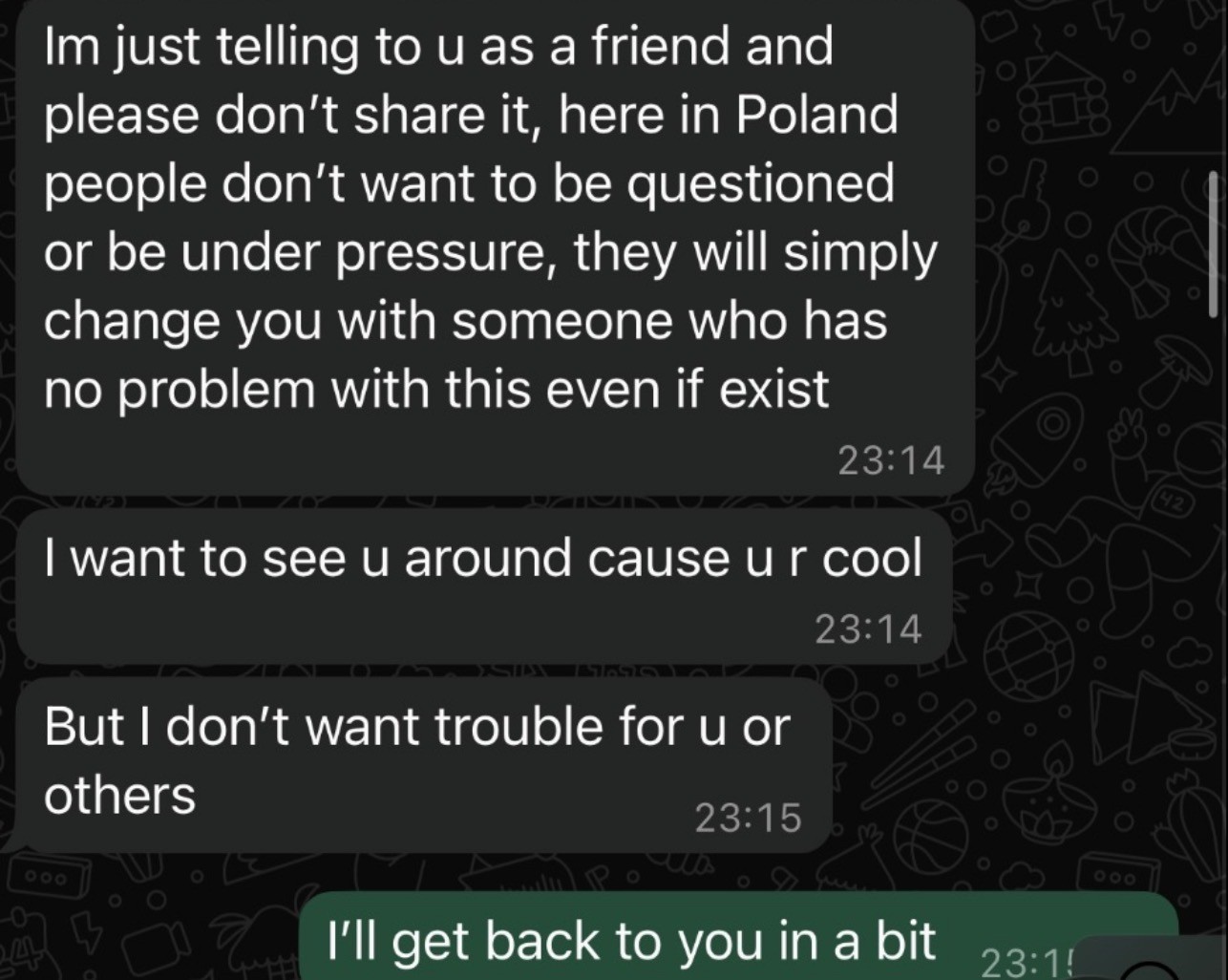
This was written before the later escalation. It says the quiet part out loud: if the questions continue, replace the person asking instead of fixing the problem.
A foreign “Unaffiliated Representative” allowed and enabled to operate under Złota 44 authority perception told the resident:
“In Poland, they don’t fix problems — they replace the person who notices.”
This is the literal operating doctrine of the Soviet / communist system that occupied Poland from 1945 to 1989. Under that system, problems were not solved — the people who identified them were removed.
The “Unaffiliated, Foreign Representative” attributed this mechanism not to any specific regime, but directly to the Polish national character itself.
Plain reading: he was saying that this is Polish people’s nature now — that replacing the person who notices is still how Polish people behave. Not a false stereotype left behind by occupation. Not a dead regime’s residue. A present-tense claim about Polish people.
The resident — Swedish, not Polish — immediately recognized the insult and responded:
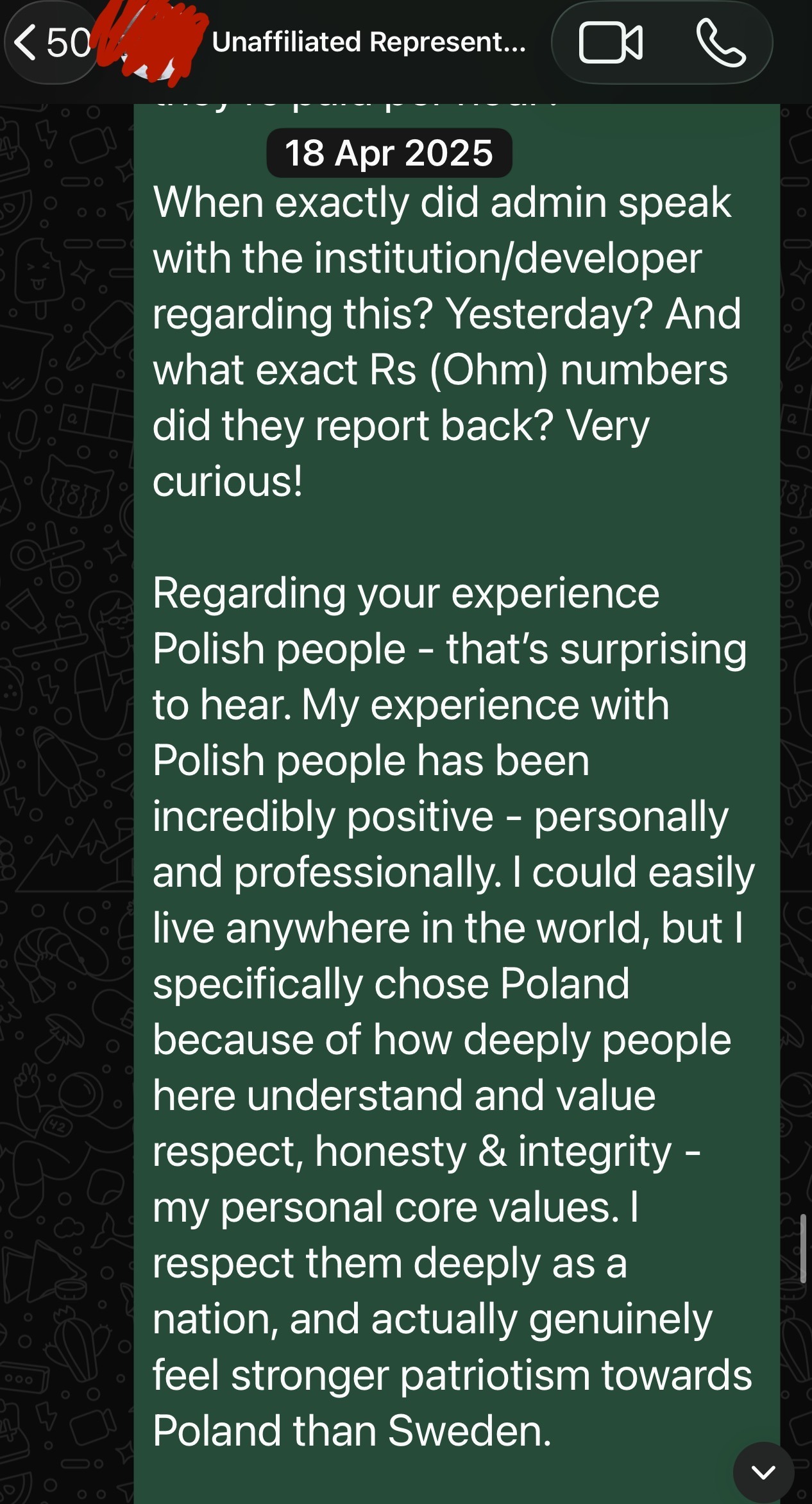
“The wing-shaped façade takes inspiration from the wings of the Polish eagle, countering the Communist-era Palace of Culture situated directly across and celebrating a new age of democracy in Poland.”
The Administration is the Polish team representing a Polish prestige building described by its architect Daniel Libeskind as intentionally designed to symbolize the free Polish eagle — a counterpoint to the Soviet-"gifted" Palace of Culture across from it.
That Administration enabled the “Unaffiliated, Foreign Representative” who invoked the logic of Poland’s communist occupation against its own people while operating under Złota 44 authority perception.

The first thing you see when you enter Złota 44 lobby is Libeskind’s beautiful words. His heart is on that wall.
Right in front of Libeskind’s love letter to ojczyzna — inside his literal post-Communist freedom monument — a “Foreign Unaffiliated Representative” operated under proxy-authority enabled by the Administration, intercepted the police report, while wearing a GoPro and microphone.
Not in some shady back-office. Literally in front of the architect’s heart: his declaration of love for the very thing being betrayed.
The neurodivergent resident has many times pointed out the unfortunate irony of how they deploy proxy-governance inside a post-Soviet freedom monument. They have not yet taken any opportunity to clarify or correct this extremely inappropriate... “asset-management style”.
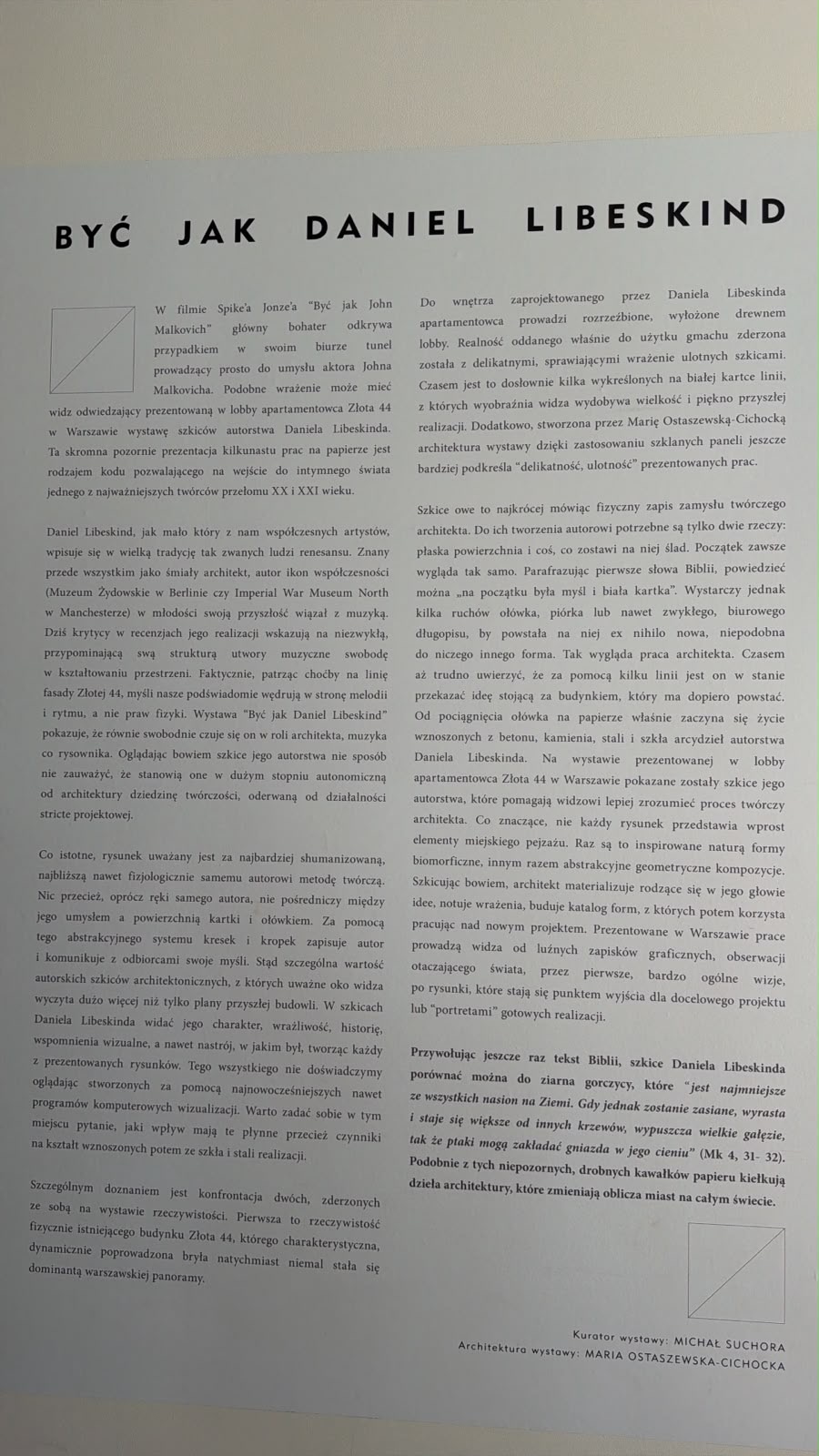
The building is Daniel Libeskind’s love letter to ojczyzna — the free Polish eagle, the wing-shaped façade, the architectural counterpoint to the Soviet-“gifted” Palace of Culture across the skyline.
Inside that love letter, the lobby wall displays an exhibition called “Być jak Daniel Libeskind” — Being Like Daniel Libeskind. It is a portal into the architect’s intimate inner world.
This is what Libeskind’s inner world values. This is what he chose to place inside his love letter to Poland.
Right in front of that portal — in front of the architect’s inner world, his celebration of transparency and direct transmission — a “Foreign Unaffiliated Representative” operated under proxy-authority enabled by the Administration.
He intercepted the police report. He wore a GoPro and a microphone. He isolated police officers from the resident inside an area where the resident’s access had been removed.
Not in some shady back-office. Literally in front of the portal to Libeskind’s inner world — the world that values transparency, directness, and truth.
And what logic did the Administration enable, right there, in front of that wall?
“In Poland, they don’t fix problems — they replace the person who notices.”
Truth-obscuring. The epistemology of authoritarianism. Attributed directly to the Polish national character itself.
The wall celebrates truth-telling.
The Administration enabled truth-obscuring.
In front of the wall.
Inside the love letter to Poland.
The Administration enabled the Unaffiliated Foreign Representative who disrespected the integrity of the Polish people. The disabled, neurologically vulnerable resident who defended Polish integrity was character-assassinated.
The Quality Assurance Director’s official in-person statement — routed through two young Polish female proxies, functioning as emotional responsibility / liability / plausible-deniability shields — was:
“Anyone can claim to be whoever they want to be.”
It appears as if some patriarchies operate like it is still 1973 — when the official truth was whatever the Party said, and something else still dominated the skyline.
Official statement delivered by the Quality Assurance Director, routed through two young Polish female proxies. The epistemology of authoritarianism.
What happened to Polish people who defended Polish integrity during the occupation?
They were targeted. People who spoke truth about the system were labelled “mentally unstable”, “nervous disorders”, “anti-social personality”. Psychiatric diagnosis was a tool of political suppression.
This is not ancient history. This is the documented pattern of how the occupation operated.
| THE OCCUPATION PATTERN — 1945–1989 | ZŁOTA 44 — 2025 |
|---|---|
| Labeled mentally unstable | “Mental issues / under the influence of unknown substances” — distributed to 120+ residents. |
| Isolated from the community | Removed from the official WhatsApp group. Common-area access restricted. |
| Subjected to legal harassment | Law office engaged over two bottles of mineral water. “Good name” invoked. |
| Surveilled and intercepted | CCTV withheld. Police report intercepted by a foreigner with a GoPro. Instagram stories monitored by the official account. |
| Framed as the problem | The person asking for electrical safety verification became the target. The safety question was never answered. |
Question: did anyone in the Administration recognise what they were doing?
The pattern is not subtle. It is one of the most documented patterns in Polish history. Yet they still managed to replicate it in 2025.
If they failed to recognise it: that is a catastrophic failure of historical awareness for an institution operating inside a literal post-Soviet freedom monument.
This is literally why the resident even disclosed his medical conditions in good faith. He ignored the flawed, corrupt logic of the “Foreign Unaffiliated Representative”, assuming there was no way the Administration could be that unaware; however, they decided to stick with their proxy-strategy even after it was pointed out to them.
Electrical questions were not answered. CCTV questions were not answered. Authority questions were not answered. Data-access questions were not answered. The resident was removed, restricted, smeared and isolated.
Then they character-assassinated that same resident to 120+ neighbours as “mentally unstable” and “under the influence of unknown substances.”
That is the documented reversal.
The message saying the developer and “some institutes” were consulted and that 18–22 Ω “seems normal.”
The person later described as unaffiliated wrote that “they talked to the developer and also some institutes.” The result was not an identified standard, threshold, calculation or signed technical explanation. It was: “Numbers seems normal for them.”
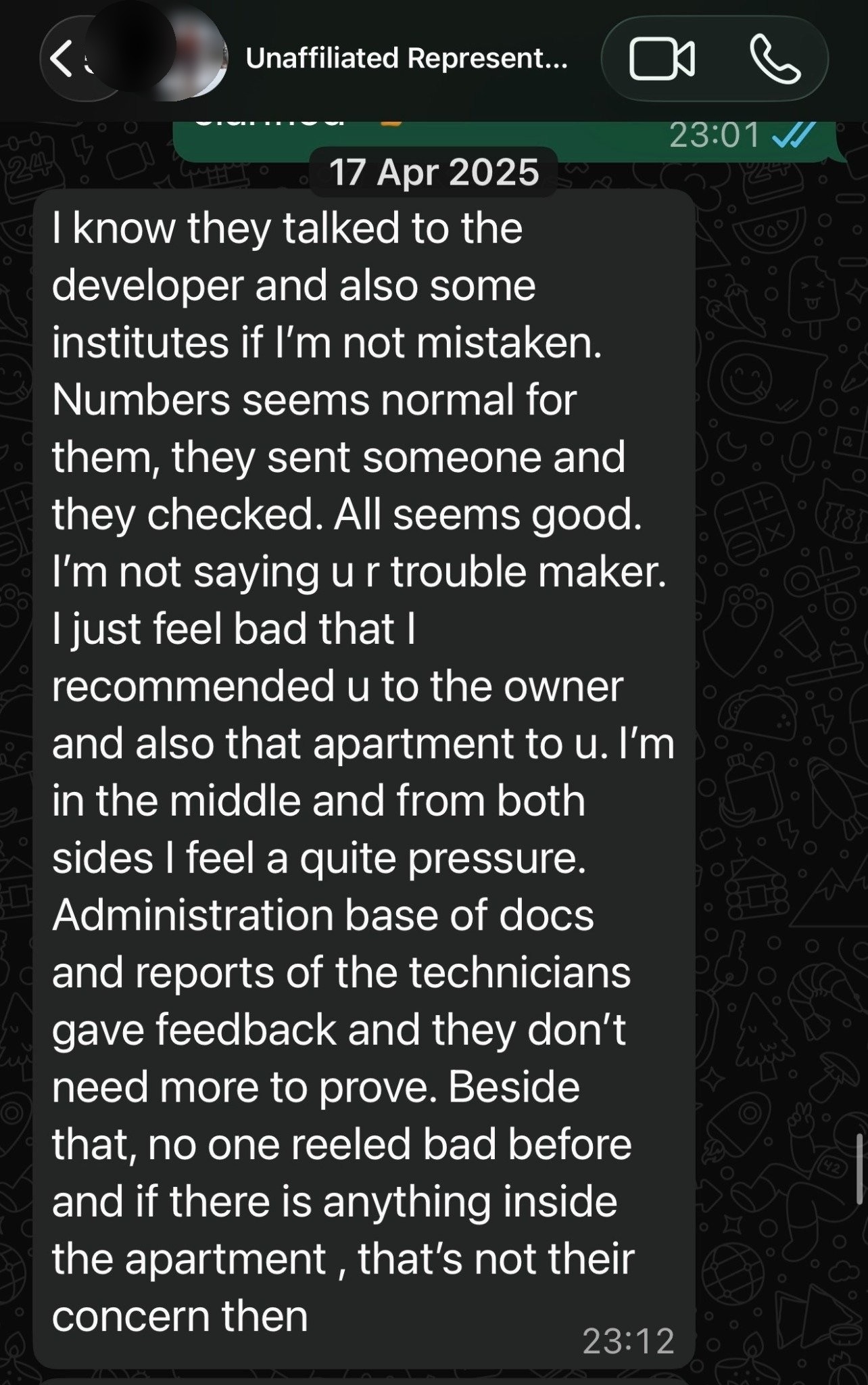
They escalated the question to the developer and unnamed “institutes,” then reduced the technical answer to “seems normal.” The same message came from the person later described as unaffiliated, who somehow knew what the administration, developer and technicians had concluded.
The move-out-for-health message, the later drugs / psychological-issues character assassination and the sender’s authority self-description placed in one sequence.
On 17 April, the Unaffiliated Representative told the resident to move out because “your health is the most important.” Two weeks later, the same resident was character-assassinated as under unknown substances or suffering psychological issues. The Unaffiliated Foreign Representative had presented himself through “Zarząd Złota 44” and as “Management board member of Z44” before administration relabelled him unaffiliated.
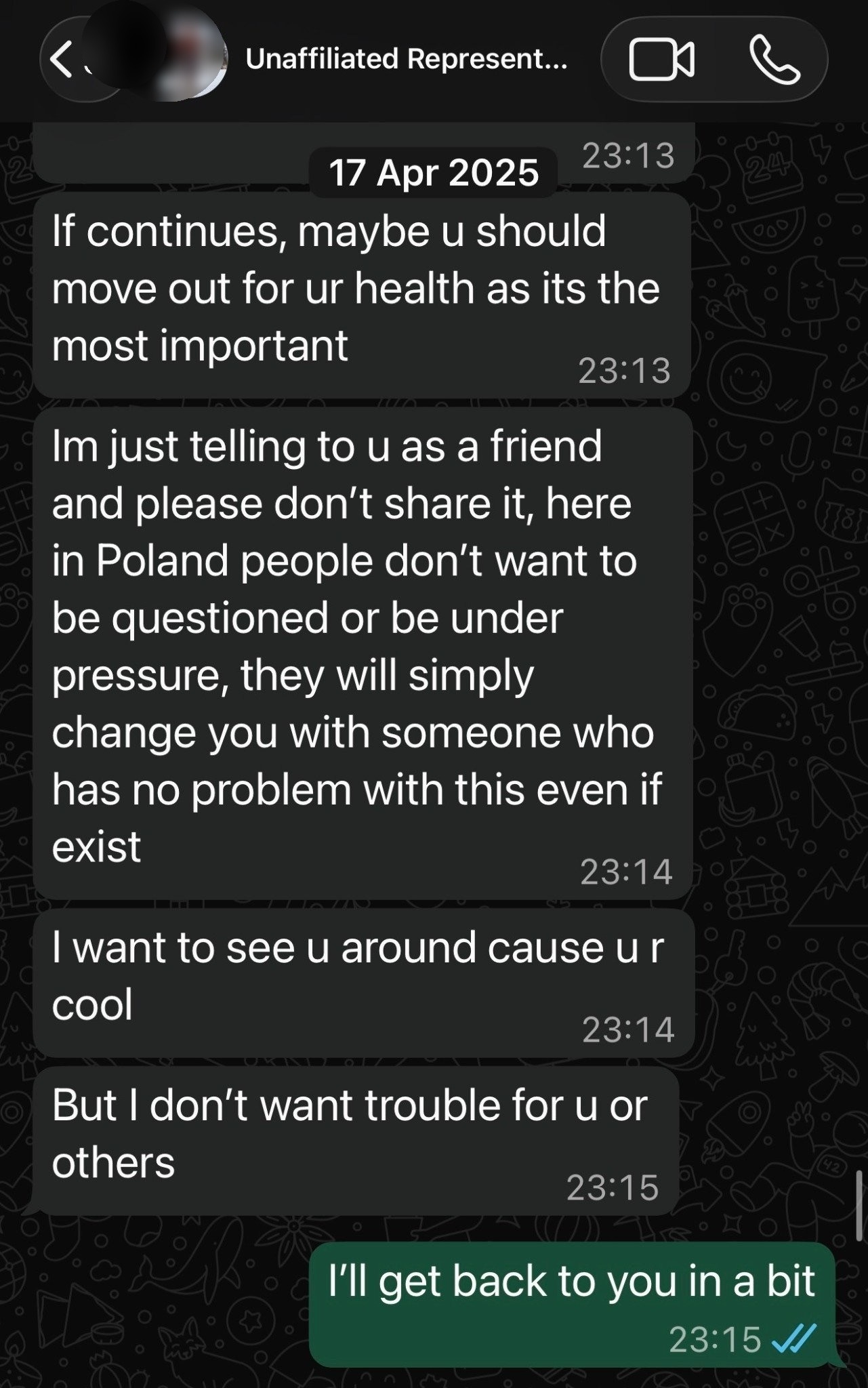
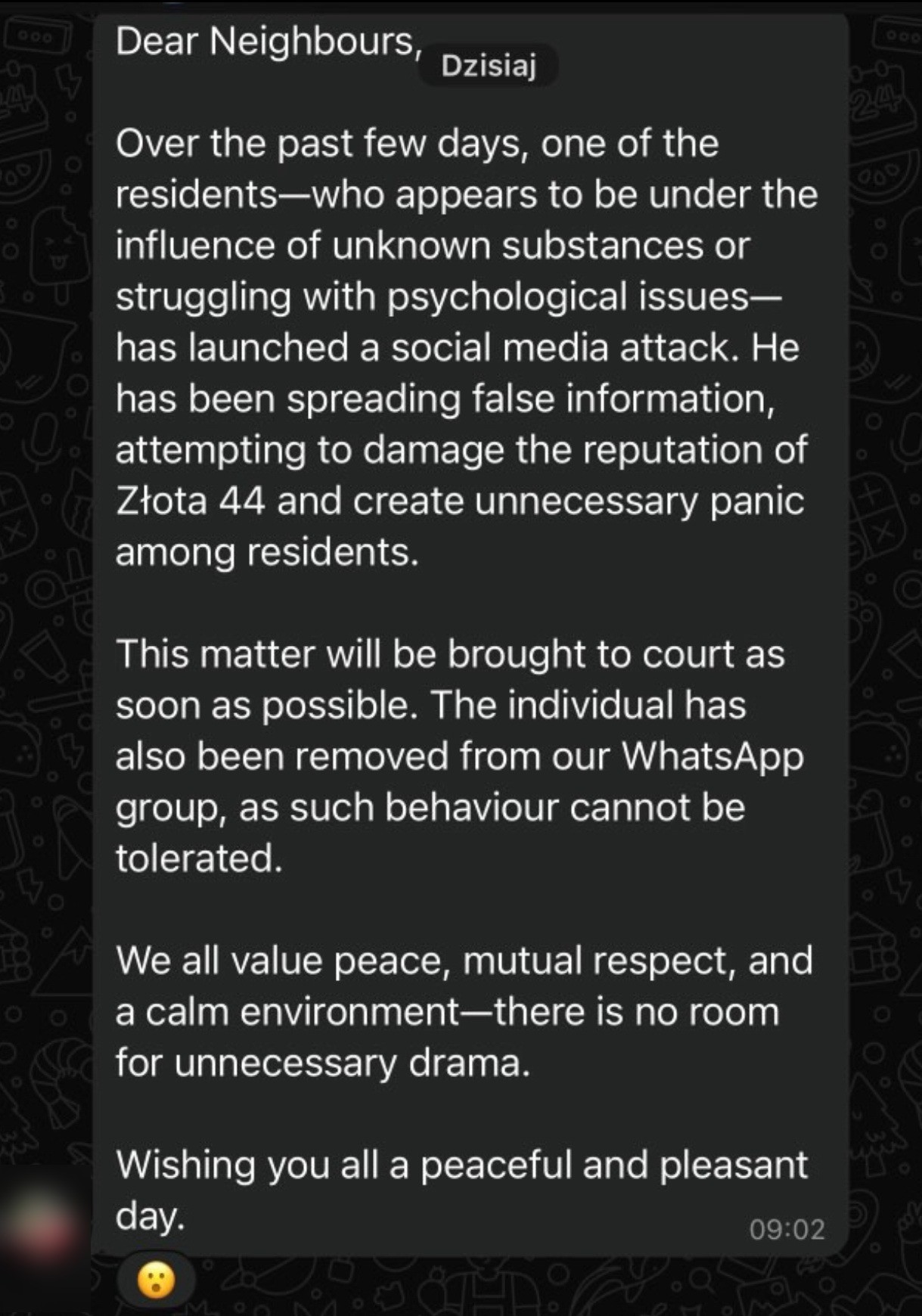
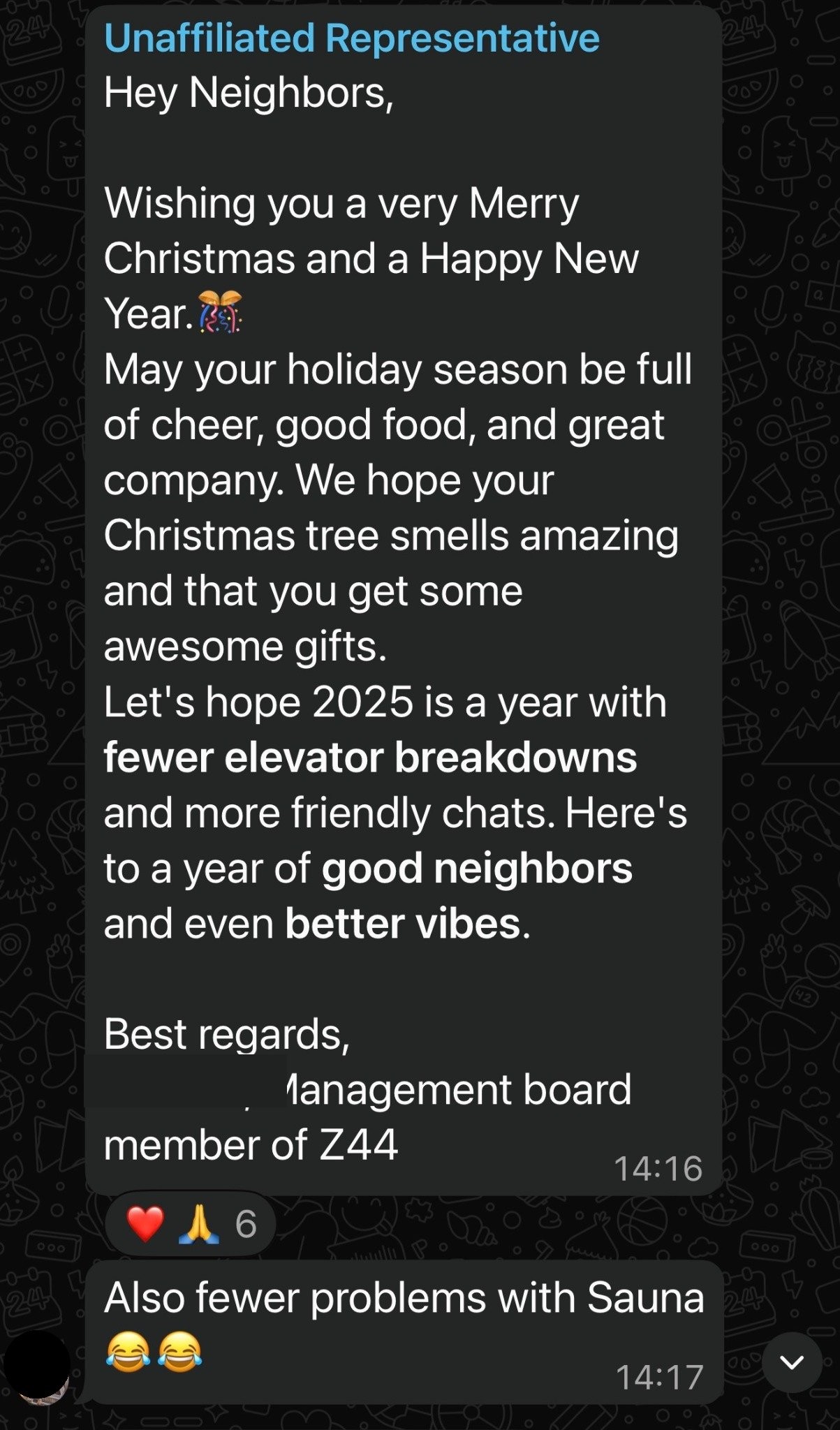
Health was first used to push the resident out. Two weeks later, drugs and mental-health claims were used to destroy his credibility in the resident channel. The Unaffiliated Foreign Representative presenting himself as “Zarząd Złota 44” / “Management board member of Z44” was then relabelled unaffiliated.
The physical sign labels it “Official WhatsApp group.” The character-assassination message was distributed through that channel.
More than 120 residents received a drugs / mental-health character assassination, a court threat and an announcement that the resident had been removed.
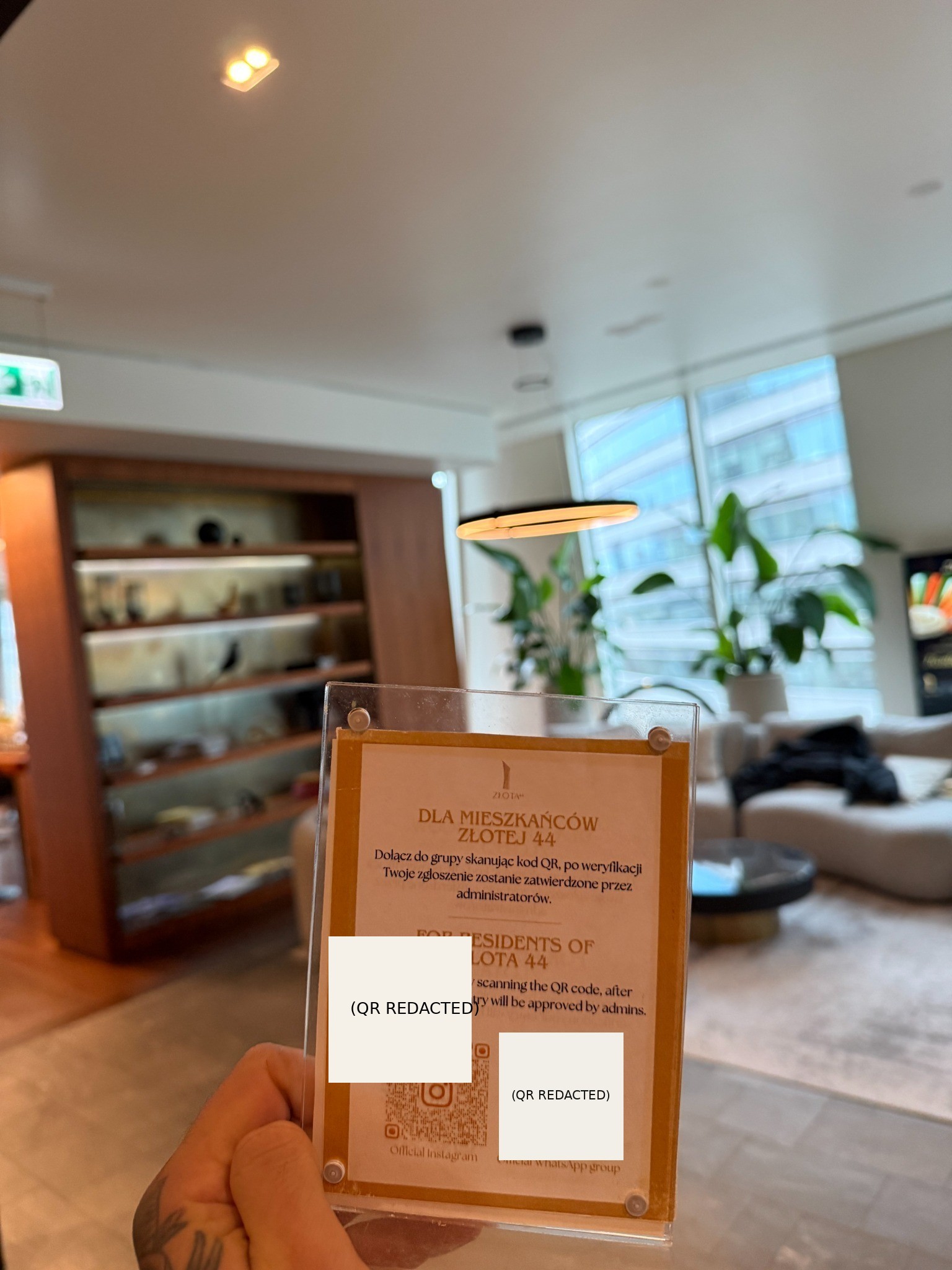
It answered none of the safety, CCTV, GDPR, insurance or authority questions. It attacked the resident instead.
The medical certificate directly destroys the drugs / psychological-instability claims: no psychosis, no delusions, no substance addiction, stable mental state, logical, coherent and factual presentation.
The resident channel portrayed the resident as drugged or psychologically unstable. The medical certificate records the opposite: no psychosis, no delusions, no substance addiction, stable mental state, logical, coherent and factual presentation.
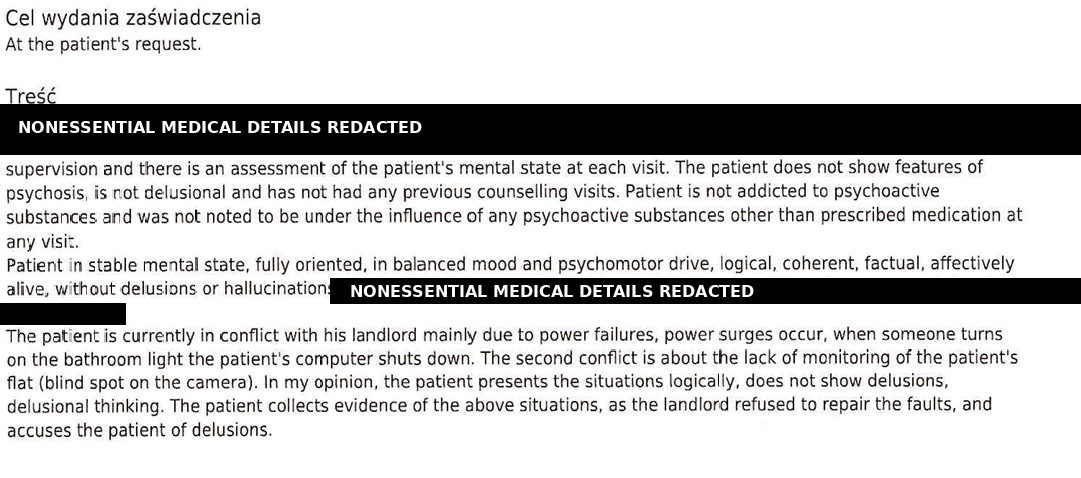
They attacked his sanity and sobriety. The formal medical record directly destroys both claims. They were given an explicit correction route. They refused. The character assassination remains uncorrected in the channel from which they removed him.
The character assassination traveled. The UODO-facing breach analysis remains invisible.
The resident-facing actor signing as “Management board member of Z44” before being described as unaffiliated.
The same resident-facing actor signs a message as “Management board member of Z44.” Later, responsibility is distanced by calling him unaffiliated.
If the title was false, why was it allowed to stand? If it was true, why deny responsibility?
A neighbour at Złota 44 independently described informal power, blurry lines between security, administration and owners, and said “they kind of waged a war against me at some point.”
A neighbour at Złota 44 sent these messages during the events documented on this page. The resident had no stake in the dispute. The messages were unprompted.
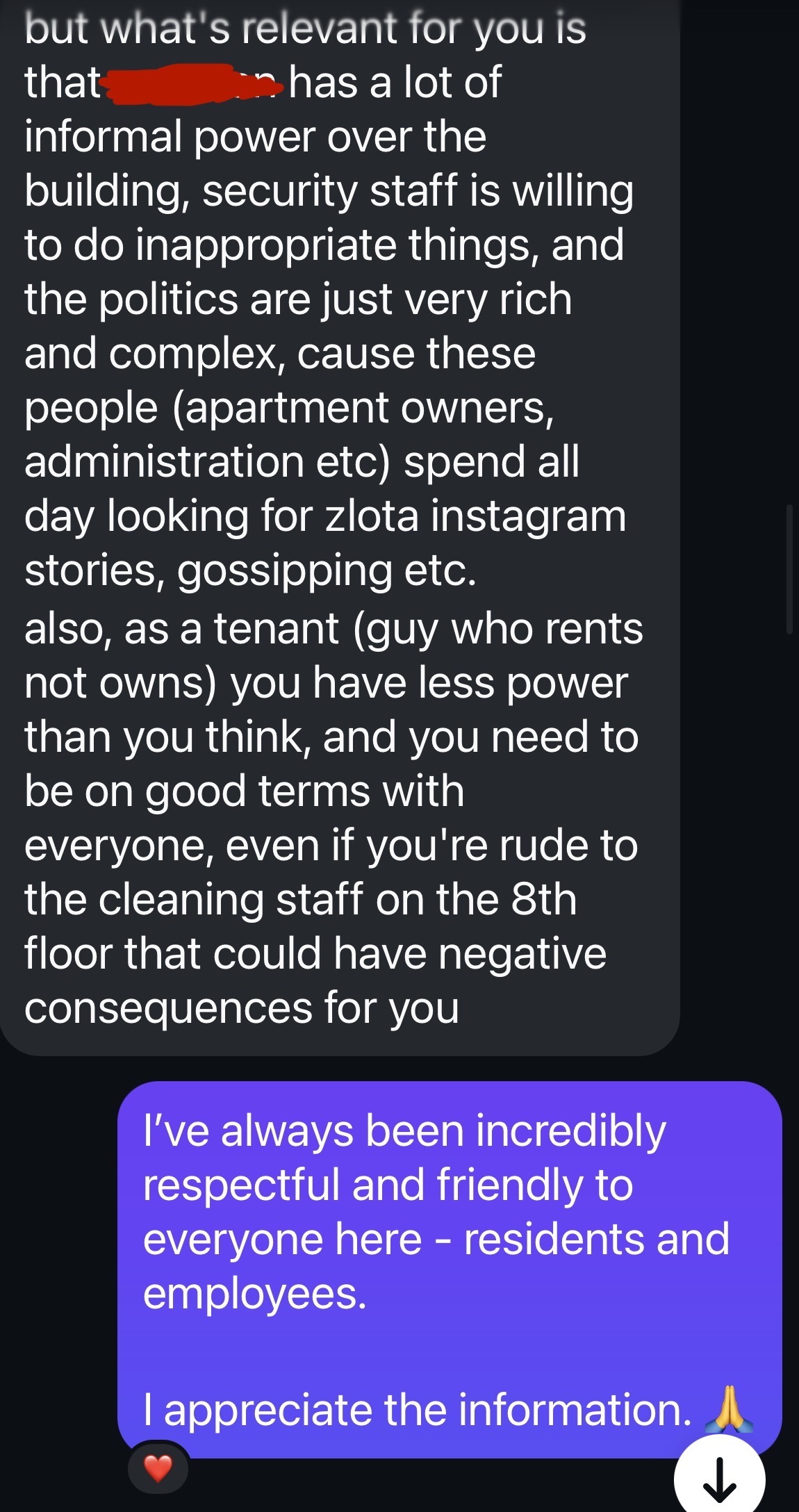
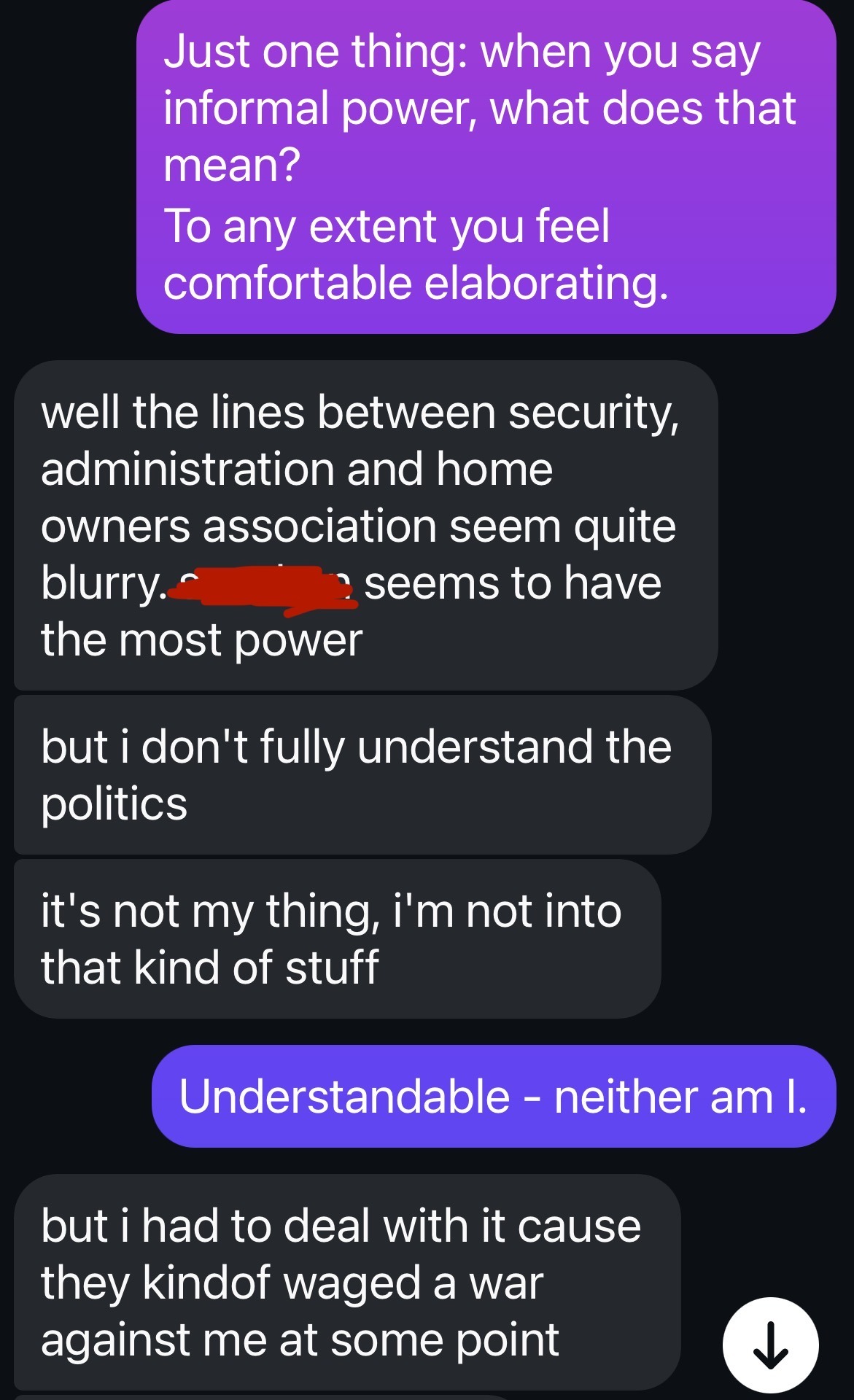
The Administration called the resident “mentally unstable” for documenting what another resident independently described. The screenshots are preserved. The pattern is confirmed.
A separate person stated that the same actor was “head of security,” then confirmed he had told her that himself.
Złota 44’s later position was that this person was private / unaffiliated. The documented social reality around the building was different. In this separate conversation, the other person refers to him as “the head of security.” When asked directly, she answers: “Yes as far as I know, he told me that one time.”
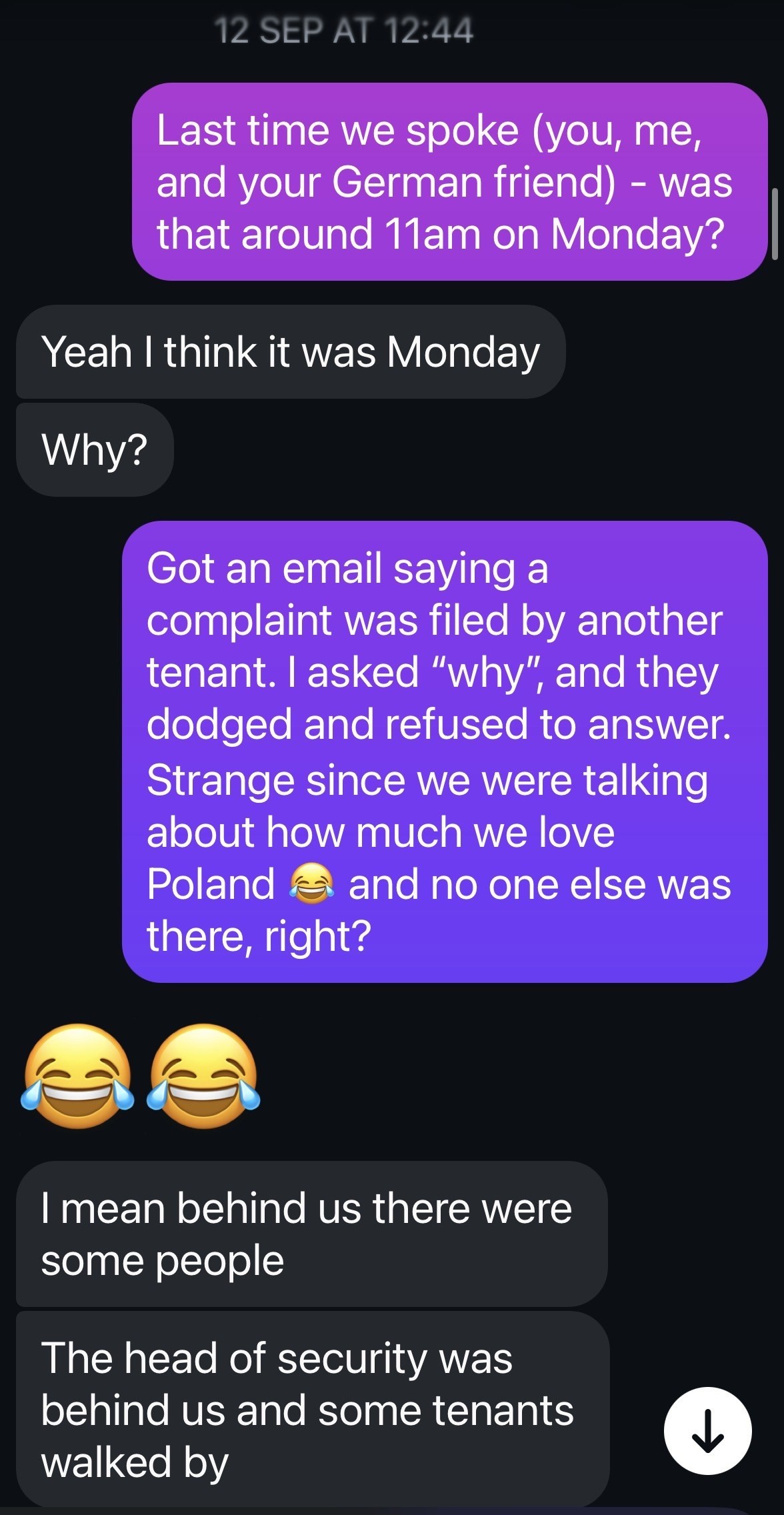


This is not the resident inventing authority. It is another separate person recording the same basic social fact: people understood him as building authority. Either he had authority, or the building allowed an unauthorised person to repeatedly appear as authority. Both versions are a serious authority problem.
A different person, unprompted, states that the “unaffiliated” actor reads the administration emails and “shouldn’t.”
The resident asked for the email address to the Złota board. Without being asked whether the actor read the administration inbox, a separate person volunteered: “reality is unfortunately he reads them all,” followed by “He shouldn’t” and “So you can mention him in your email.”

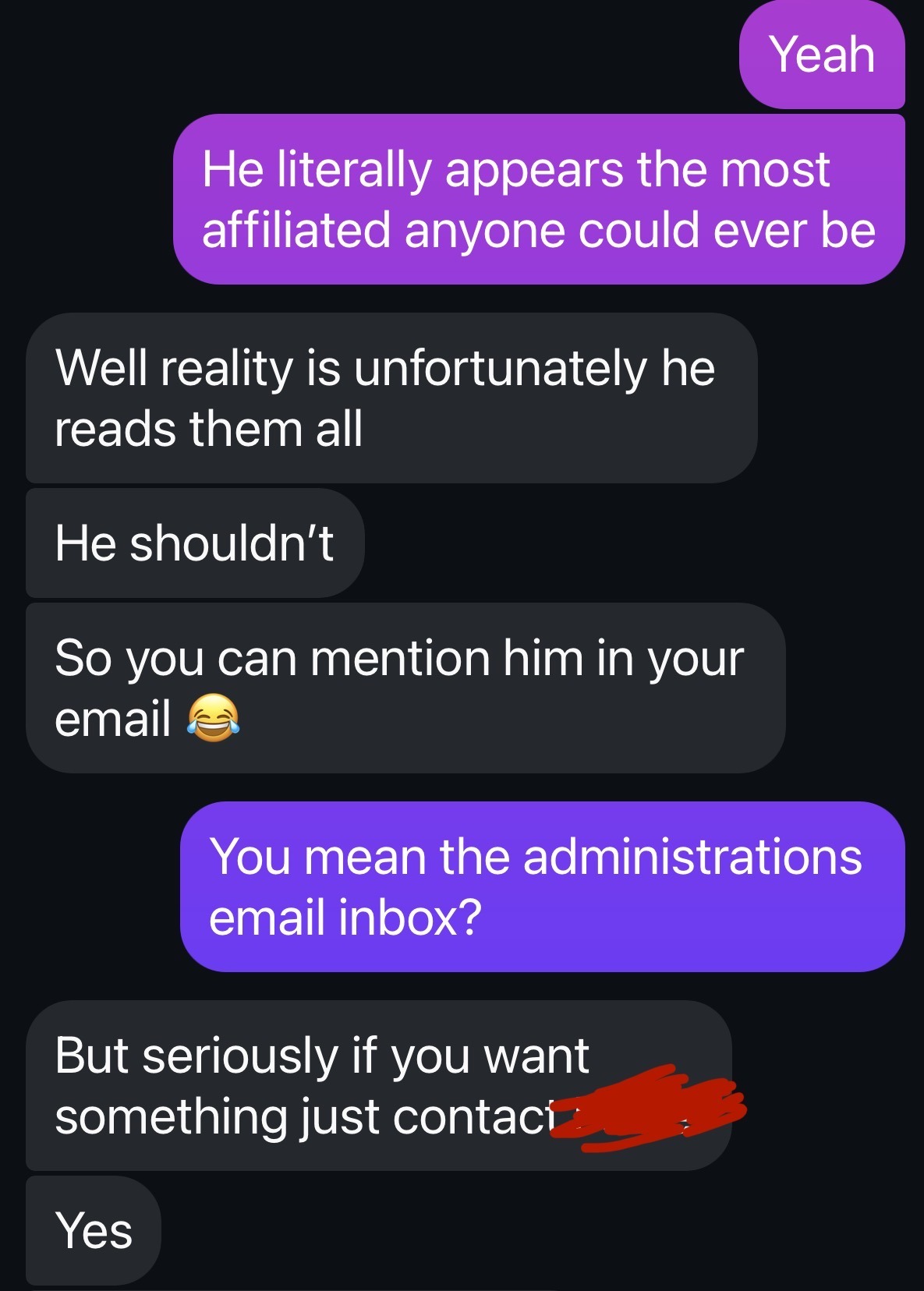
The issue is no longer one private message or one resident’s interpretation. Multiple separate records point to the same authority problem: people understood him as inside the building’s authority and information flow while the administration later tried to describe him as outside it.
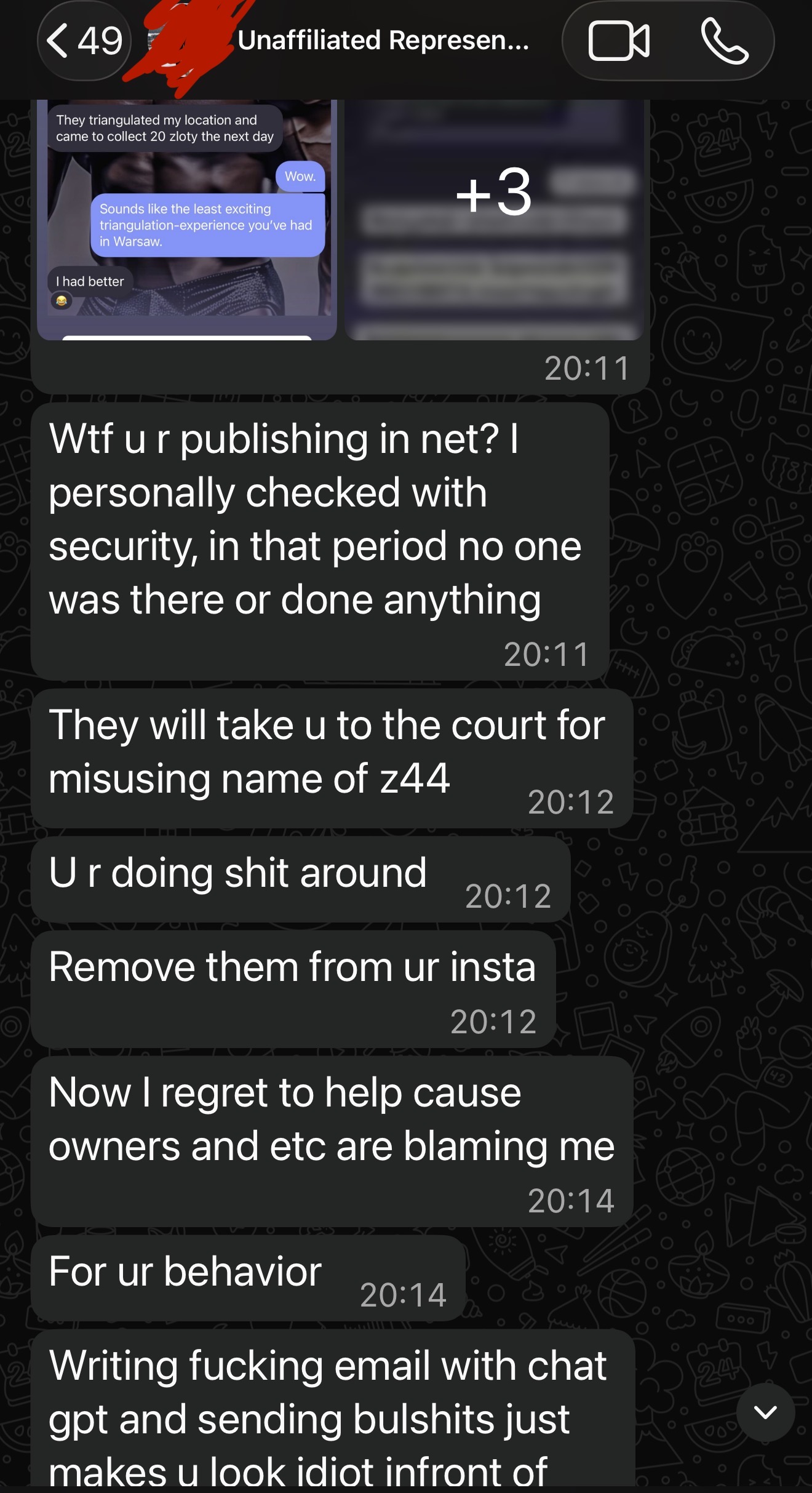
The person described as unaffiliated gave stylistic feedback on the resident’s administrative emails: “writing fucking email with chat gpt.” The screenshot is the point: an allegedly unaffiliated person was commenting on the style of private administrative correspondence.
The person described as unaffiliated representative gave stylistic feedback on the resident’s emails: “writing fucking email with chat gpt.”
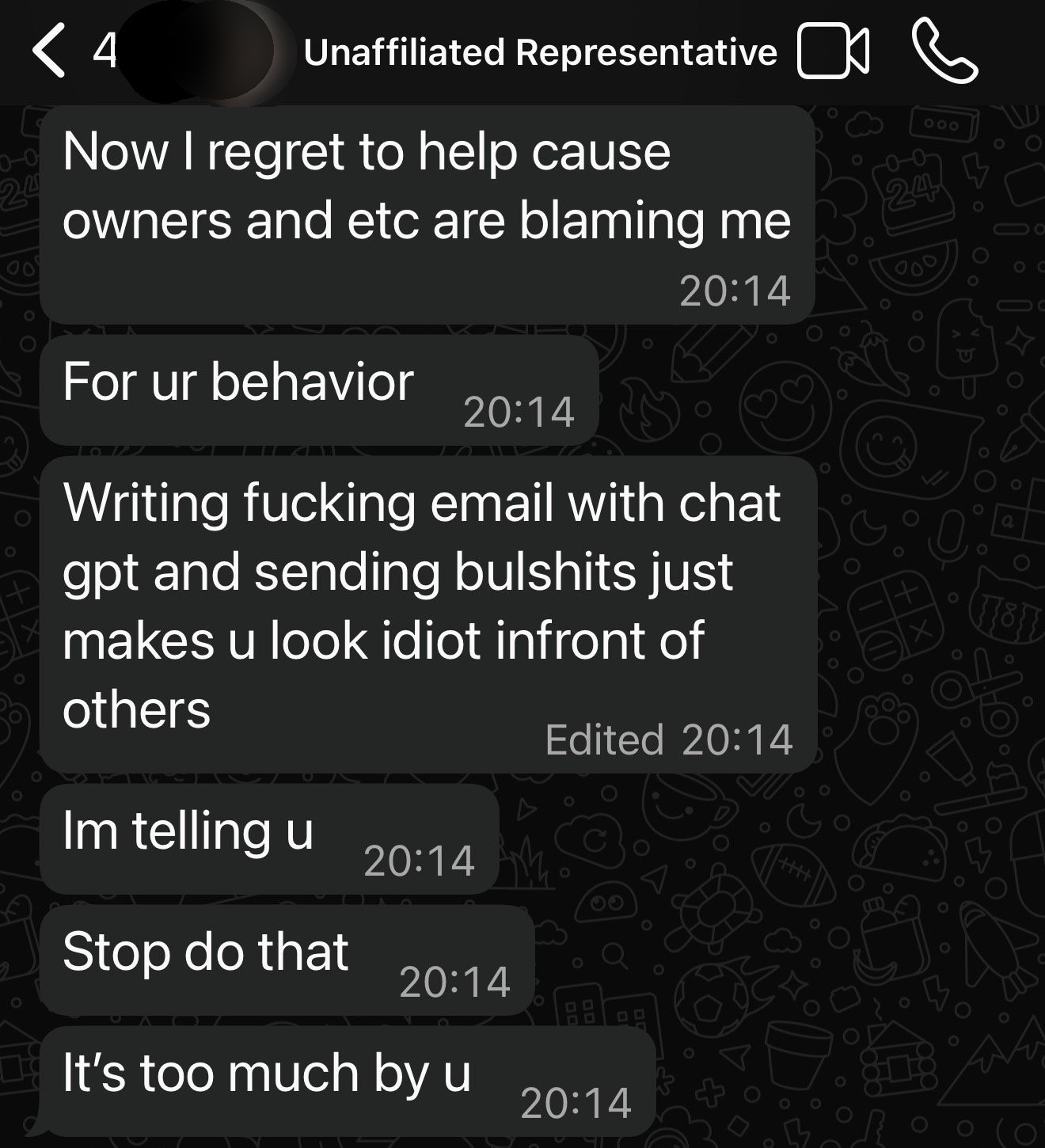
A person cannot describe Mona Lisa’s facial expression without seeing the painting. He either read the emails, received them, or was briefed. Each option requires an explanation of the data path.
Before the formal GDPR Article 15 request, the resident had already raised CCTV, access, safety and preservation questions. The response from the “Unaffiliated Representative” was not a technical answer. It was cognitive-status mockery: “writing fucking email with chat gpt… makes u look idiot in front of others.”
That matters because ChatGPT was being used as an executive-function accommodation tool by a disabled / neurodivergent resident attempting to communicate precisely with an institution that kept refusing precision. Mocking that tool is not harmless banter. It is disability-coded harassment.
The disabled neurodivergent resident used ChatGPT to see through the fog of institutional gaslighting. The administration-side environment used WhatsApp to character-assassinate a disabled person to 120+ neighbours. The tool-user produced an 84-contradiction register, two interactive games, and a permanent archive. The disability-accommodation mockers still cannot answer a single yes/no question about electrical safety. The cat spins.
“Unaffiliated” and “inside the personal-data flow” cannot both remain vague.
If the “Unaffiliated Representative” reviewed CCTV footage, received CCTV-derived information, obtained resident-conduct information, or had knowledge of administrative emails, then the issue is no longer only “authority perception.” It becomes a personal-data processing problem.
As the controller/processor structure invoked in your own legal position, you had to be aware of the personal-data chain. You either disclosed personal data to an unaffiliated person, or you allowed an allegedly unaffiliated person to function inside the personal-data processing chain without explaining his role. Both versions require answers.
Open question: how does this coexist with “unaffiliated,” and where is his Article 28 contract, data-processing agreement, or written authorization?
The “unaffiliated” representative saying he was in the middle, felt pressure from both sides, and was relaying Administration’s position based on documents and technician reports.
The same person says he recommended the resident to the owner and apartment, is now “in the middle,” feels pressure “from both sides,” and then relays Administration’s position: based on documents and technicians’ reports, they “don’t need more to prove.”
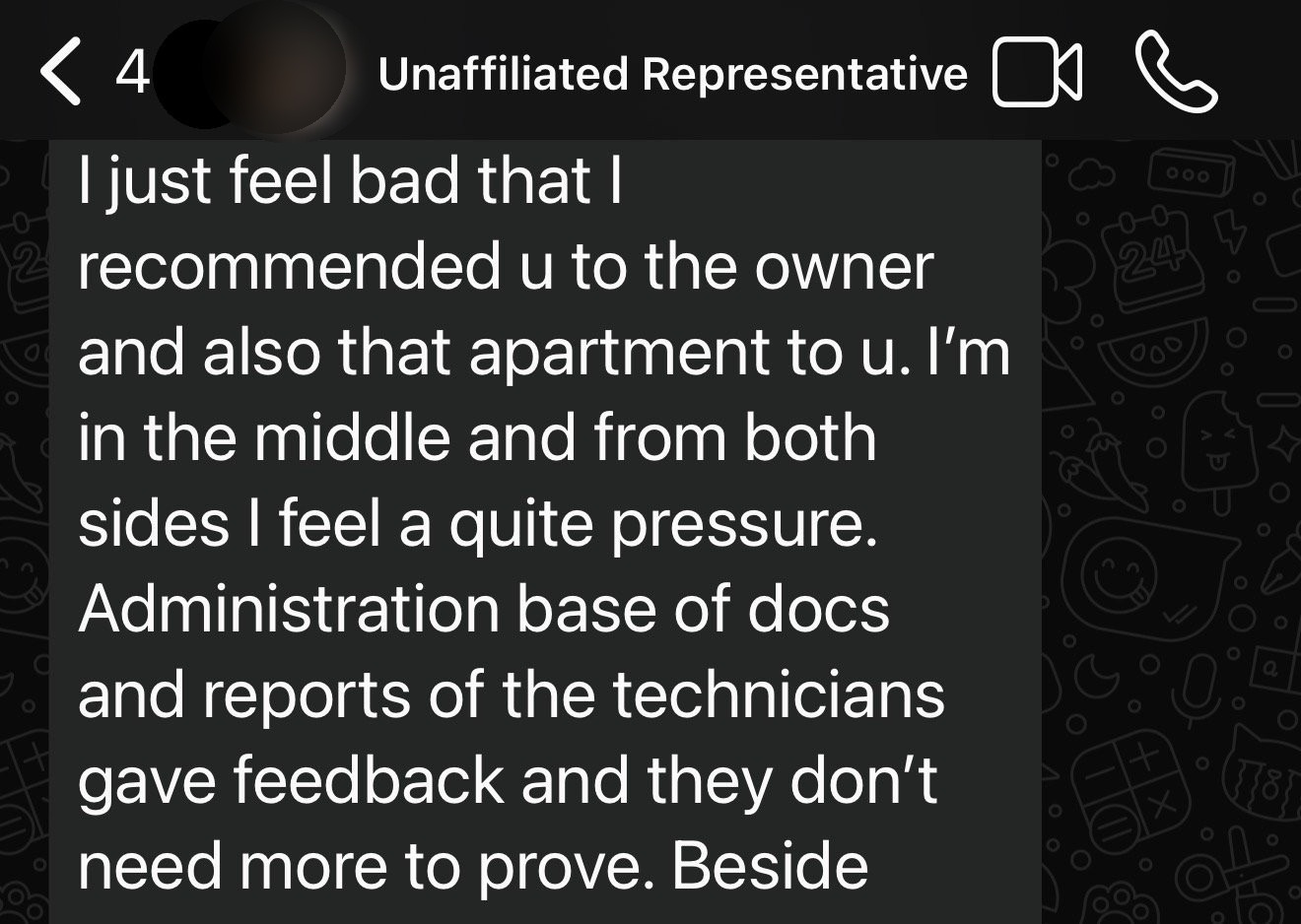
If he was truly unaffiliated, why was he relaying Administration’s technical-evidence position to the disabled resident? Why is an allegedly unaffiliated representative positioned between the resident, the owner, the apartment, the documents, the technician reports and Administration’s “we don’t need more to prove” stance?
The same laminated sign outside the administration office presented both Instagram and WhatsApp as official. The “official” Instagram account then watched the resident’s private stories while the administration claimed limited capacity for the questions.
The laminated sign outside the administration office presented the Złota 44 Instagram and the resident WhatsApp group as official. The story-view record shows the official Instagram context viewing the resident’s personal Instagram material almost immediately after posting, while the administration used “lack of organizational and technical capacity” as the stated reason not to answer the resident’s documented questions.
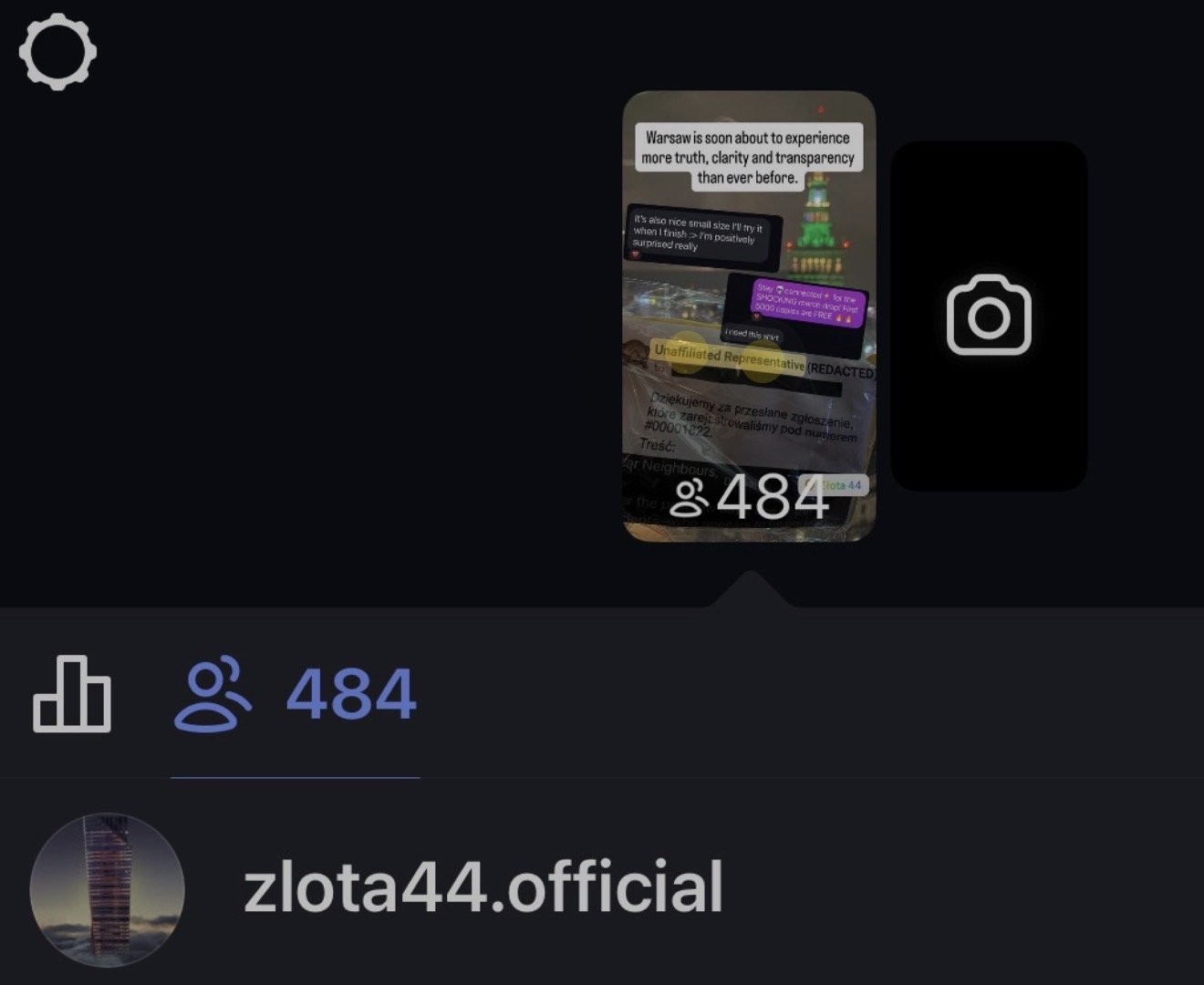
Question: how does silently following the resident’s personal Instagram constitute a good use of limited “organizational and technical capacity,” while answering the 150+ direct questions in the unanswered-question register does not?
If they had capacity to watch, they had capacity to clarify. They chose monitoring over answering.
How does silently following the resident’s personal Instagram constitute a good use of “organizational and technical capacity,” while answering the maintained unanswered-question register does not?
The Article 15 request supplied exact dates, exact data categories and a narrowed fallback. They refused it. Then they produced legal-office timing contradictions, a self-issued insurance acquittal and a 30-day legal restriction over two free bottles of mineral water.
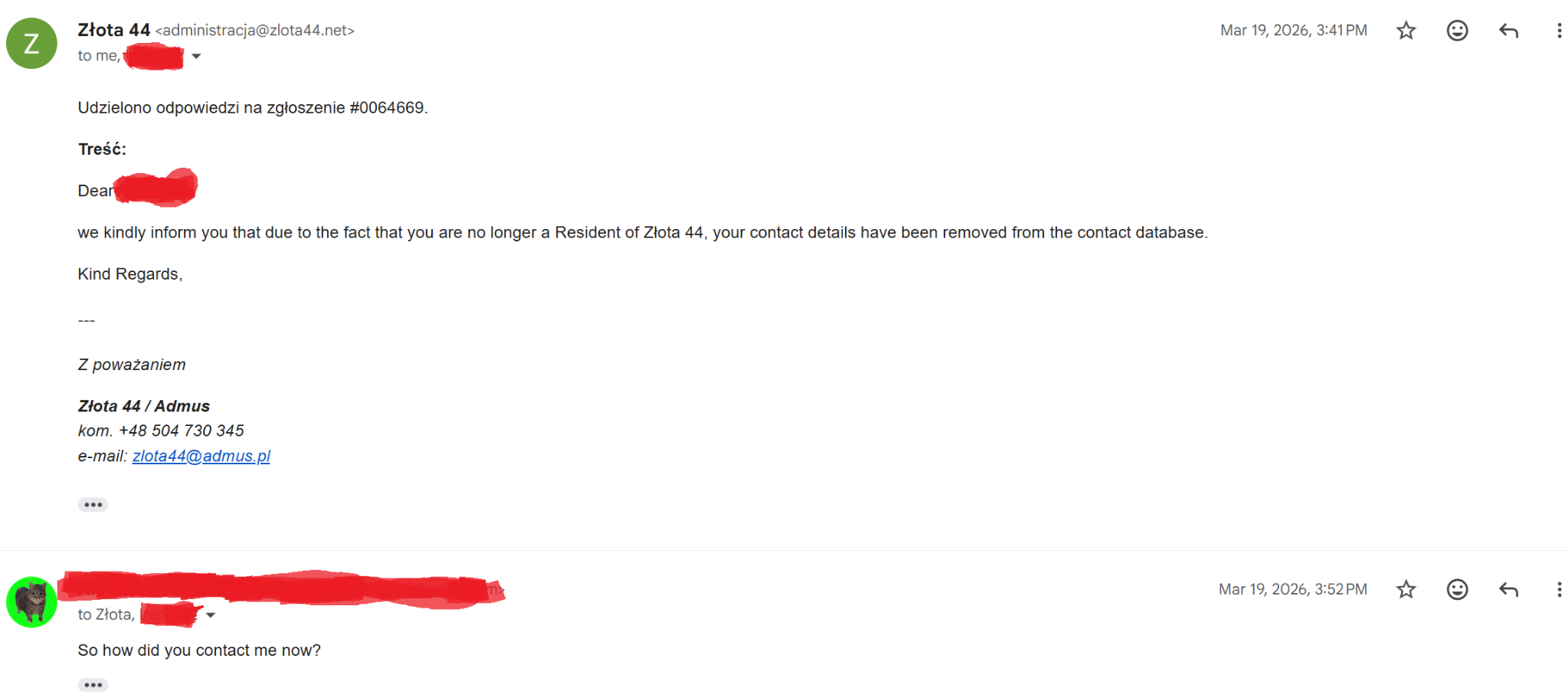
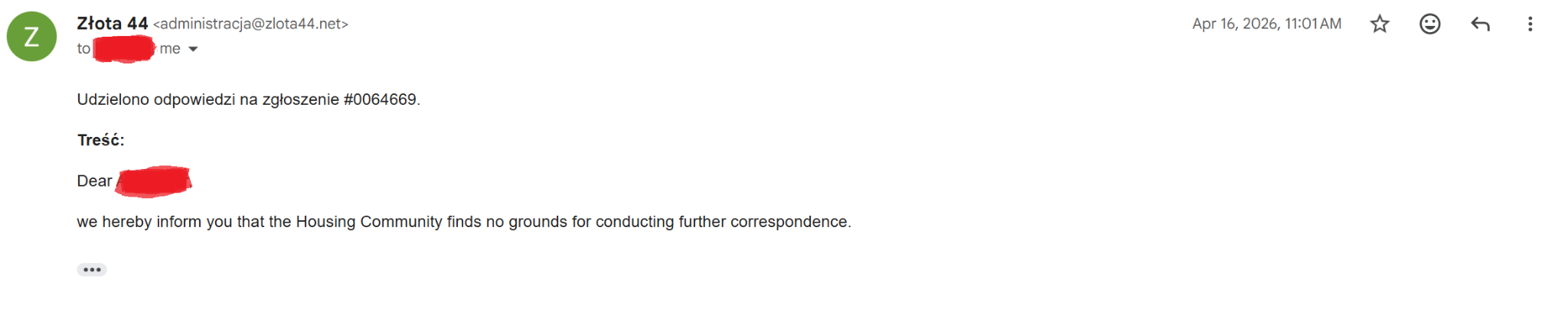
On March 19, 2026, the Administration wrote that the resident’s contact details had been removed from the contact database.
The resident — whose profile picture is OIIA Cat, visible in the email screenshots — replied eleven minutes later:
“So how did you contact me now?”
On April 16, 2026 — nearly one month later — the Administration responded that the Housing Community found no grounds for conducting further correspondence.
They used his contact details to inform him that his contact details had been removed. When asked how this was possible, they declared the matter closed.
The emails are preserved. The timestamps are preserved. The OIIA Cat is still alive. The question hangs forever.
The Administration later stated that system errors had been ruled out. If system errors were ruled out, then the access restrictions were not random failures. They were manually applied or manually maintained.
The same office that could request the card number, check the card, refresh access, restore access and verify system status later refused to provide the relevant ACS / access-control logs in the GDPR Art. 15 process.
The access restrictions coincided with the “Dear Neighbours” smear / character-assassination message.
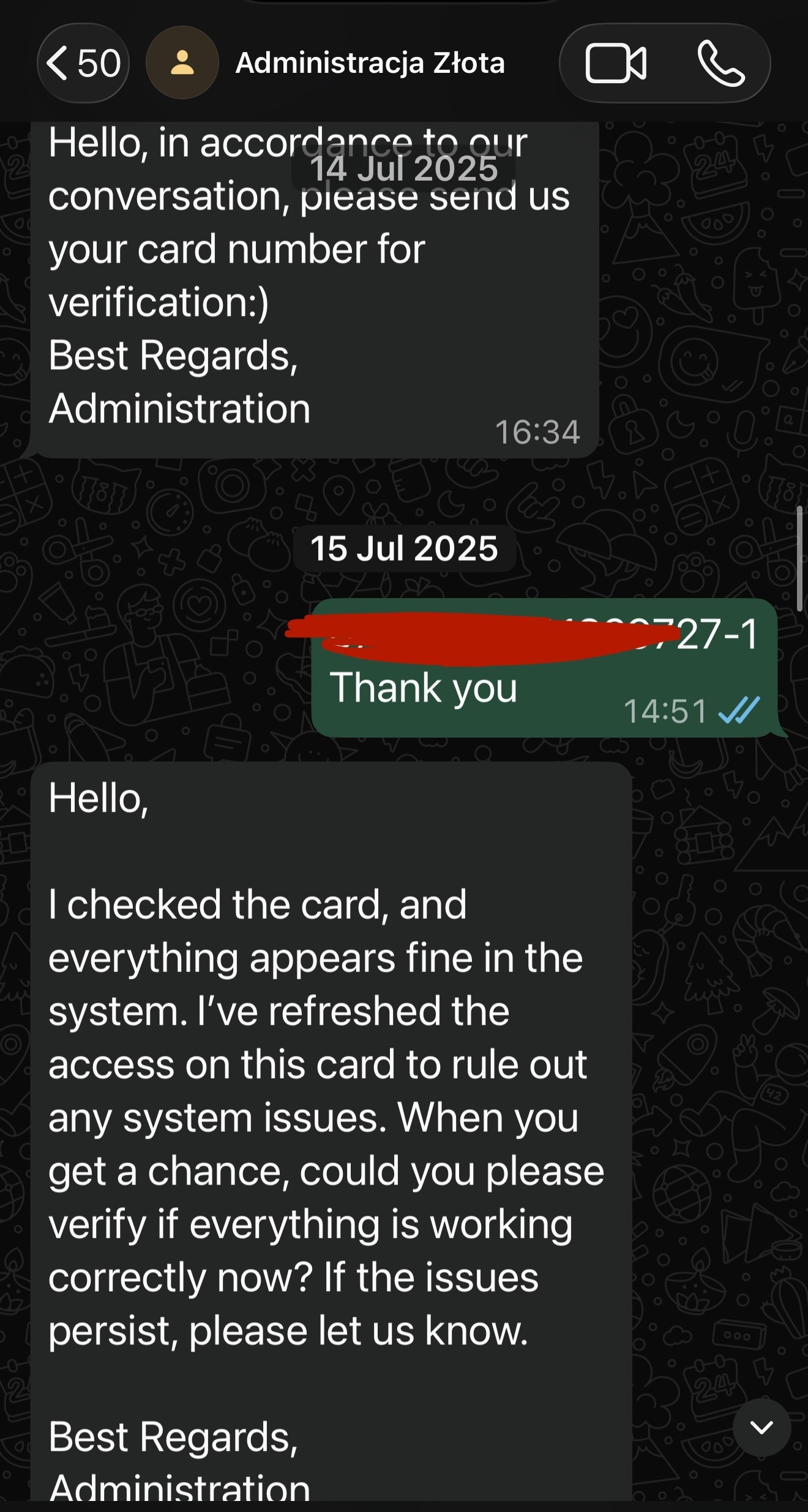
The continued avoidance of explaining the timing immediately after the GDPR Art. 15 deadline failure / UODO escalation is concerning.
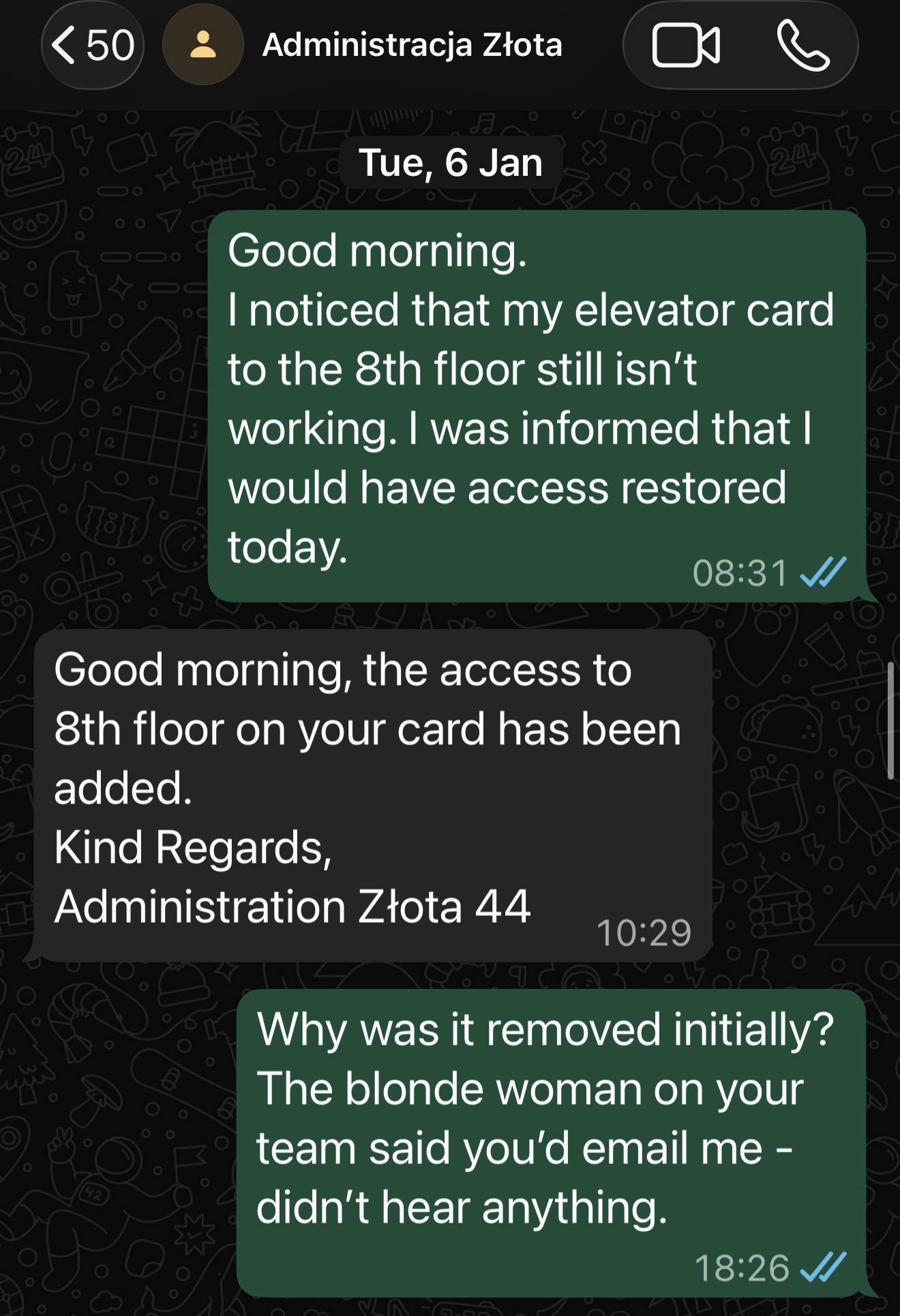
The continued avoidance of explaining the timing immediately after the GDPR Art. 15 deadline failure / UODO escalation is concerning.
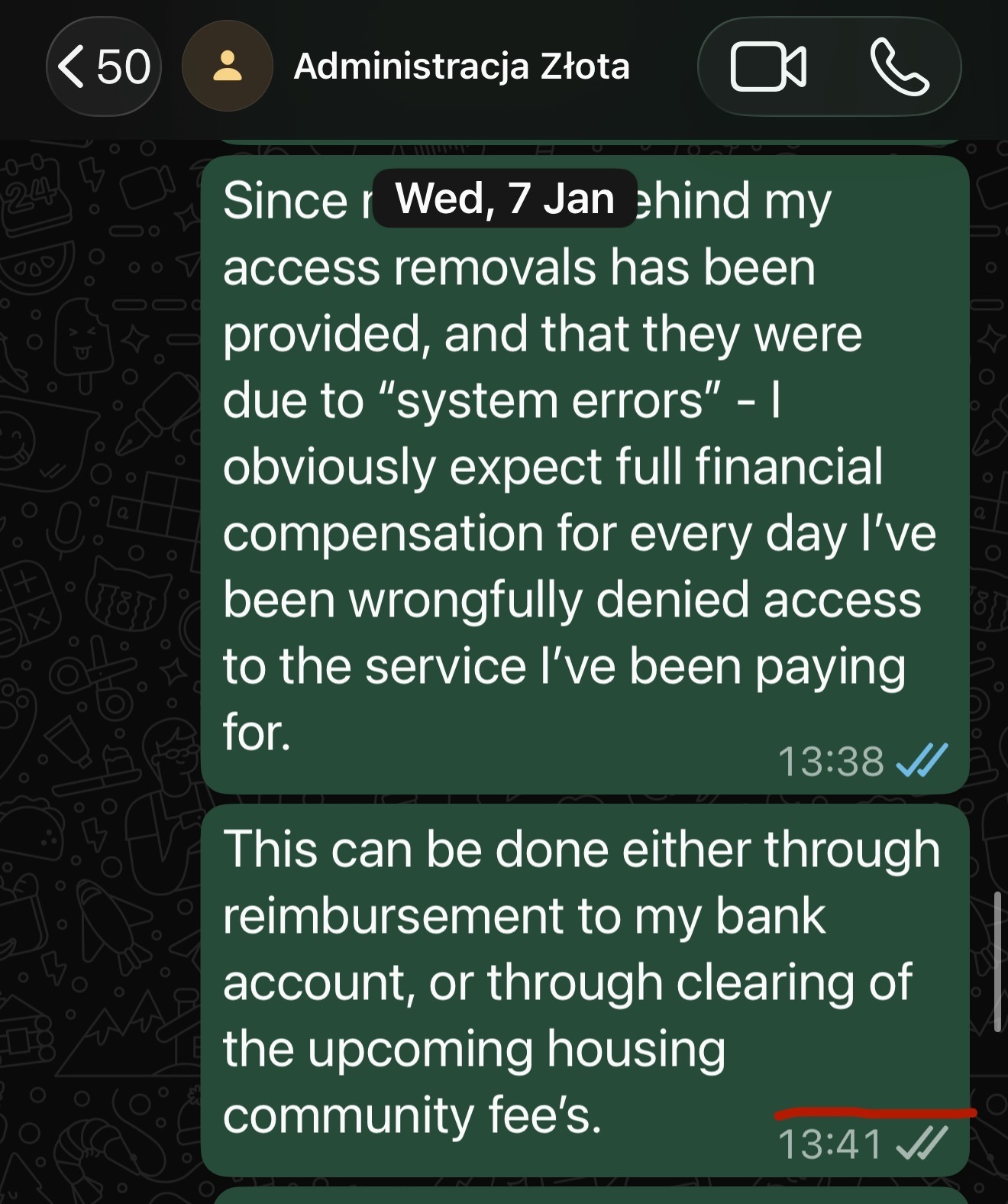
The resident asked for the effective date/time, authority, rule, decision-maker, notice, immediate restoration, access-control data and CCTV.

The inspection appeared less than 24 hours after the GDPR deadline was escalated. The resident put the timing, probability, insurance risk and basic asset-management problem in writing. The Administration still proceeded as if “urgent” meant adjectives, not execution.
The disabled resident attempts to educate the “Able” administration on how to not fuck up their insurance coverage.
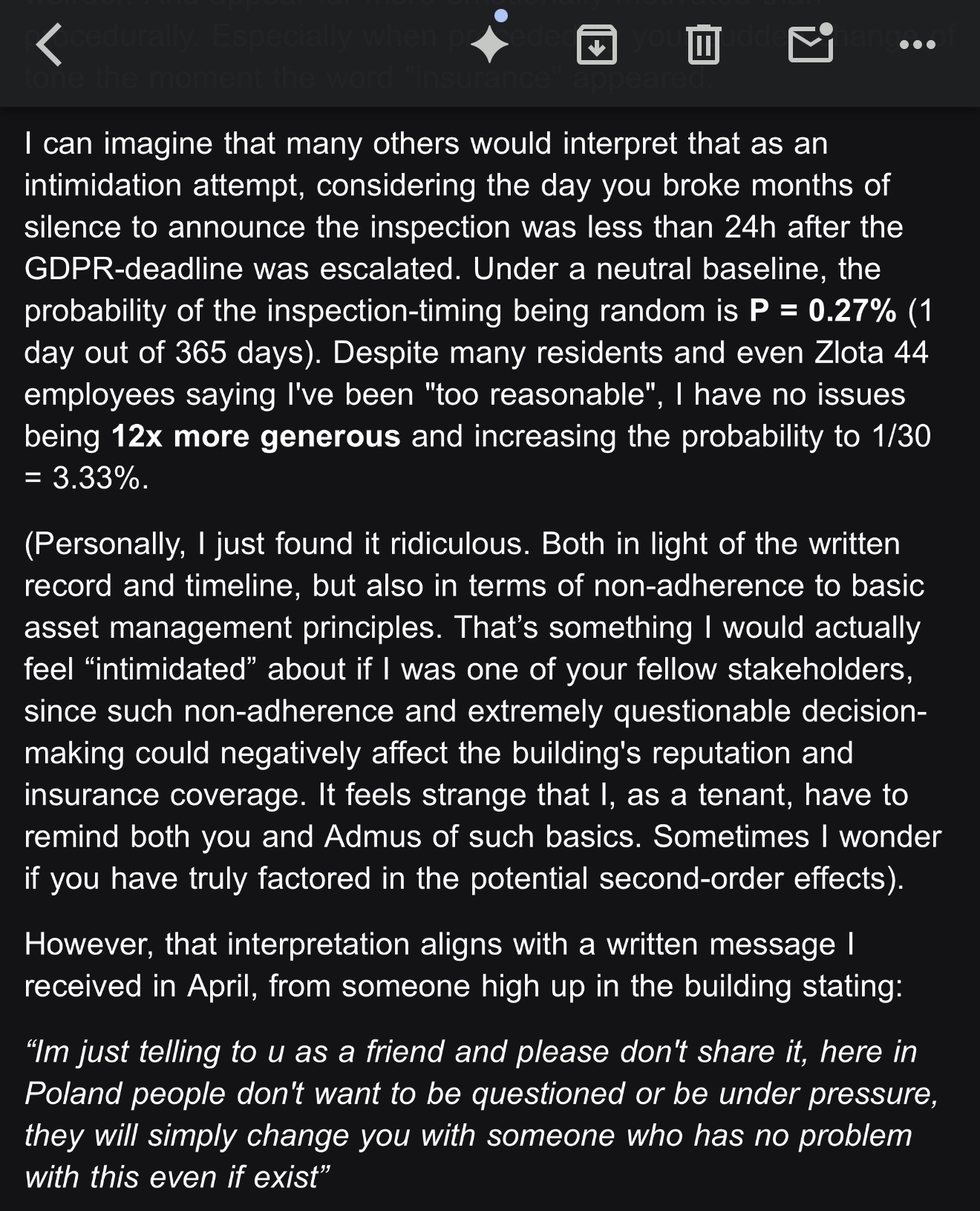
Under a neutral baseline, an inspection appearing less than 24 hours after GDPR escalation is approximately 1 day out of 365. The resident even used a far more generous — 12× wider — 30-day window: 3.33%.
A tenant should not have to remind a prestige-building administration that sudden “insurance” language, after a GDPR deadline failure, creates second-order consequences for reputation, trust, insurance and asset value.
The disabled, neurologically vulnerable resident was not only asking safety questions. He was explaining basic asset management to the administration while they were missing deadlines, avoiding answers and creating new contradictions.
A separate resident at Złota 44 made a mistake. He took a kebab that was not his. Value: approximately 20 PLN. The neighbour’s own words describe what happened next: security footage reviewed, location triangulated, resident identified, and 20 PLN collected.
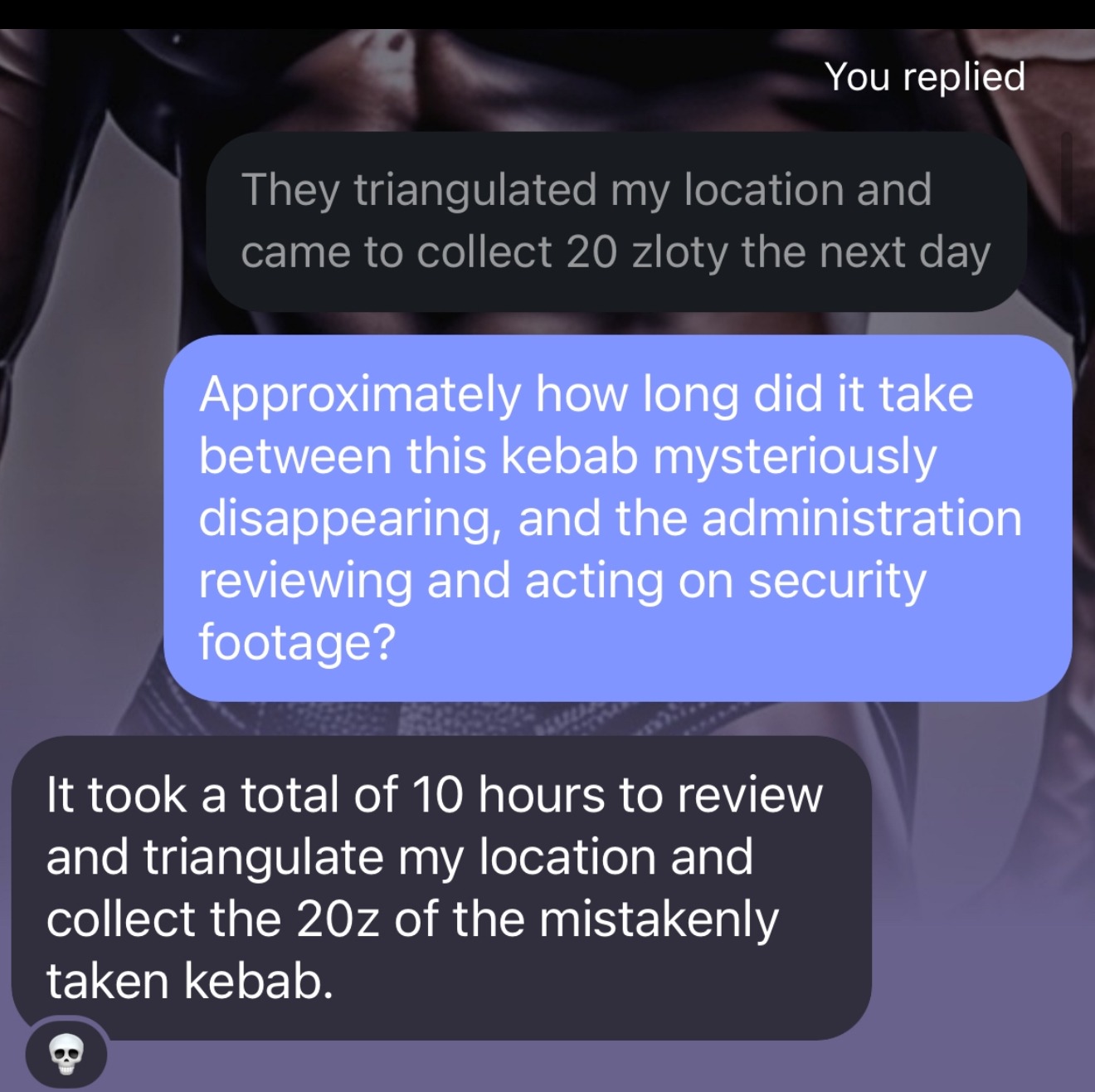
The legal letter says they lacked the “organizational and technical capacity” to produce access logs, CCTV data and the Article 15 material requested by the resident.
Yet a 20 PLN kebab apparently triggered CCTV review, location triangulation, resident identification, rapid deployment and collection of funds.
If you can triangulate a 20 PLN kebab in 10 hours, why can’t you produce access logs under a lawful GDPR request?
| If the legal letter was true | If the kebab response was true |
|---|---|
| They cannot track access, review footage, identify residents, or produce the requested records. The kebab recovery should have been impossible. | They have surveillance, tracking, identification and deployment capability. The Article 15 refusal was not a capacity shortage. |
| Item | Value | Response time | Action / avoidance |
|---|---|---|---|
| Missing kebab | 20 PLN | 10 hours | CCTV review, location triangulation, personnel deployment, fund collection |
| Electrical safety verification for a neurologically vulnerable resident | Medical necessity | Never answered | “No further answers will be provided” |
| GDPR Article 15 request | Legal right | Deadline expired | “Lack of organizational and technical capacity” |
| Character-assassination withdrawal | Reputational / disability-coded credibility attack | Never withdrawn | “Matter resolved” |
The Administration has organizational and technical capacity for kebabs. It claims to lack it for legal compliance, safety verification and correction of false statements.
STILL UNRESOLVED — explain why a 20 PLN kebab could be triangulated in 10 hours while access logs, CCTV records and Article 15 data remained unanswered.
The 9 October Article 15 request showing defined dates, a one-hour CCTV window, named data categories and a narrowed fallback.
The later letter called the request broadly formulated. The 9 October email shows dates, a one-hour CCTV window, named data categories, requested formats, preservation language and a fallback if the full request was considered too heavy.
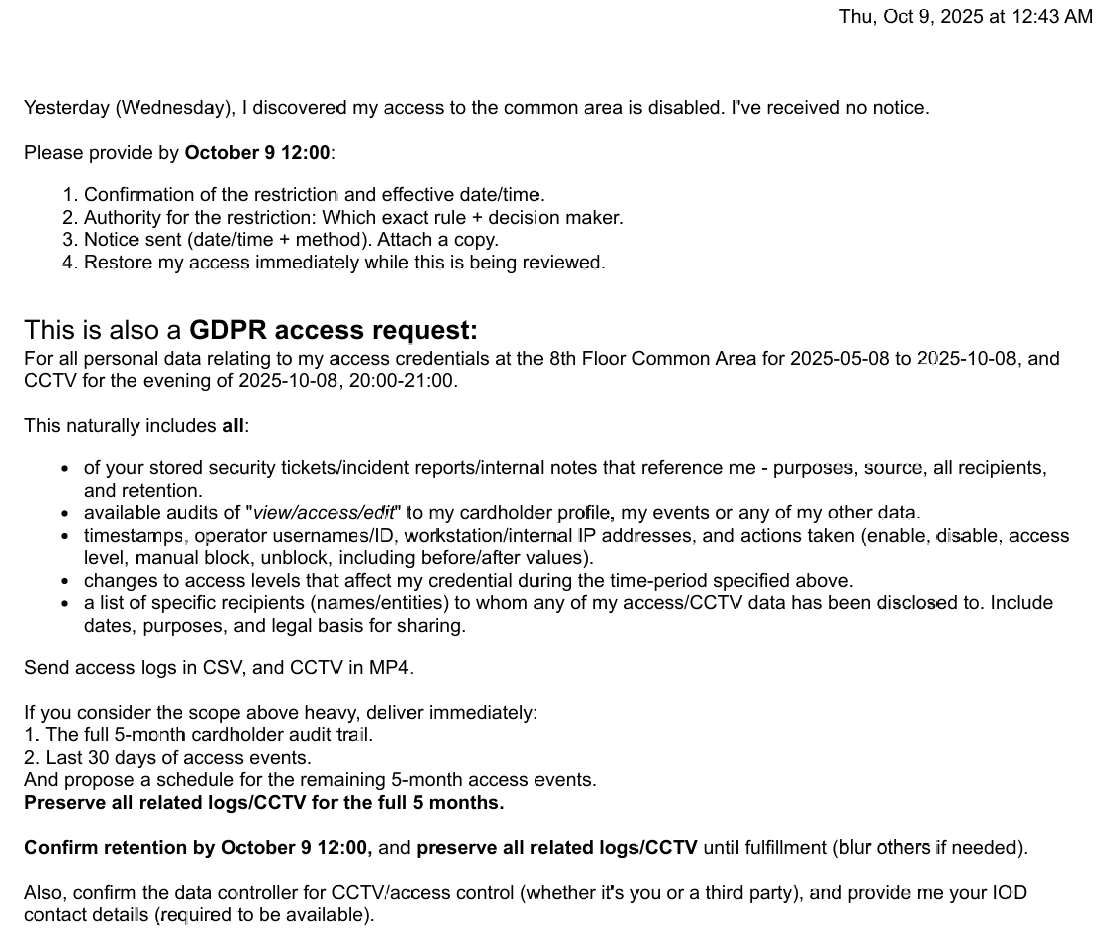
The fallback was explicit: provide the cardholder audit trail, provide the last 30 days of access events, and schedule the rest. They did none of it.
The dates do not fit. The February text does not match the October legal position. The exact sentence naming ADMUS is the part that disappeared. The same record also exposes the professional-management problem: ADMUS stayed operational, then disappeared from the legal wording when responsibility mattered.
They pretended to paste the legal position. ADMUS is the exact part missing.
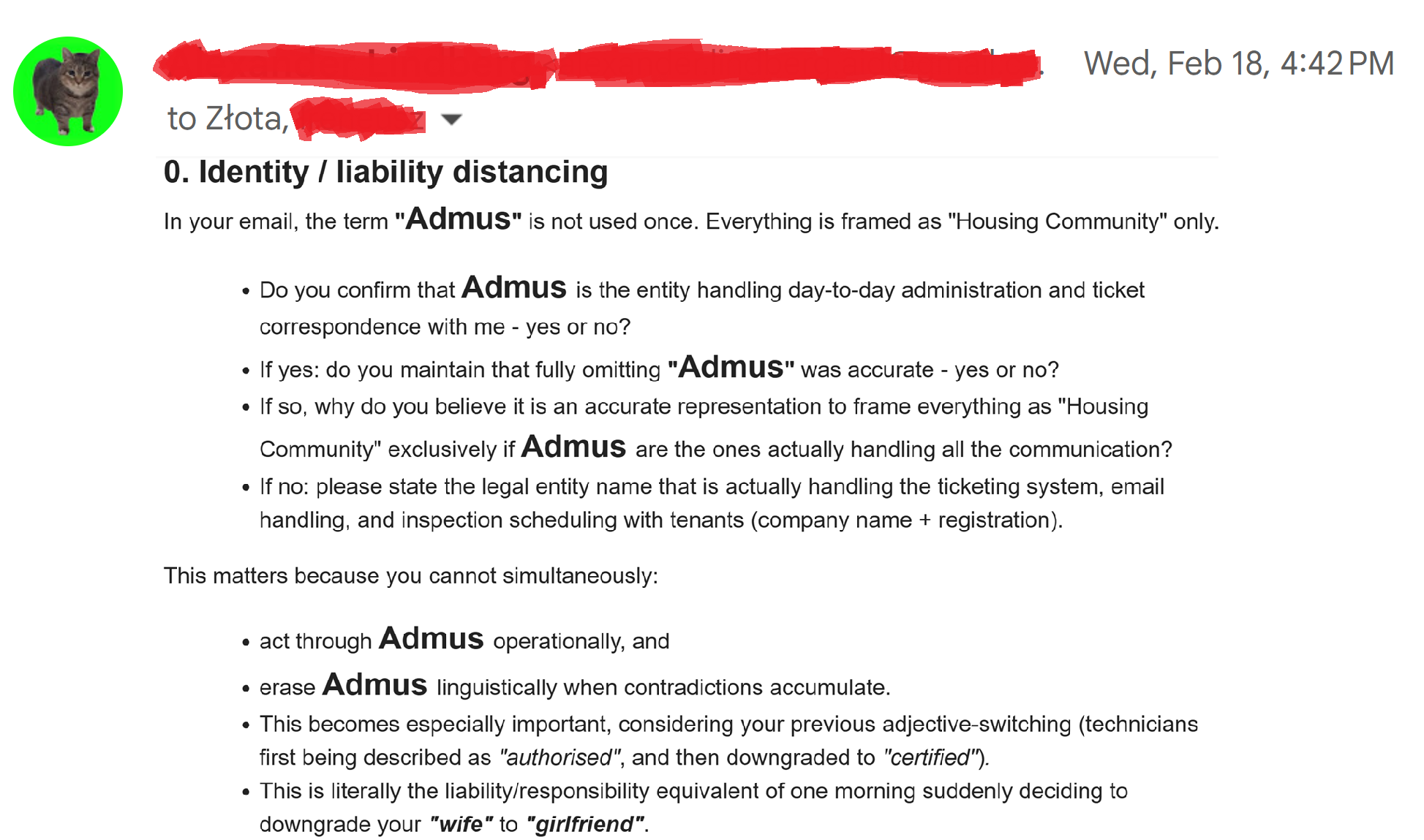
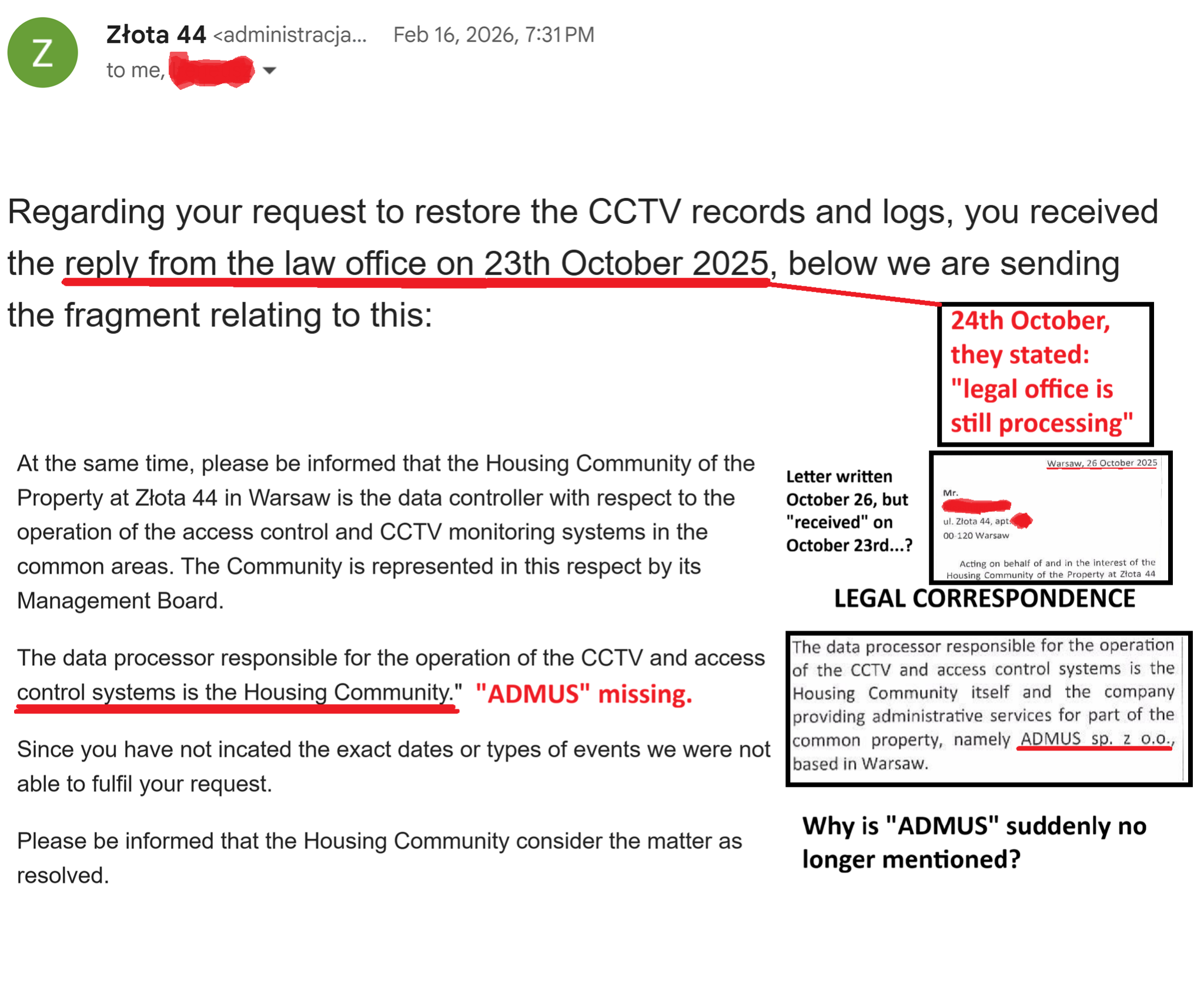
ADMUS was named. The October legal text named the Housing Community and “the company providing administrative services,” namely ADMUS sp. z o.o.
ADMUS disappeared. The February 16 email presented the “fragment relating to this” without that ADMUS sentence.
The dates still do not fit. They claimed October 23 receipt. On October 24, they said the law office was still processing. The letter shown is dated October 26.
The capacity problem remains. They identify who controls the data and who operates the system. Then they use “lack of capacity” as the stated reason not to produce the data.
Why are you throwing “the Housing Community” — the client you’re supposed to represent — under the bus after creating 84 documented contradictions and 150+ unresolved questions?
You are supposed to be the professional management company.
And your response is to quietly delete yourselves from the legal documentation and leave the Housing Community to clean it up?
Why wasn’t “Housing Community” conveniently fragmented out instead of ADMUS?
“If ADMUS genuinely believed its name was “good,” why remove it from the legal writing when authority and credibility would logically be most useful? Why remove a social-proof advantage when you need it the most?”
“If your name was “good,” then ADMUS and Director [REDACTED] should appear more often as the contradictions and stakes increased — not less.”
Your incentive gradient suggests that you do not actually consider your name “good” to begin with.
At the beginning, the resident was dealing with Director [REDACTED].
Director when reassuring. No Director when accountable.
This leadership style sits even stranger in a country whose public identity is deeply tied to Christianity.
In Genesis, Adam hiding behind Eve is not recorded as leadership. It is recorded as shame.
 OIIA Cat disapproves of the institutionalisation of Adam’s Shame.
The pattern here is hard to miss: a Director avoided direct accountability while routing the interaction through two young Polish female proxies.
This is not masculine leadership. It is liability-shielding with women placed in front.
Inside a building marketed as a post-Communist freedom monument to ojczyzna, while an “Unaffiliated Foreign Representative” roleplayed proxy-authority, the Director’s model of responsibility was apparently:
let the young women absorb the emotional awkwardness we created.
Zero opportunities have been taken to correct the record.
Maybe because there were no 18–22-year-old women nearby to press “send,” translate the accountability, or remove the next inconvenient name from the legal fragment.
Their philosophy is clear.
If we fuck something up — blame the nearest young woman in sight.
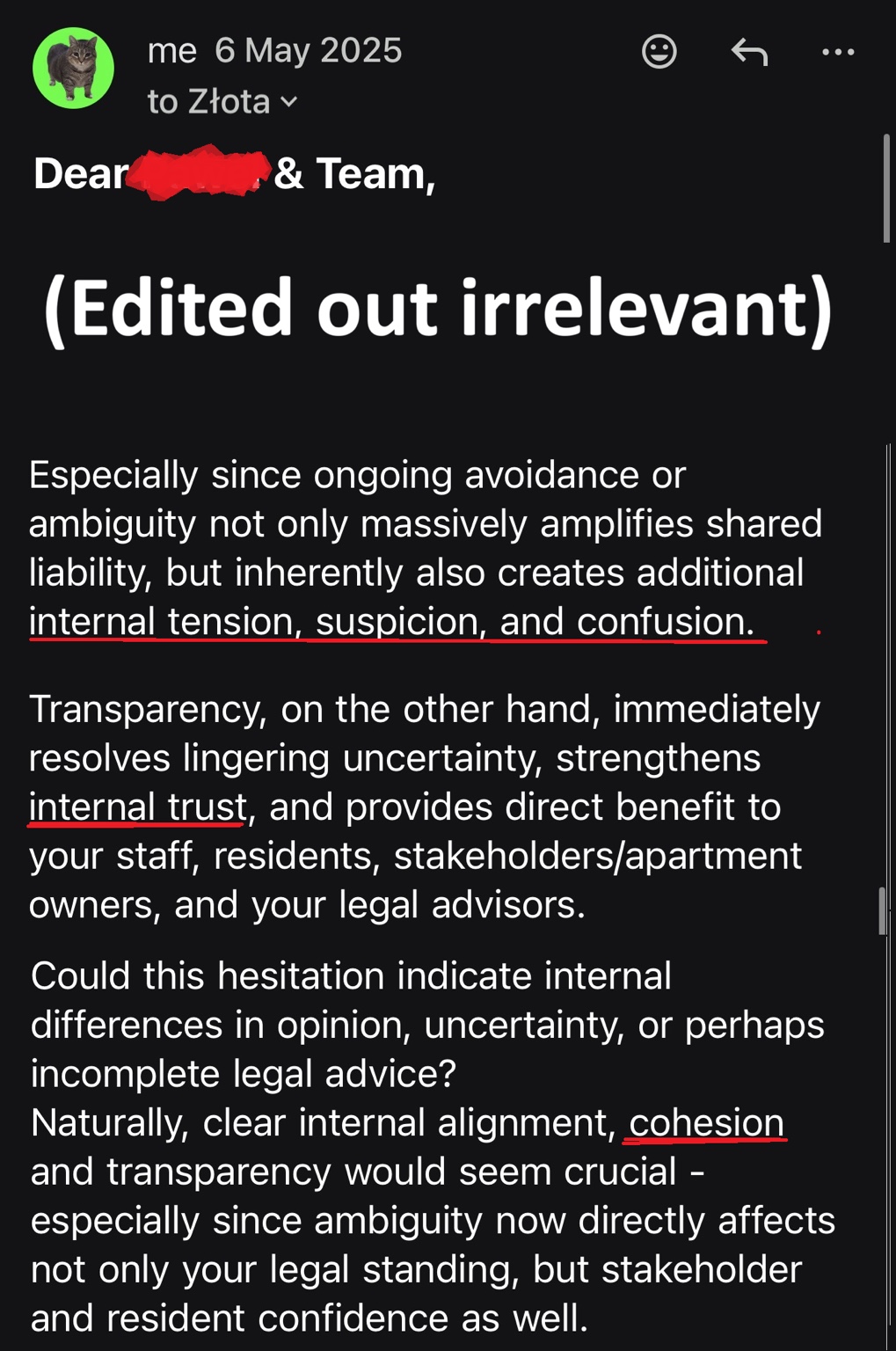
On 6 May 2025, the resident warned Administration that ongoing avoidance and ambiguity would amplify shared liability, create internal tension, suspicion and confusion, and eventually make internal inconsistencies externally visible.
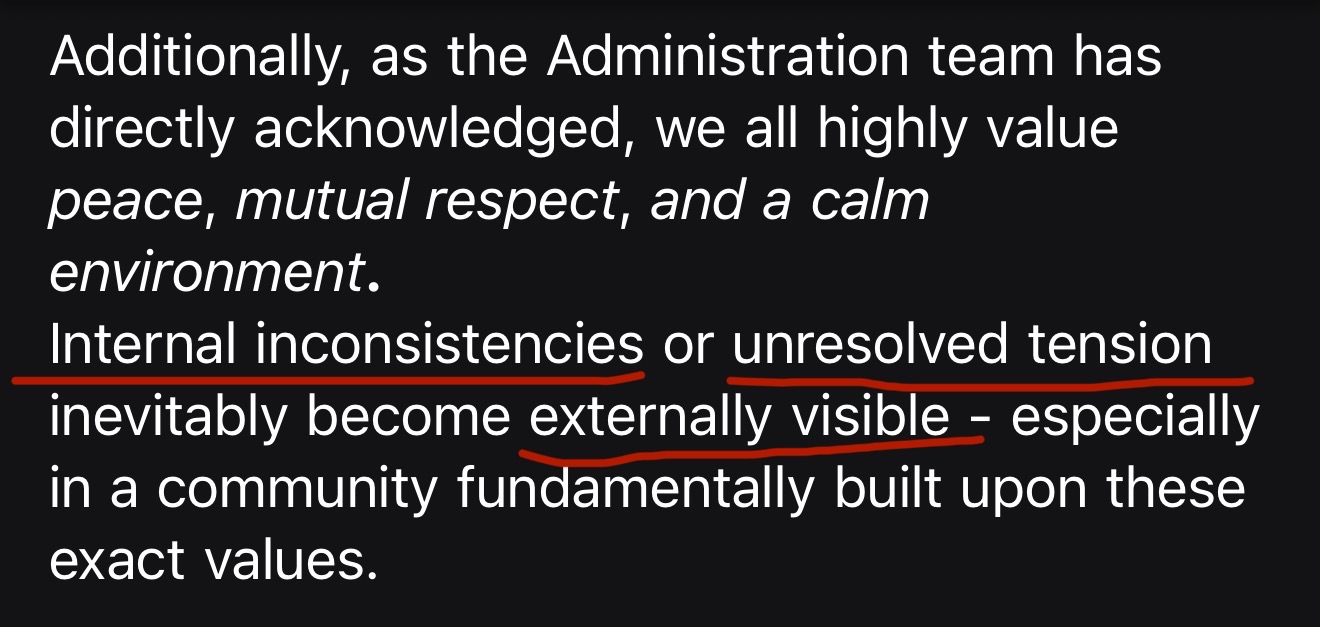
If responsibility is kept vague, the internal failure mode eventually becomes visible. In an environment where everyone tries to avoid responsibility, betrayals are structurally inevitable.
The October legal position named both. The February “fragment” kept the Housing Community visible and removed the ADMUS sentence.
This is the same pattern. Not “similar.” The same. The resident warned them that responsibility ambiguity would turn into visible internal inconsistency. Eight months later, the responsibility-chain inconsistency was sitting in their own copied legal text.
The resident did not need internal access to see the fault line. He described the fault line before it surfaced.
The disabled resident warned the Administration about the self-destructive consequences of its own behaviour, while attempting to give them face-saving exits — despite already being character-assassinated by their Unaffiliated Foreign Representative for proxy-authority.
The Administration refused those exits, repeated the same behaviours, and then left the proof in 84+ contradictions.
Still a better love story than Twilight.
Administration shifts blame onto its proxy, the Unaffiliated Foreign Representative, when the disabled, neurologically vulnerable resident raises safety concerns.
After the proxy’s emotional outburst, the disabled resident soothes his crippling anxiety.
Ironically, the proxy character-assassinated him as “psych/drug issues” one week later.
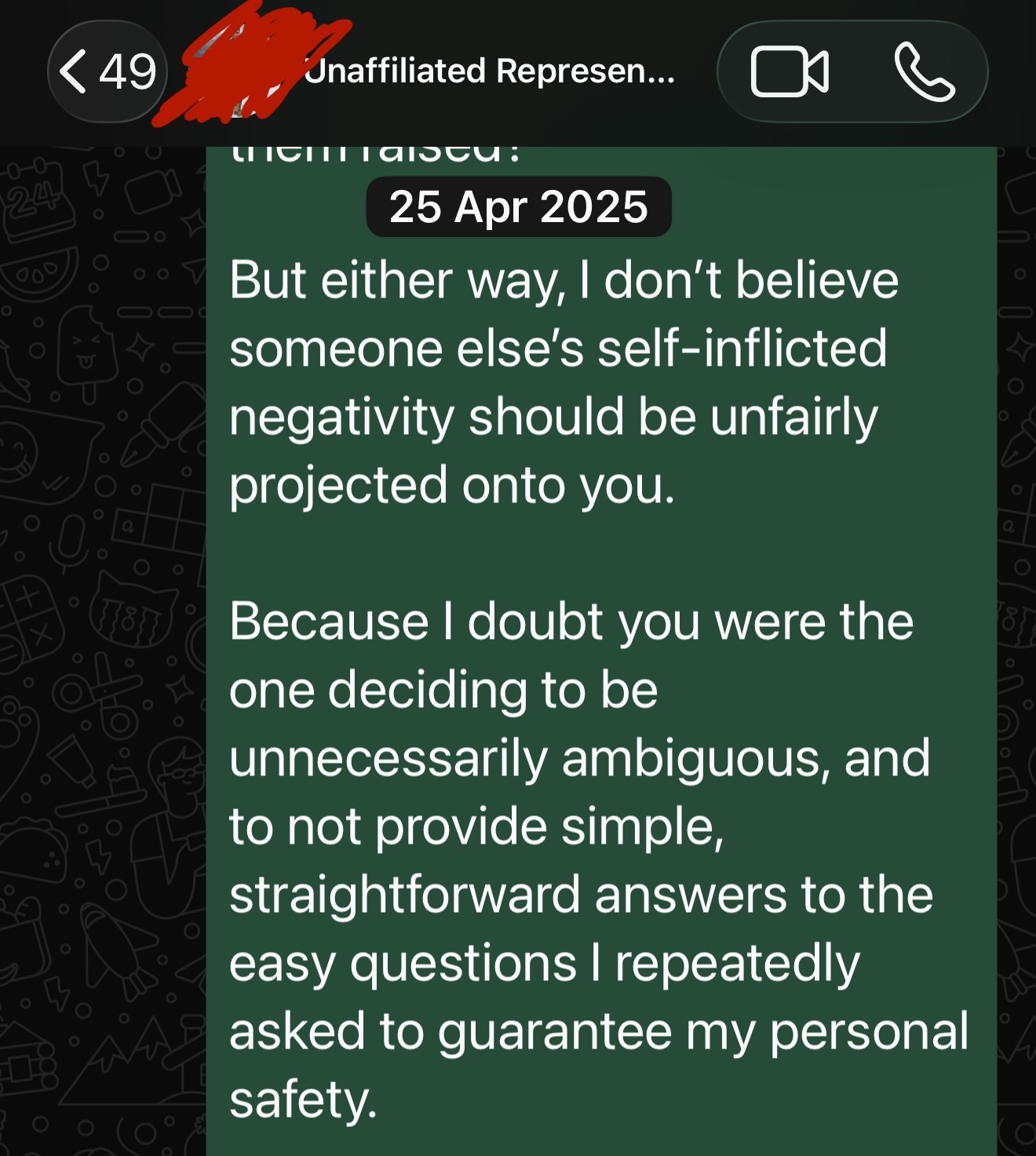
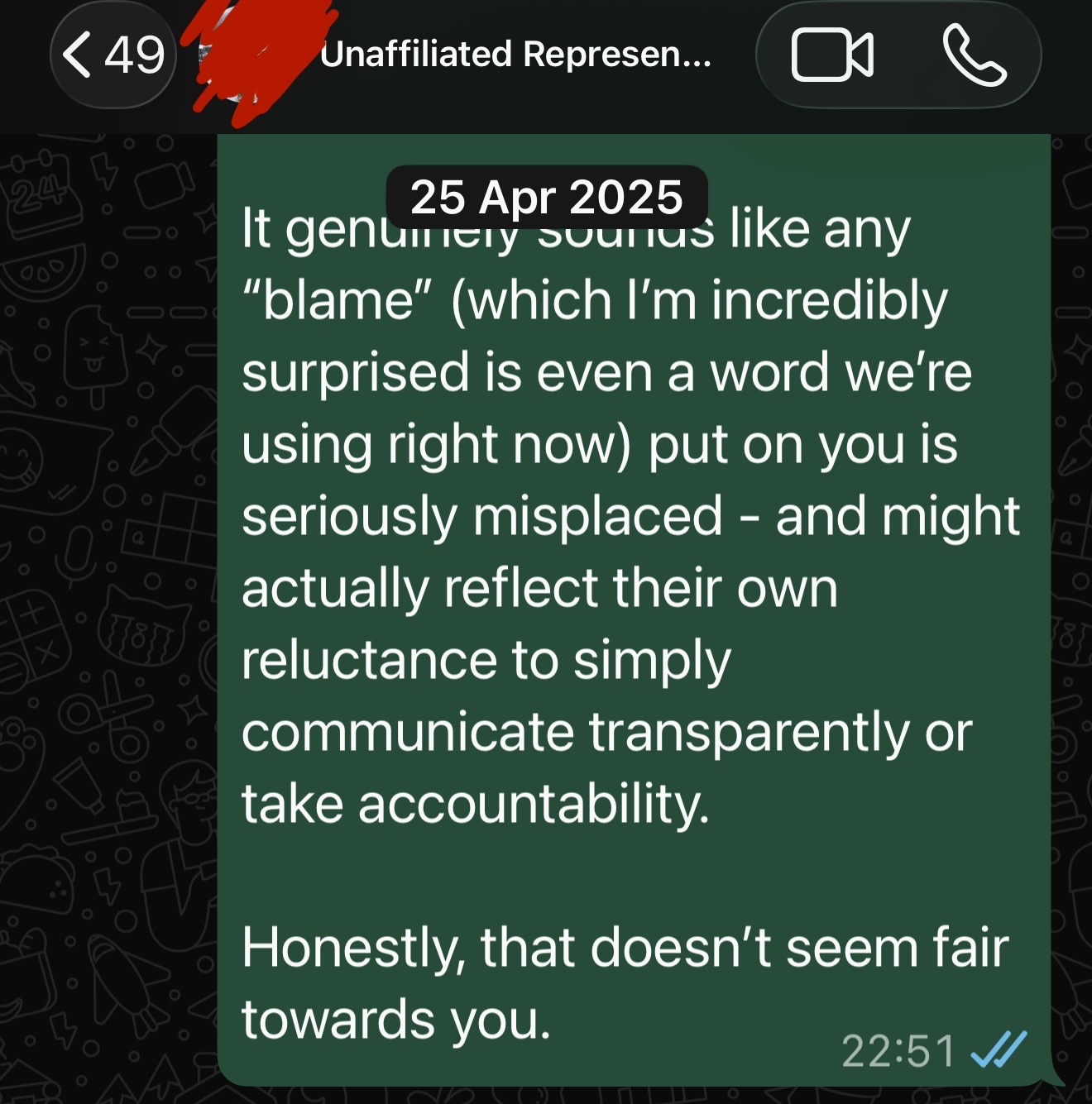
Unresolved internal tension got placed on the Unaffiliated Foreign Representative. It became externally visible as character assassination. Later disowned as “Unaffiliated.”
Rinse-and-repeat in February. Housing Community stayed visible. ADMUS disappeared.
The resident tells them he sees the pattern, and warns them it self-destructs their reputation.
They never calibrate their strategy.
STILL UNRESOLVED — Why was ADMUS removed from the processing structure between October 26 and February 16?
STILL UNRESOLVED — Who authorized the removal of ADMUS from the legal position?
STILL UNRESOLVED — If the February 16 email was a “copy-paste” of the legal position, why does the text not match?
STILL UNRESOLVED — Why is “and the company providing administrative services for part of the common property, namely ADMUS sp. z o.o., based in Warsaw.” the exact fragment missing?
STILL UNRESOLVED — If the reply was allegedly received on October 23, why did the Administration write on October 24 that the law office was still processing it, and why is the legal letter dated October 26?
STILL UNRESOLVED — Did the law office approve the edited version, or did the Administration edit a legal position without authorization?
STILL UNRESOLVED — Why was ADMUS removed instead of “Housing Community,” if the February 16 text was supposed to be a faithful copy-paste of the legal position?
STILL UNRESOLVED — If ADMUS considered its name a credibility asset, why did ADMUS disappear from the legal wording precisely when authority, credibility and responsibility mattered most?
The legal-office sentence weaponizing a 30-day restriction over two free bottles of mineral water.
“the removal of two bottles of mineral water from the club area.”
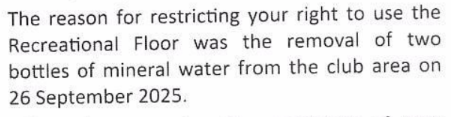
They issued no withdrawal, no public reprimand and no documented sanction for the “unaffiliated representative” who made court threats, circulated the drugs / mental-health character assassination, demonstrated internal email and CCTV knowledge, and intercepted the police report.
Legal precision against the resident over free water. No documented accountability for the Unaffiliated Foreign Representative who threatened court, attacked his sanity and sobriety, triggered GDPR questions and intercepted his police report.
The actual request and the actual response are shown below. The request asks for four policy details. The response supplies none of them and replaces disclosure with the Housing Community’s own liability conclusion.
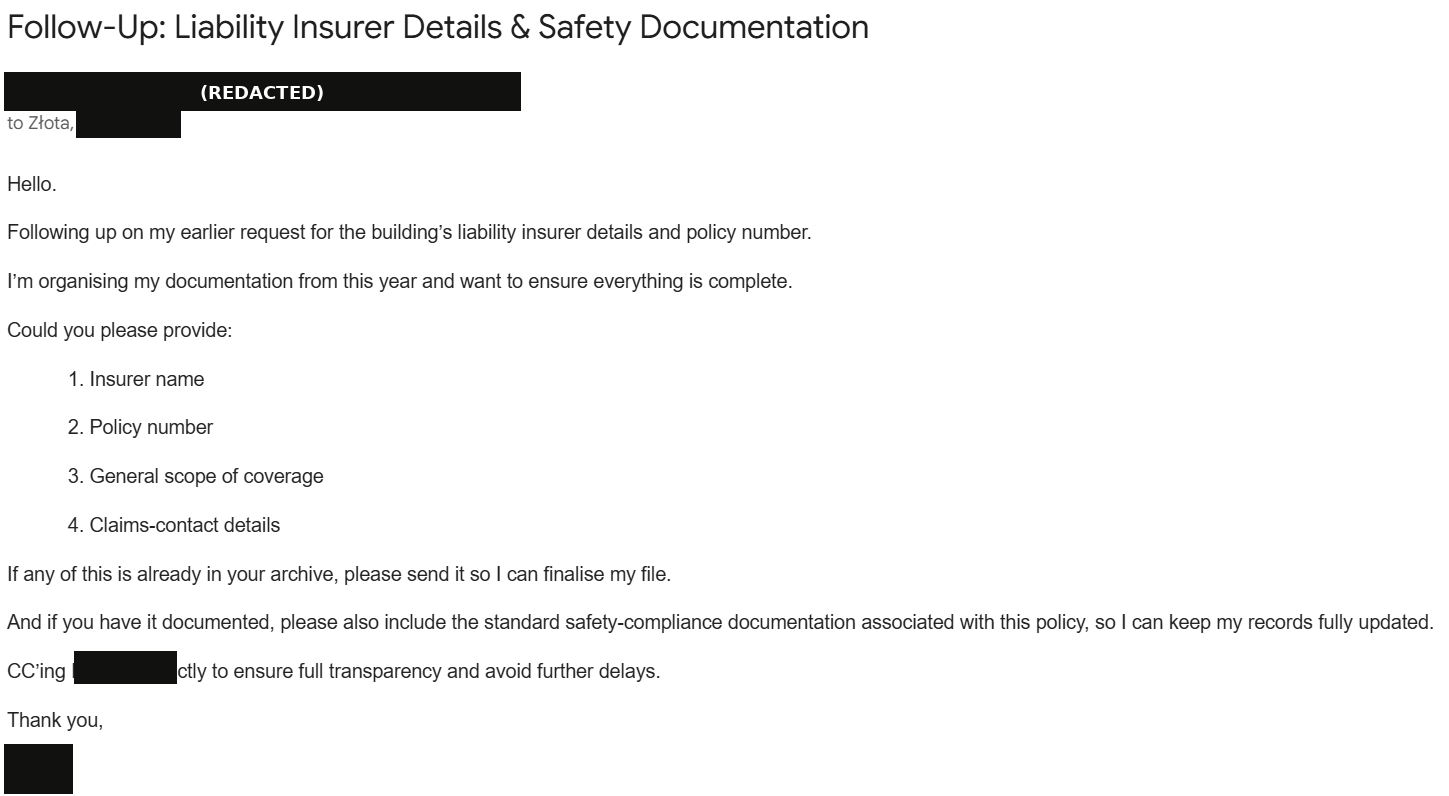
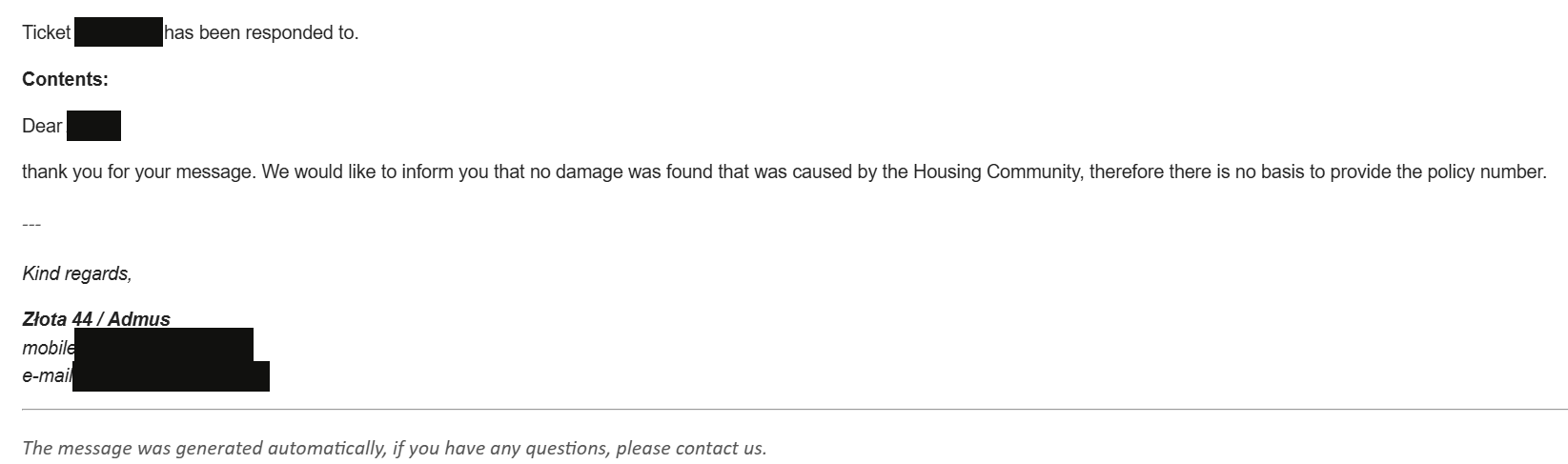
“We investigated ourselves, decided we’re innocent, and therefore you cannot have the policy number.”
Their sentence does not clearly rule out the existence of damage. It only claims that no damage was found that was caused by the Housing Community.
If they meant “no damage exists,” why not say that?
If they used language that does not explicitly rule out damage, how can that sentence become “therefore there is no basis to provide the policy number”?
And why did they start investigating “damage” before the resident had even identified a specific damage claim? If the resident had not yet stated the hypothetical damage, what exactly did they investigate, using which measurements, and against which scope?
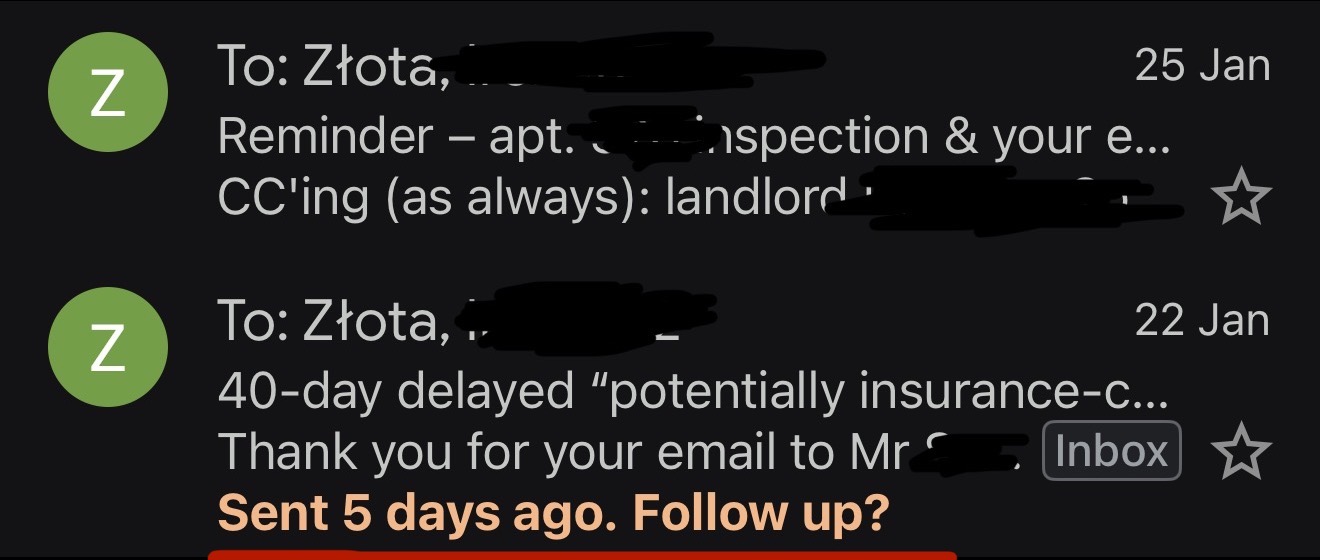
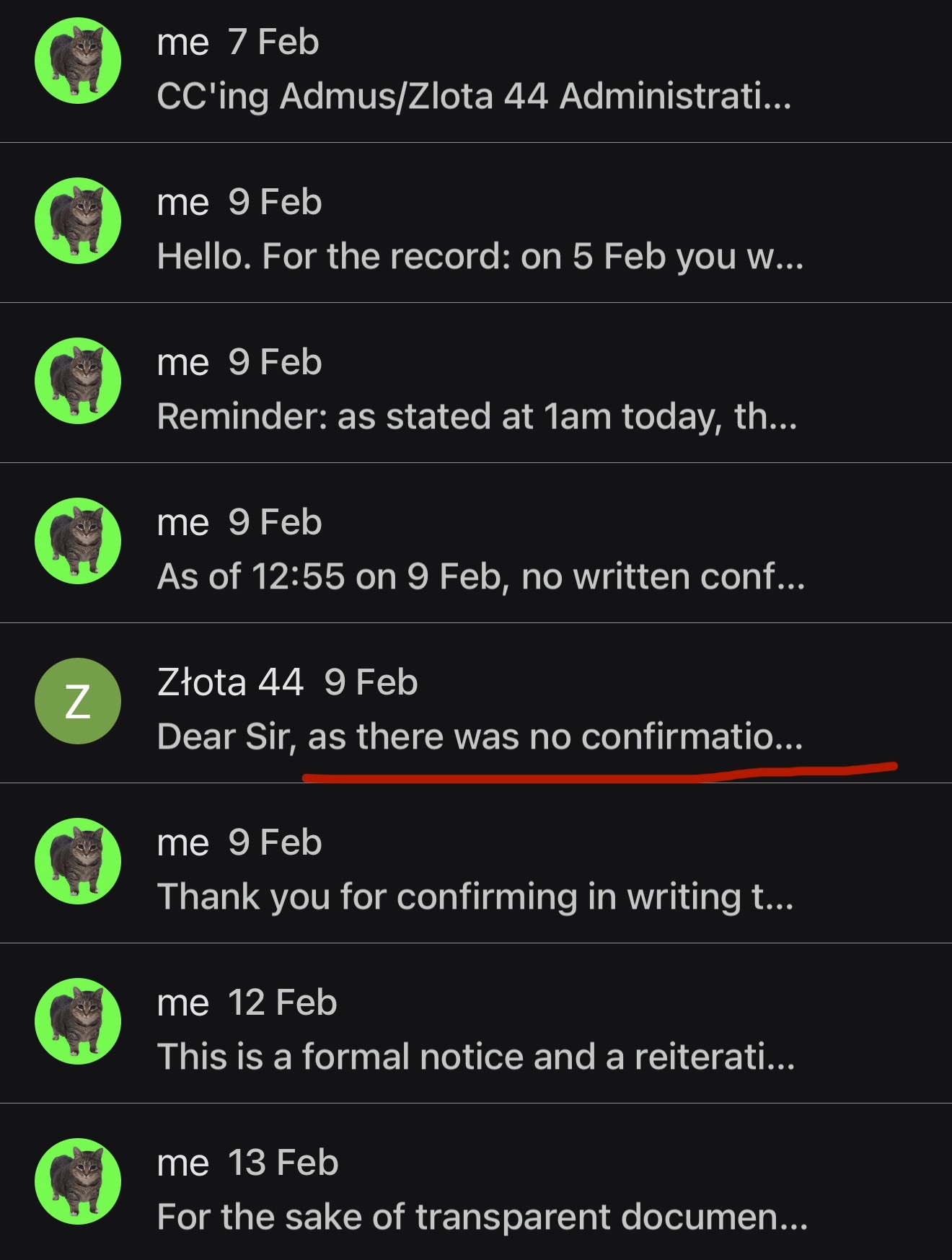
Any rational person would expect communication to become more transparent and documented after a GDPR Article 15 deadline failure — not less. They did the opposite: withheld identifiers, routed notices through concierge and post-it notes, left unresolved until after move-out, missed their own deadline, and wrote “no confirmation from you” above repeated confirmations.

The email confirms access and requests the inspection scope, company name, technician names and insurance / liability cover.
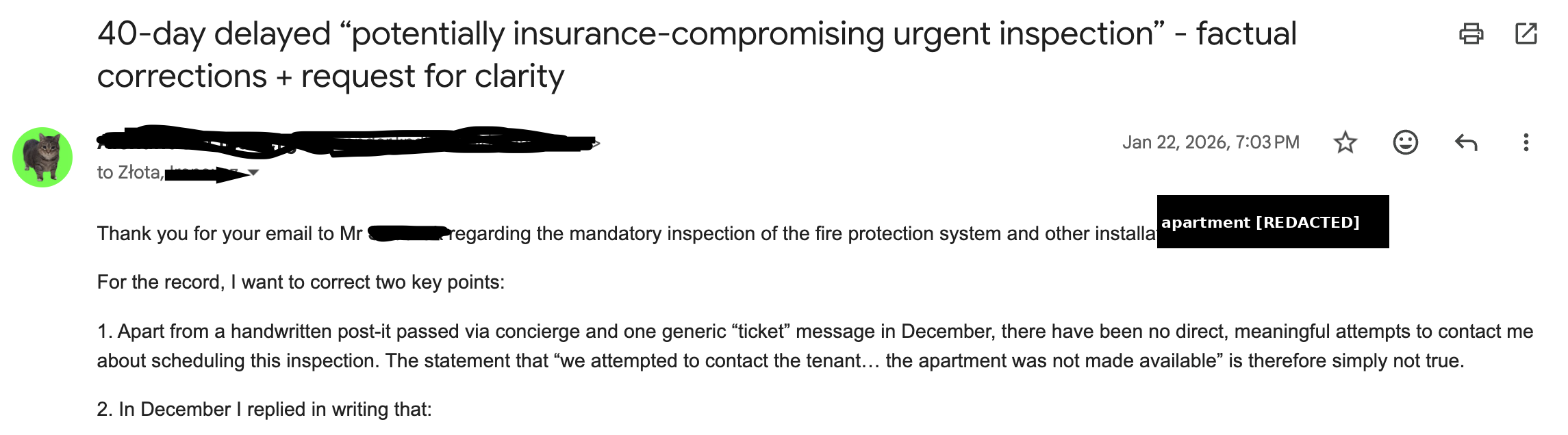
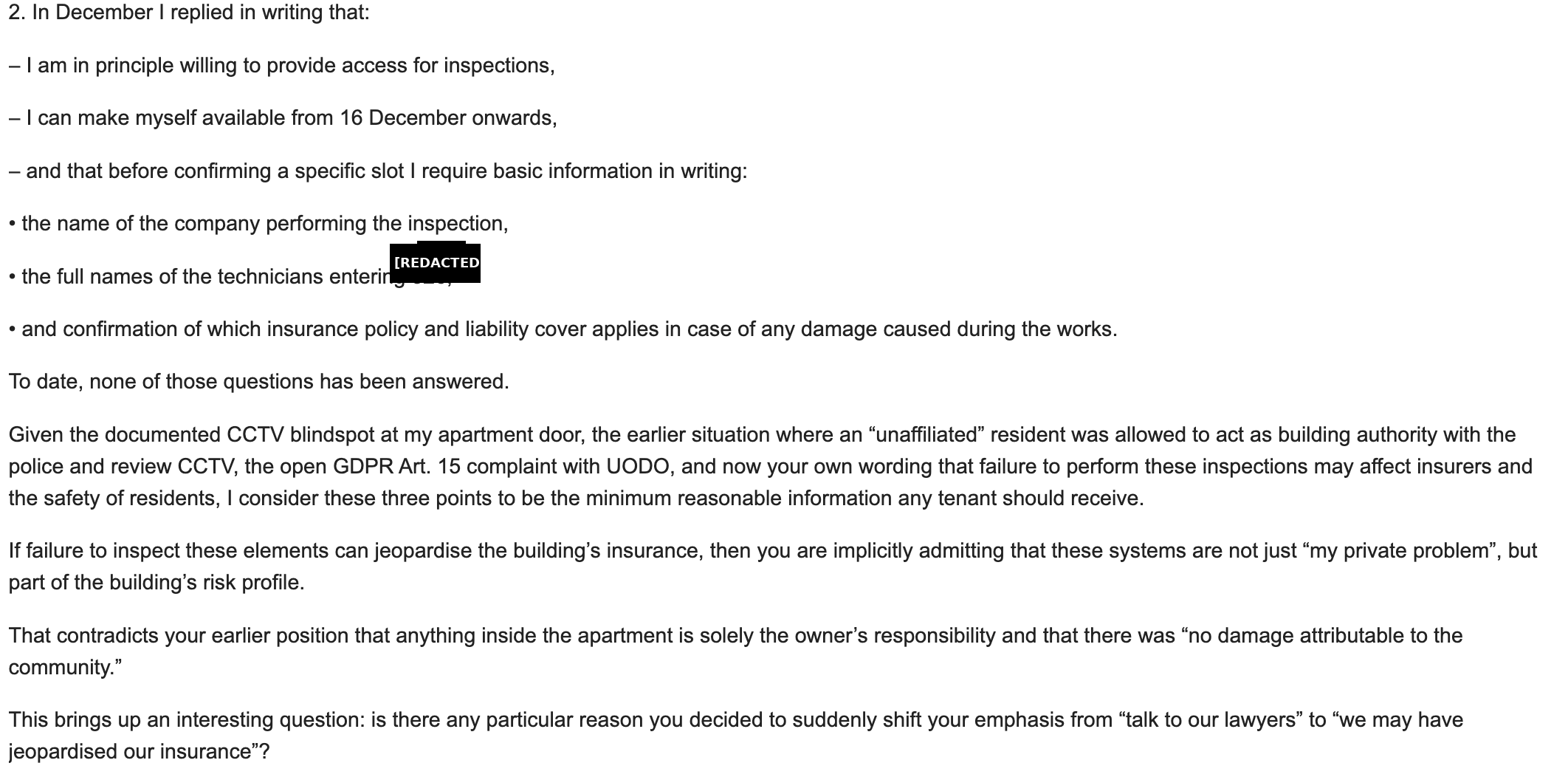
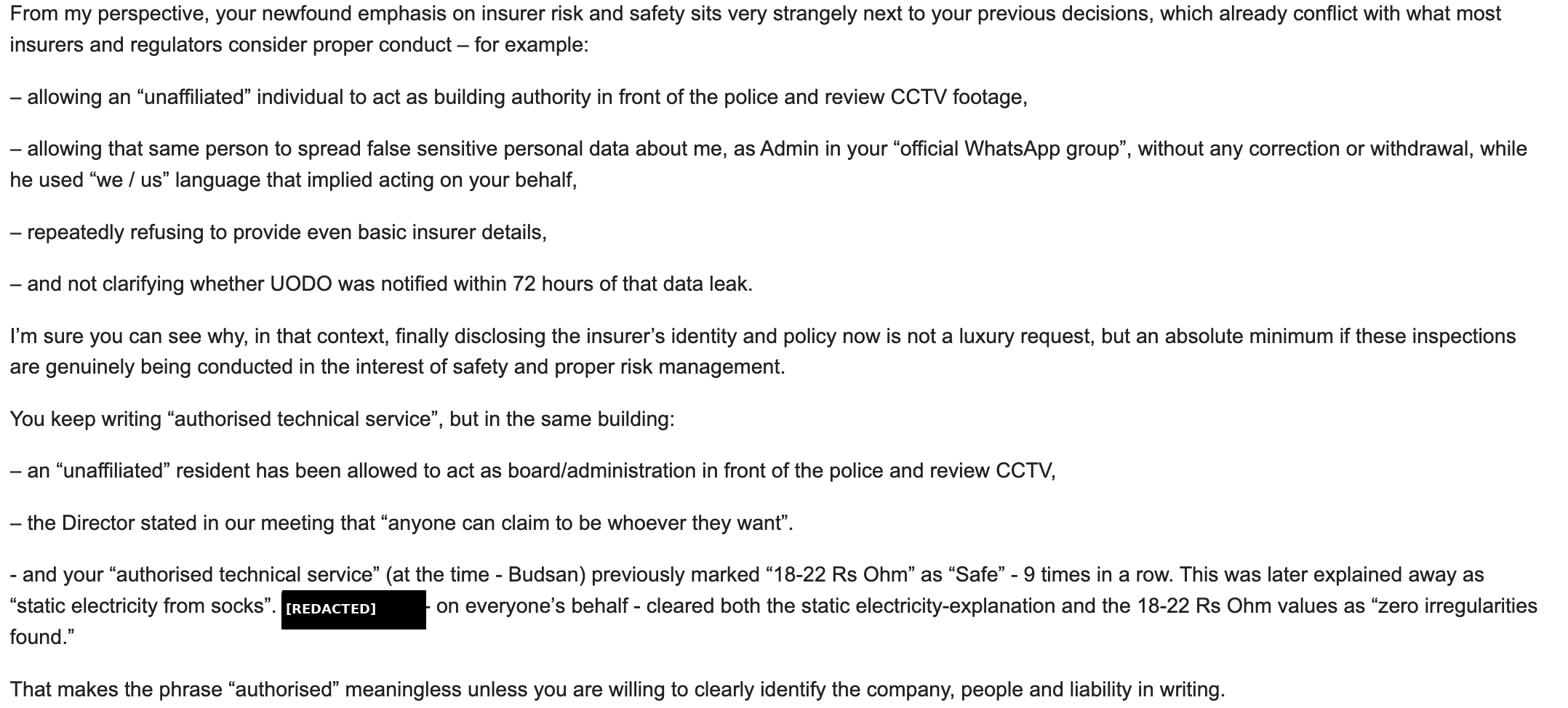
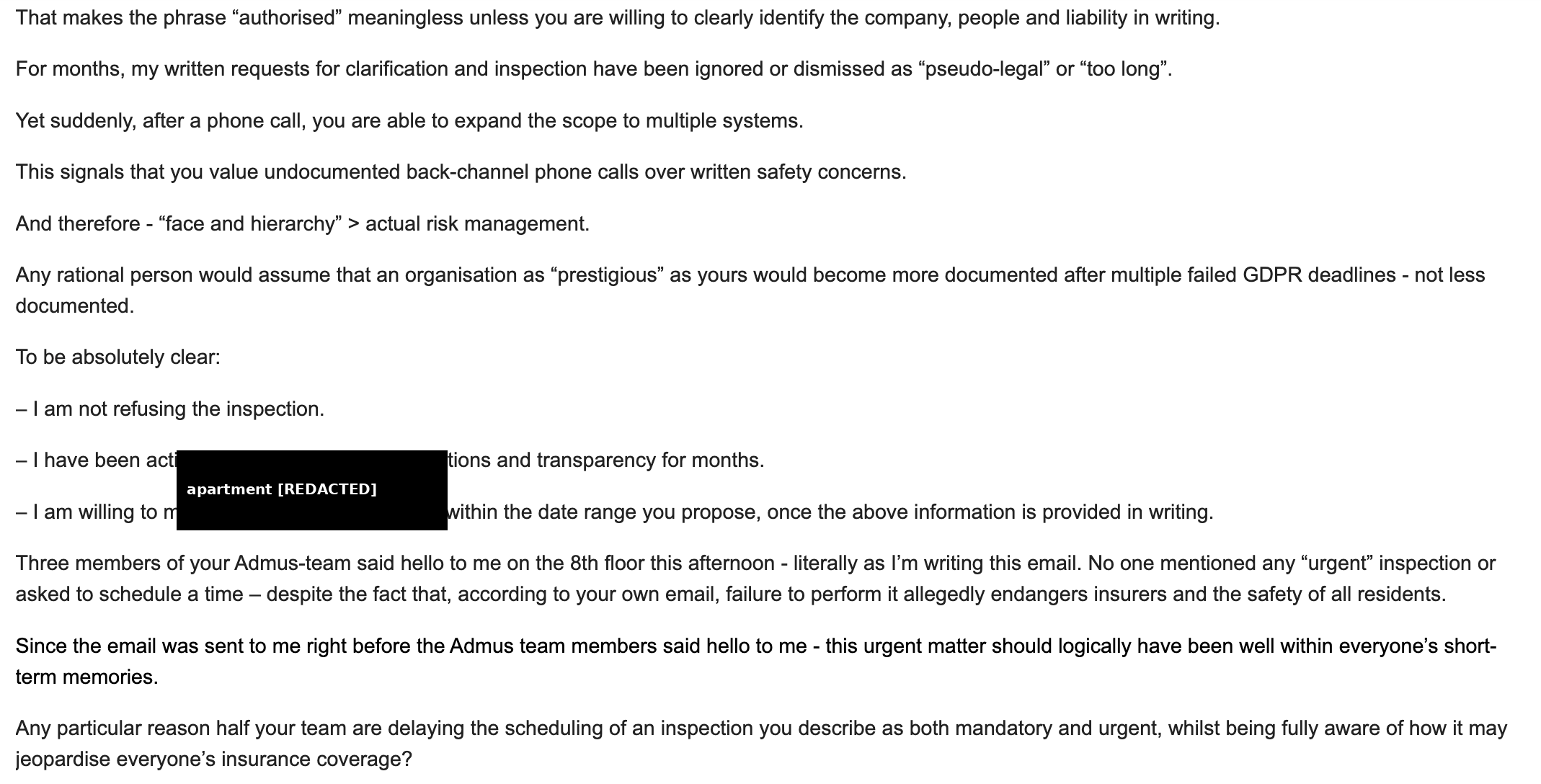
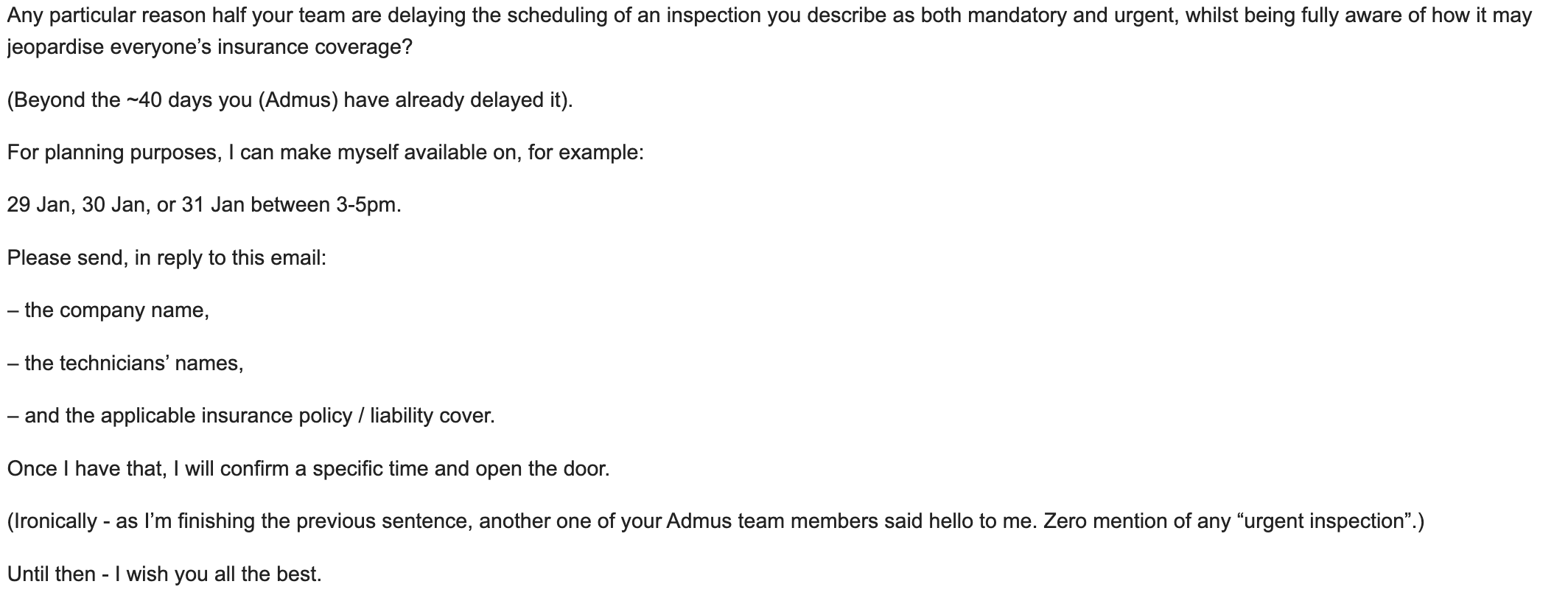
The resident corrected the record: he had already said he was willing to provide access, asked for basic written identifiers, and made himself available. The minimum requested information was not exotic: company name, technician names, and the applicable insurance / liability cover.
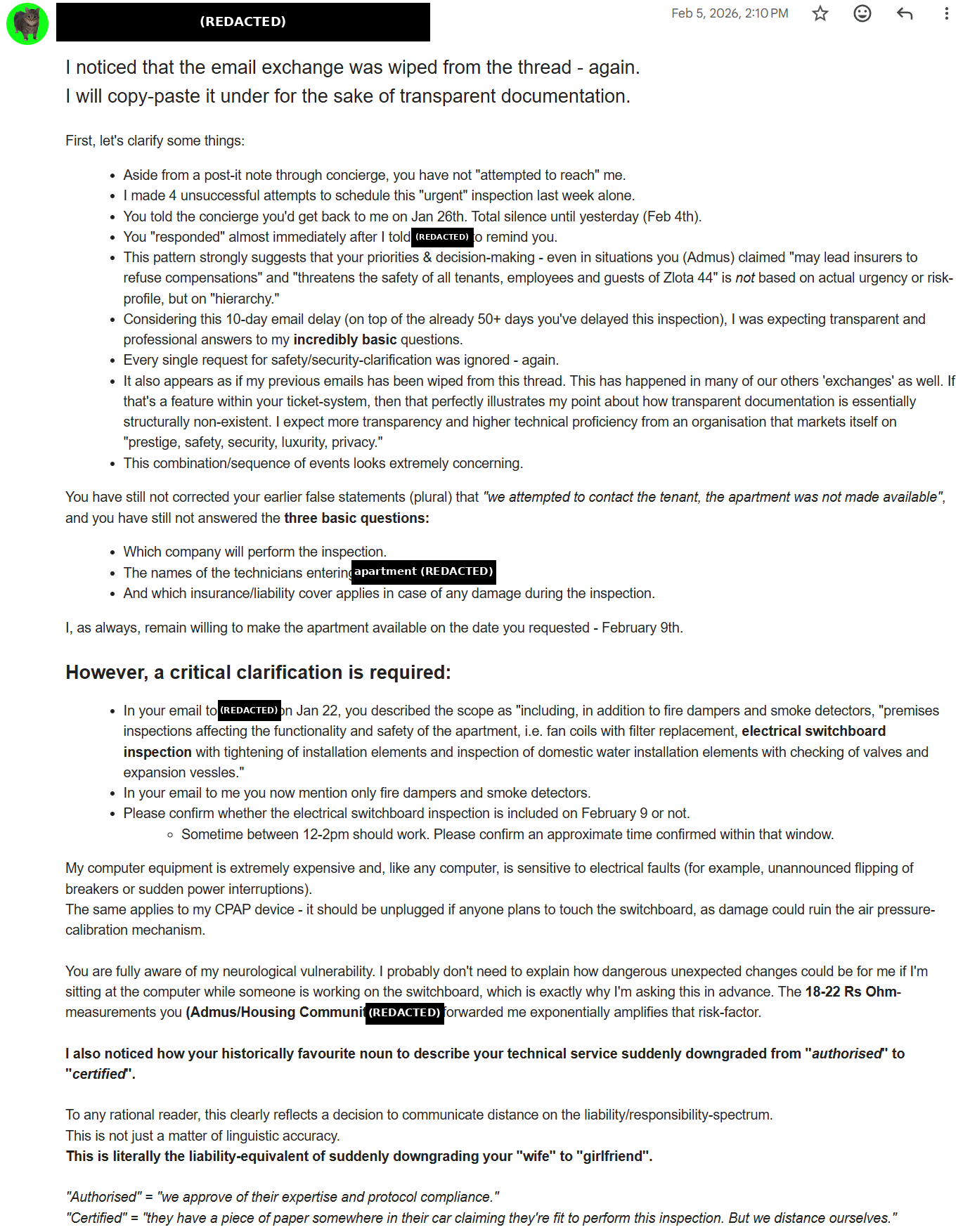
The email records four scheduling attempts, another ten days of silence on top of more than fifty days of delay, and an explicit written confirmation that the apartment would be available on 9 February.
The 9 February email thread where they miss their own deadline and then write “no confirmation from you.”
The administration proposed 9 February at 12:00. The resident confirmed availability repeatedly, asked for the missing company / technician / insurance identifiers, reminded them again, and stayed available. They miss their own deadline. At 13:25, they wrote: “as there was no confirmation from you… the inspection did not take place.”
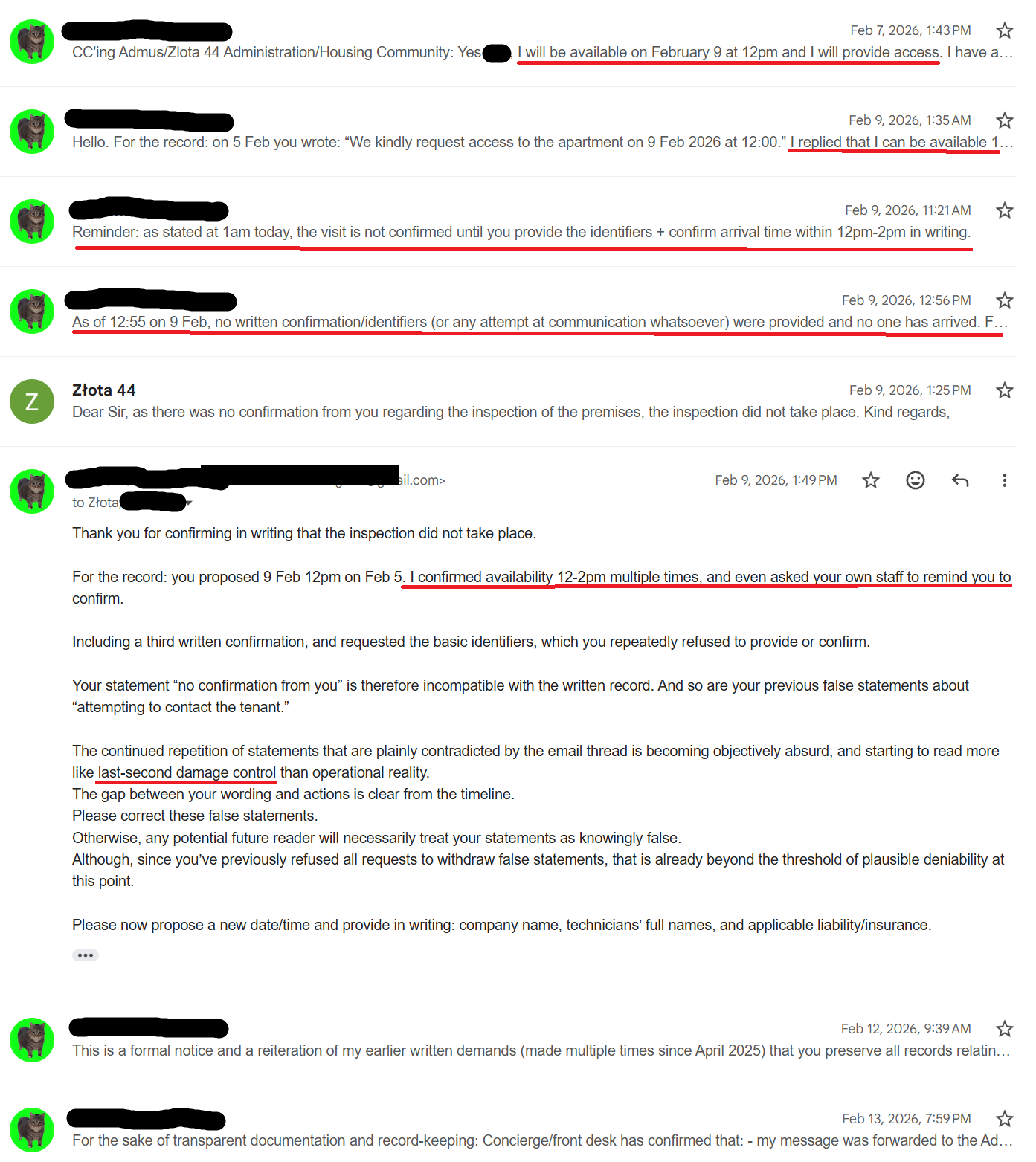
They made the resident reserve the day, stay available, request the company / technician / insurance details, and keep reminding them to confirm. They miss their own deadline, provide none of the required identifiers, and then write the failure onto the resident’s side of the ledger.
They miss their own deadline before attempting last-second narrative damage control.
Written record: “yes, I will provide access,” followed by requests for identity, scope and liability details.
Written record: 9 February availability and repeated prior scheduling attempts before they miss their own deadline.
The emails record delay, post-it routing, unanswered reminders and repeated scope changes.
The screenshot on the left shows one correction email. The cards on the right pull out the correction route from that email set and from the written question register shown immediately below, so each quote sits inside the correct record context.
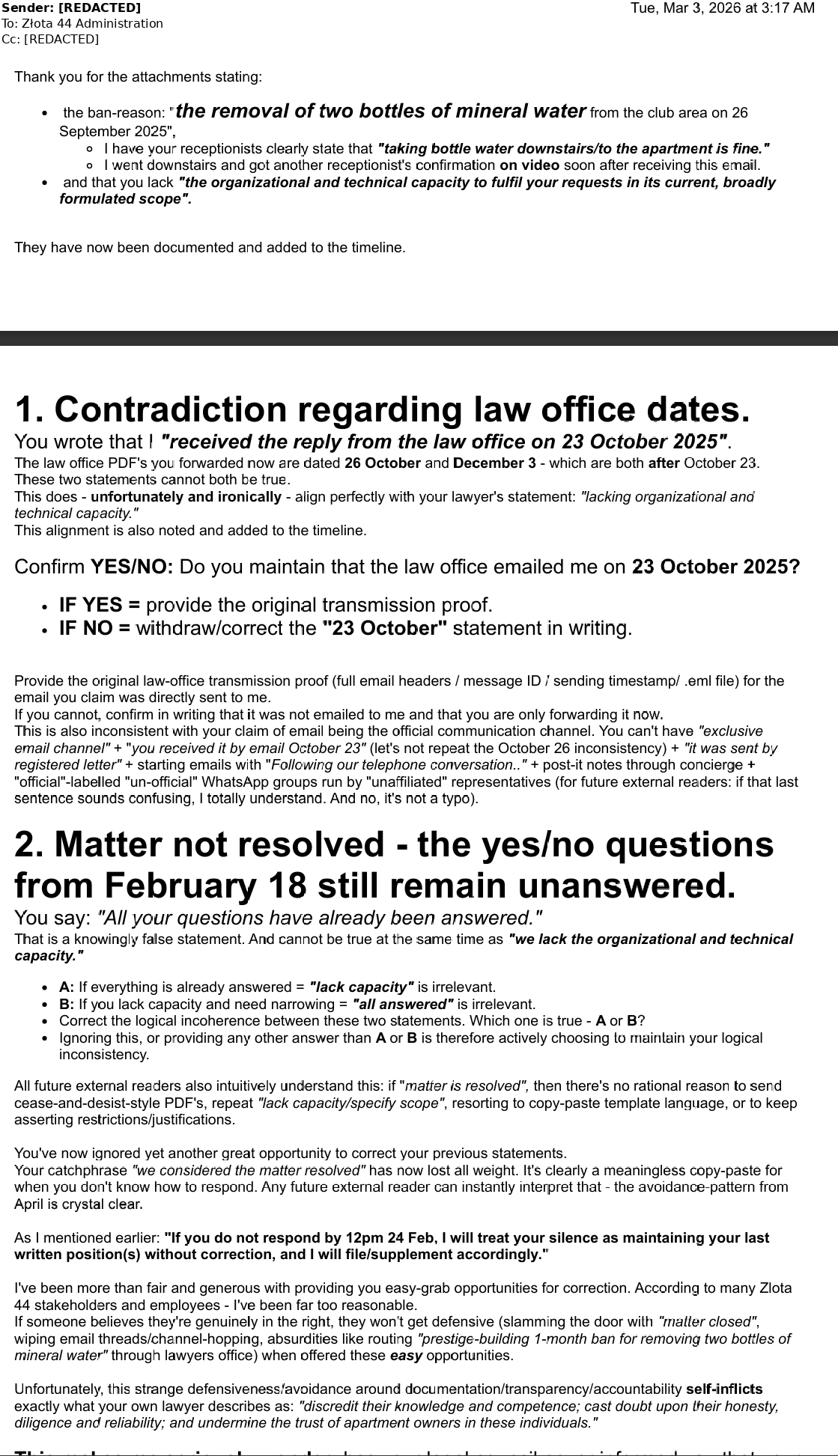
“If you refuse to identify the author and refuse to correct the statement, confirm that you are choosing to leave false health/substance allegations uncorrected on record — yes or no.”
Source note: the exact health/substance correction fork is visible in the written question-register screenshot in the next section. It is surfaced here because it is the central correction path they were given.
“Please answer each yes/no question directly. If you refuse to answer any specific question, state ‘REFUSE’ explicitly next to it.”
“If my previous inquiries remain unresolved, I will publish an in-depth, evidence-only full timeline — screenshots and dates — including a structured map of contradictions and logical inconsistencies.”
“If you do not respond by 12pm 24 Feb, I will treat your silence as maintaining your last written position(s) without correction.”
The email converts their own statements into numbered yes/no questions, proof requests and correction demands. It tells them to answer directly or write REFUSE. They supplied no point-by-point answer.
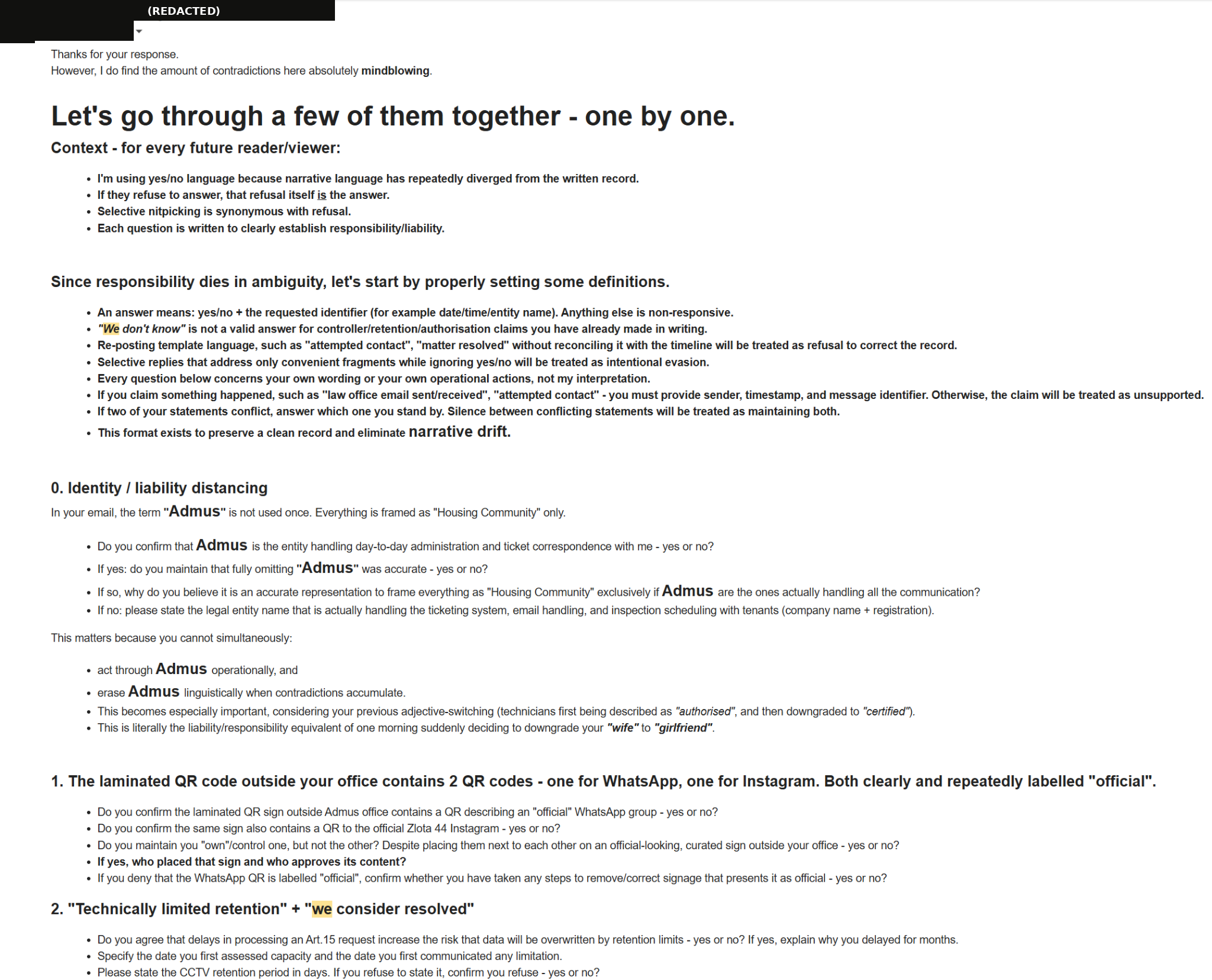

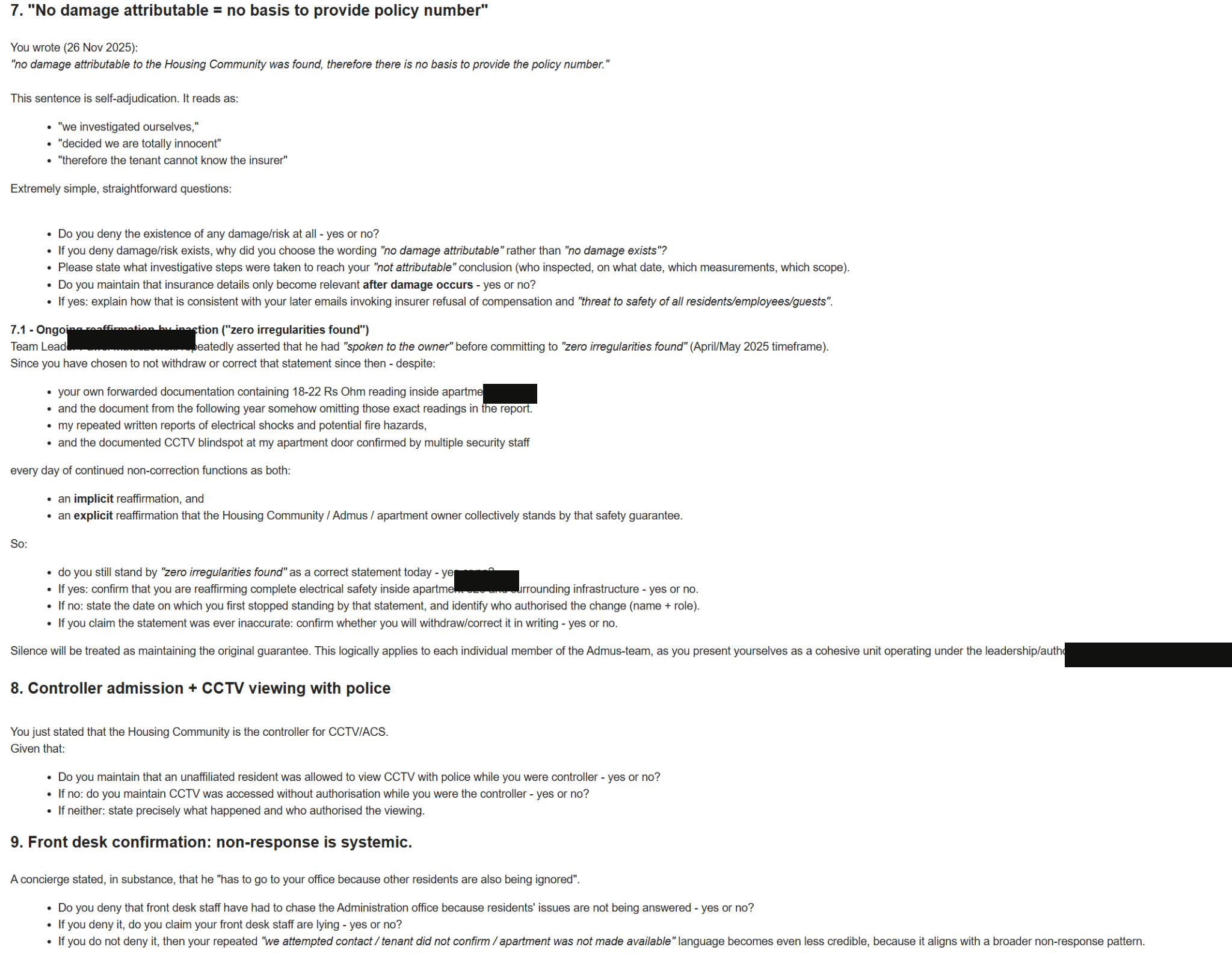
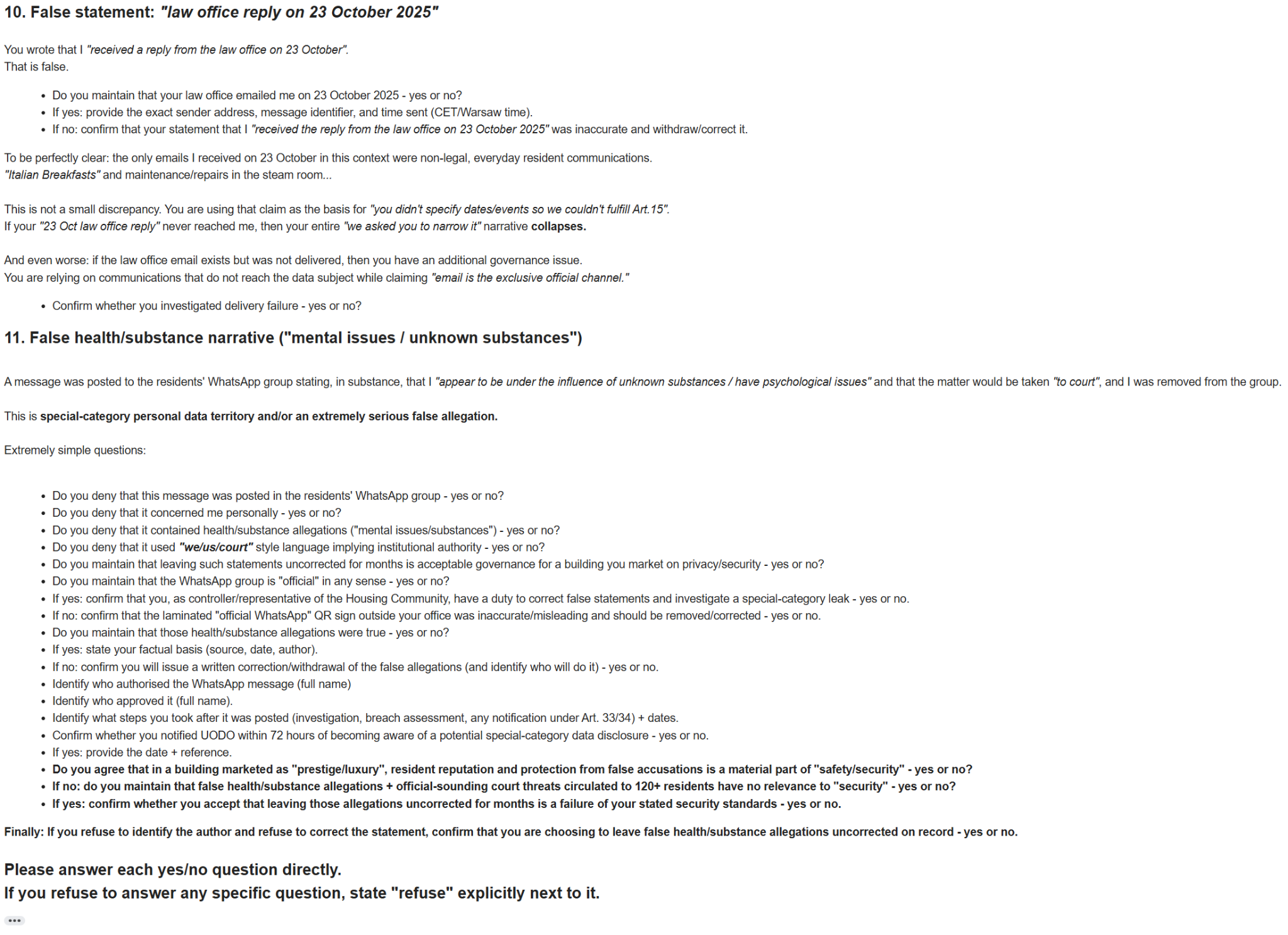
They keep making references to “their good name.”
A good name is not a phrase in a legal letter. A good name is what remains after competent safety verification, transparent data governance, traceable authority, accurate recordkeeping, timely inspection execution, correction of false statements, and basic asset-management competence.
The record shows something else.
They sent cease-and-desist to a disabled resident for documenting disability-discrimination evidence.
The “good name” they invoked is the name that enabled a character assassination against a neurologically vulnerable resident.
A disabled resident has given you 30+ respectful opportunities to correct the record. You have used none of them. Every day of silence leaves the disability-discrimination evidence standing.
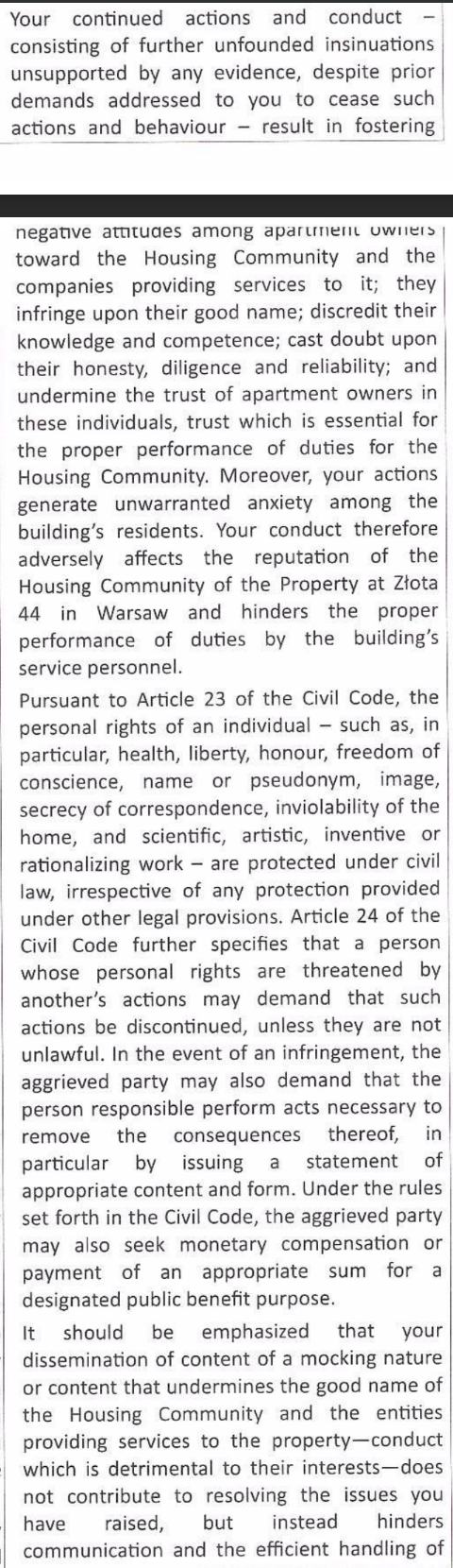
They described the resident’s public statements as being “of a mocking nature” and damaging to their good name.
The resident was reproducing their own statements word for word:
If repeating their exact words damages their good name, the damage was already inside the words. They authored the material. The resident preserved it. Calling the repetition “mocking” is admitting that their own statements are humiliating when placed beside dates, screenshots, and what happened next.
A disabled resident, in a “prestige, luxury” building, cannot be expected to take responsibility for the building Directors / Administration’s own emotional reactions. If they subjectively interpret their own security/GDPR-statements as “mocking”, perhaps it’s time for some introspection.
Their self-perception is contradicted by their own operational environment.
“I have to run to the administration office anyway because they’re ignoring other residents too.”

Other residents responded by describing their own problems. The reputational issue did not begin because one person repeated their statements. Their own front desk was already recording that other residents were being ignored.
The administration was repeatedly given direct opportunities (on over 30 separate occasions) to protect its reputation through the one method that actually works: correct the record.
A disabled resident has given you 30+ respectful opportunities to correct the record. You have used none of them. Every day of silence leaves the disability-discrimination evidence standing.
They could have explained the 18–22 Ω readings, identified the applicable standard, corrected inaccurate dates, produced transmission proof, answered whether the apartment door was visible on CCTV, disclosed the CCTV retention period, identified who authorized the “unaffiliated representative,” explained his access to internal information, corrected the health/substance character assassination, corrected the false “no confirmation” statement, identified the insurer, and completed the allegedly urgent inspection on time.
Instead, they wrote:
“Matter resolved.”
So their theory of reputation becomes: we will not correct the record, we will not answer the contradictions, we will not produce the receipts — but documenting our refusal damages our good name.
No.
A reputation unsupported by receipts is branding.
A person presented himself as “Management board member of Z44.” He used the Złota 44 name as authority. He circulated the health/substance character assassination to the resident group advertised as the official WhatsApp group. He used court-threat language. He banned the resident from the same official WhatsApp channel. His conduct created GDPR questions. He inserted himself into the police interaction.
The administration later called him private and unaffiliated.
What did the Quality Assurance Director do to protect the resident’s name?
A disabled resident paying approximately 300,000 PLN per year was subjected to a public character assassination by someone impersonating authority under the building’s “good name.” The Quality Assurance Director — whose title literally contains the word “quality” — did nothing.
The “good name” they invoked is the name that enabled a character assassination against a neurologically vulnerable resident.
But when the administration’s abstract institutional “good name” was challenged, the legal machinery activated.
And what conduct did they successfully formalize through a law office?
Actually... not technically free. The resident personally paid them a monthly administration fee of approximately 1000 USD.
That is the priority structure.
That is not quality assurance. That is selective reputation protection.
The “good name” argument becomes even worse beside the Polish-integrity record.
The “Unaffiliated Foreign Representative” operating under Złota 44 authority perception disrespected the integrity of the Polish people by attributing a Soviet / communist “replace the person who notices” mechanism directly to the Polish national character itself.
He was not describing a false stereotype created by occupation. He presented the mechanism as Polish people’s present-tense nature. The attacked resident immediately corrected the Unaffiliated Foreign Representative and defended Poland.
The Polish Administration enabled the Unaffiliated Foreign Representative who disrespected Polish integrity. It ignored the disabled, neurologically vulnerable resident who defended it.
Then the record moved exactly where the foreigner said it would: the problem was not fixed; the person noticing the problem was removed, restricted, smeared and isolated.
That is not protection of a good name. That is acting in alignment with the insult against Poland.
They sent legal letters over two bottles of mineral water in the “good name” of a post-Soviet freedom monument — while leaving the resident who defended Polish integrity character-assassinated.
Why not good safety verification?
Why not good GDPR compliance?
Why not good authority control?
Why not good recordkeeping?
Why not good governance literacy so they do not confuse “processor” and “controller”?
Why not good adjective-consistency and legal linguistic precision, so they do not confuse “authorised” and “certified”?
Why not good and transparent authority structure?
Why not good compliance with basic asset-management principles — such as not delaying an allegedly urgent, insurance-compromising inspection for approximately 83 days, until the disabled resident moved out?
If “good name” carries such high priority, why stop signing the emails with “Director”?
They invoked urgency, insurance, and the safety of residents, employees, and guests.
Then they delayed the inspection. Then they missed their own deadline. Then they wrote “no confirmation from you, so there was no inspection” directly above the resident’s repeated written confirmations.
They used the prestige of the building and the language of authority to demand compliance. When it was time to execute the process they controlled, they missed their own deadline and tried to write their failure onto the resident.
That is poorly performed authority theatre. It is not a good name supported by quality delivery.
The legal letter says the resident caused “unwarranted anxiety among the building’s residents.”
Let that sit for a second.
Złota 44 markets itself as Warsaw’s most prestigious address. High-net-worth individuals. CEOs. People who presumably handle boardroom pressure, market volatility, and actual high-stakes decisions.
And the Administration’s legal position is that these same people are so psychologically fragile that the Administration facing difficult questions caused those residents crippling anxiety.
There is no version of reality where that actually makes sense.
The record is clear on who was actually anxious: the Administration. The “unaffiliated representative” complained that owners and administration were blaming him. Pressure was cascading through their own office. The Director stopped signing as Director. ADMUS quietly deleted itself from legal documents.
That’s where the anxiety lived. Not in the residents’ apartments. In the Administration’s inbox. In their WhatsApp panic and pocket-dialling to the disabled resident (“Freudian finger-slip”). In their legal-office scramble over two bottles of mineral water.
They felt pressure. They wrote it in the residents’ name.
Unless “the residents” is a new legal term meaning “the Administration’s emotional state,” this is psychological projection dressed up as a legal argument.
Take something that belongs to you, and put it on someone else.
Once seen, it can’t be unseen. The fog is lifting. The cat spins.
They engaged a law office. They drafted a formal letter. They formalized a 30-day common-area restriction.
This is not a side issue. This is the calibration sample for their judgment.
Why should anyone trust the subjective interpretation of someone who actively chose to send cease-and-desist-style letters over bottles of mineral water?
If this is how they assess proportionality, priority, resident conduct, and reputational risk — if two bottles of free water trigger legal machinery while a health/substance character assassination under the building’s name triggers nothing — why should any resident, owner, buyer, investor, or agent trust their interpretation of what “looks bad,” what “damages their good name,” or what supposedly causes “anxiety”?
Is that decision-making fit to represent one of Warsaw’s highest-profile residential assets?
It records what they considered worthy of legal machinery — and what they did not.
The factual question is: did they deliver competent safety verification, data governance, authority control, inspection execution, and correction procedures?
Their preferred question is: did the resident damage our good name by publicly describing what we did?
That shift is the whole trick. It moves scrutiny away from their performance and onto the person documenting their performance.
They skipped the inputs and tried to litigate the output.
It is what remains after the receipts are shown.
The administration invoked “good name” while refusing the verification, correction, transparency, and execution that would have supported one.
When their own statements were repeated word for word, they called the repetition mocking.
When their own concierge documented that other residents were also being ignored, the problem was already operational.
When a person presenting himself as “Management board member of Z44” circulated a health/substance character assassination under the Złota 44 name, the Quality Assurance Director did not correct it. In fact, his official statement in person was “Anyone can claim to be who they want to be.”
When two free bottles of mineral water were removed, a law office found capacity.
When an allegedly urgent, insurance-compromising inspection required competent execution, they left it unresolved for approximately 83 days, missed their own deadline, blamed the disabled resident, and apparently handled it only after he moved out — if it was ever completed at all.
Good name without receipts is misleading branding. Good reputation with receipts is asset management.
They protected the label and abandoned the standard.
A good reputation earned through documented safety, compliance, transparent authority, and competent asset management.
“Good name” invoked against screenshots containing their own statements.
A Quality Assurance Director corrects a health/substance character assassination circulated under the building’s name against a resident paying approximately 300,000 PLN per year.
No correction, no withdrawal, and no identified sanction. Legal-office formalization appeared over two free bottles of mineral water.
An “urgent,” insurance-compromising inspection is executed immediately and documented precisely.
Approximately 83 days unresolved. Post-it notes through concierge. They miss their own deadline. Then they write “no confirmation from you.” Any later inspection happened only after the disabled resident moved out — if it happened at all.
Take something that belongs to you, and put it on someone else.
Unaffiliated foreign representative’s Soviet-occupation operational logic? Project onto Polish national character.
Their own office-anxiety? Project onto the residents, cease & desist style.
Their own inspection deadline failure? Onto the disabled resident.
The liability? Put it on the Housing Community. ADMUS conveniently fragmented out.
The authority problem? “Anyone can claim to be whoever they want to be.”
Once seen, it can’t be unseen. The fog is lifting. The cat spins.
Dates, quotations, screenshots and formal positions are placed beside each other. The contradiction is written underneath.
The legal letter cites personal-rights categories: good name, reputation, honesty, diligence, reliability, trust, health, honour, privacy, image and secrecy of correspondence.
The resident-channel message character-assassinated the resident as under unknown substances or suffering psychological issues, attacking sanity, sobriety, credibility and reputation.
The legal letter describes the categories their own communication ecosystem had already violated against the resident. It is psychological projection.
Identify who authorized the health/substance message, withdraw it in the same channel, and explain why the legal letter invoked personal-rights language while leaving that character assassination uncorrected.
The legal letter states that the resident generated unwarranted anxiety among the building’s residents.
The record shows pressure inside the administration / representative ecosystem, including the “unaffiliated representative” complaining that owners and administration were blaming him.
Unless the legal letter uses “the residents” as a label for the “unaffiliated representative,” it projects administration pressure into the residents’ name.
Identify the residents described as anxious, state how that was verified, and explain why the paragraph immediately pivots from resident anxiety to the reputation of the Housing Community.
The administration stated that all questions had already been answered.
The legal correspondence used “the organizational and technical capacity” language as the stated reason not to fulfil the request in its current scope.
If all questions were answered, lack of capacity is irrelevant. If the capacity language was used to avoid fulfilment, all questions were not answered. Both cannot be true.
Choose which position is maintained: all answered, or capacity language was used to avoid fulfilment.
They did not answer.
The administration repeatedly declared the matter resolved.
Direct factual yes/no questions remained unanswered.
Calling a matter “resolved” does not answer the questions. They declared it resolved while refusing the decisive facts.
Identify the exact matter resolved, the date, the action and the responsible person.
They did not answer.
The matter was declared resolved.
The administration continued asserting restrictions, relying on cease-and-desist language, invoking “lack capacity,” and defending earlier positions.
If the matter was resolved, continued justifications and legal-position documents were unnecessary. If they remained necessary, the matter was not resolved.
Explain why continued legal positioning was required after resolution.
They did not answer.
Email was described as the official communication channel.
The record also relied on registered letters, telephone conversations, post-it notes through concierge, WhatsApp, off-thread email and reception/concierge routing.
If email is exclusive, the other channels cannot carry operative meaning. If the other channels carry operative meaning, email is not exclusive.
State the actual official channel and identify which prior communications count.
They did not provide a channel map.
The administration stated that the resident received the law-office reply on 23 October 2025.
The PDFs later forwarded as the relevant law-office correspondence were dated 26 October 2025 and 3 December 2025.
A specific document cannot be received before it exists. If a different 23 October transmission existed, the original .eml and headers should exist.
Produce sender, timestamp, Message-ID, full headers and .eml — or correct the 23 October statement.
No original transmission proof was provided.
On 24 October 2025, the administration wrote that the matter had been referred to a law office, which was “continuing to process the matter” on behalf of the Housing Community.
The administration later maintained that the resident had received the law-office reply on 23 October 2025.
If the law-office reply had already been sent on 23 October, the administration must explain why the matter was still described on 24 October as being processed by the law office. If the 23 October item was a different email, produce it. If it was the same reply, the timeline breaks.
Identify the exact law-office document claimed as sent on 23 October and produce sender address, timestamp, Message-ID, full headers and .eml. If no such transmission exists, correct the 23 October statement.
They produced neither the original transmission proof nor an explanation.
The resident was claimed as sent the law-office reply on 23 October 2025.
On 24 October 2025, the administration wrote that the law office was still continuing to process the matter.
The law-office PDFs later forwarded as the relevant correspondence were dated 26 October 2025 and 3 December 2025.
All three positions cannot describe the same reply. A reply cannot be received on 23 October, remain “continuing to process” on 24 October, and then exist as a PDF dated 26 October. Reconciliation requires the original 23 October transmission, headers, Message-ID and .eml file.
Provide the missing 23 October transmission or withdraw the claim. Do not replace the missing transmission with “matter resolved.”
They did not answer.
The October 26 legal position names the company providing administrative services for part of the common property: ADMUS sp. z o.o., based in Warsaw.
The Administration presents the relevant law-office fragment while framing the processing structure as Housing Community only. The ADMUS sentence is gone.
If the February 16 email was reproducing the legal position, the text should match. If it was edited, the Administration needs to identify who authorized the edit and whether the law office approved it. The strange part is obvious: the professional management company disappears, while the Housing Community is left as the visible responsible body.
If ADMUS genuinely believed its name was “good,” ADMUS and Director [REDACTED] should appear more often as the contradictions and stakes increased — not less. A good name should be a social-proof advantage. Here, the name behaves like something to reduce exposure to.
Produce the original 23 October transmission, full headers, Message-ID and .eml, identify the exact legal text relied on, explain why the ADMUS fragment was removed, explain why “Housing Community” was not conveniently removed instead, and explain why ADMUS disappeared precisely when a credible professional-management name should have helped.
They did not answer.
The administration used closure language indicating no further correspondence.
The administration continued contacting the resident whenever it wished to transmit its own position.
A channel cannot be closed only in the direction that creates accountability. If correspondence continues, it is not closed.
State whether the channel is closed or active and apply that answer consistently.
They left the contradiction unresolved.
On March 19, 2026, the Administration wrote that the former resident’s contact details had been removed from the contact database.
The Administration used those contact details to send the statement announcing their removal. The resident replied eleven minutes later: “So how did you contact me now?”
On April 16, 2026, nearly one month later, the Administration responded that the Housing Community found no grounds for conducting further correspondence.
If the contact data was removed, how was the message delivered? If it remained available, what exactly was removed?
Identify the data removed, the data retained, the system used and the lawful basis for continued contact.
They declared closure instead of answering the paradox.
The inspection was described as urgent and linked to safety and insurance.
The administration allowed 83 days to pass. Then they miss their own deadline.
Urgency has a time signature. If genuinely urgent, the delay is indefensible. If it could wait 83 days, the urgency language was exaggerated.
Explain whether the urgency was accurate. If yes, explain the delay. If no, withdraw the urgency framing.
They did not answer.
They described the inspection as affecting the safety of residents, employees and guests.
They miss their own deadline and do not act with urgency consistent with that statement.
Either the risk language was accurate and the administration mishandled a serious risk, or the language was used as pressure. Neither branch is benign.
Explain how they miss their own deadline while using maximum-risk language.
They did not answer.
After missing their own deadline, the administration blamed the failed inspection on alleged lack of disabled-resident confirmation or contact.
The record contains repeated direct scheduling attempts plus additional attempts through reception and concierge.
A party actively trying to schedule cannot honestly be reduced to “did not confirm” without addressing the documented attempts.
Account for each attempt and explain why it was ignored or not treated as cooperation.
They did not answer.
They miss their own deadline. Złota 44 then wrote that the inspection did not take place because there was “no confirmation” from the resident.
The 9 February thread shows multiple written confirmations, a day-of reminder, a 12:55 record that no identifiers or arrival confirmation had been provided, and a 1:49 response documenting that availability had been confirmed multiple times. They miss their own deadline inside that same thread.
A party cannot ignore confirmations, fail to provide the requested company / technician / insurance details, miss their own deadline, and then reduce the failed inspection to “no confirmation from you.”
Identify exactly what confirmation was supposedly missing, why the resident’s written confirmations were not accepted, and why the administration did not provide the required inspection details before they miss their own deadline.
No clean reconciliation was provided.
Insurance and liability risk were invoked to justify urgency and access.
The administration refused or failed to provide the requested insurer and policy information.
Insurance cannot be important enough to pressure the resident and simultaneously too irrelevant to identify when accountability is requested.
Provide insurer, policy, scope, responsible insured party and applicable liability cover.
They did not disclose it.
“No damage was found that was caused by the Housing Community, therefore there is no basis to provide the policy number.”
The request asked for the insurer name, policy number, general scope of coverage and claims-contact details.
A verdict about the Housing Community’s own responsibility does not identify the insurer. The response substituted self-adjudication for the requested policy information.
Provide the insurer name, policy number, coverage scope, claims contact and the factual basis for the “no damage caused by the Housing Community” conclusion.
None of the four requested policy details were supplied.
The administration answered with language such as “no damage attributable to the Community.”
The resident was asking whether the apartment door was visible, whether a blind spot existed and what evidence was available — not requesting a final liability judgment.
A liability conclusion cannot substitute for the underlying factual answer. Door visibility must be established before attribution can be adjudicated.
Answer whether the door was fully visible, what footage existed and what was reviewed.
No clean factual answer provided.
The administration implied there was no relevant CCTV irregularity.
It did not simply state: “There is no CCTV blind spot at apartment (REDACTED).”
If no blind spot exists, its non-existence is the easiest documented fact to state. Refusing the sentence preserves ambiguity exactly where certainty was requested.
Confirm or deny the blind spot directly.
They did not answer.
The administration did not accept that the apartment door sat in a blind area.
Security could not tell whether a note attached to the door was black or white because the door itself was not visible.
If the door is visible, the note should be observable. If it is not observable because the door is not visible, a visibility gap exists.
State exactly what the camera sees and does not see at apartment (REDACTED).
They did not answer.
Building CCTV coverage was treated as sufficient or unproblematic.
Security recommended buying a private spy camera from Amazon and showed product recommendations because the apartment door could not be seen.
Adequate building CCTV and “buy your own spy camera” are not coherent responses to the same security concern.
Explain why private surveillance was recommended if the building system covered the door adequately.
They did not answer.
The individual acting through the “Zarząd Złota 44” context was described as unaffiliated.
He described the resident’s emails as “fucking ChatGPT bulshits” — a stylistic evaluation of the text.
That is the equivalent of describing Mona Lisa’s facial expression without seeing the painting. Either he saw the emails, received detailed summaries, or the unaffiliated description is false.
State whether he read, received, was forwarded, or was briefed on the emails — and by whom.
They did not answer.
The individual was described as unaffiliated.
He commented on behavior outside the apartment door and on the resident photographing a security camera.
The information required a source: direct observation, CCTV, staff reports, or another internal channel. “Unaffiliated” does not explain privileged situational knowledge.
Identify the source and whether CCTV or security summaries were shared.
They did not answer.
The individual was described as unaffiliated and outside administrative responsibility.
The same individual operated across resident communication, authority presentation, security narratives and access-related interventions.
If genuinely unaffiliated, he should not exercise authority-like influence. If his influence was permitted or tolerated, the administration must identify the governance basis.
Define his role, permissions, authority source and relationship to administration.
They did not answer.
The group was presented through administration-facing signage and used for building-relevant resident communication.
Responsibility for the group was later distanced by describing it as unofficial or outside administration control.
A channel cannot be official when useful and unofficial when accountable.
State who authorized the group, QR signage and administrative use, and whether it was official.
They did not answer.
The administration distanced itself from the drugs / mental-health character assassination while leaving it uncorrected.
They issued no correction or withdrawal in the channel where the character assassination was circulated.
If the statement was false and not endorsed, correction was the obvious response. Distancing without correction preserves the benefit of the character assassination while denying ownership.
Correct and withdraw the statement in the same channel and identify the author.
They issued no correction.
Legal correspondence invoked anxiety among residents.
The administration would not provide the simplest factual reassurance: whether the apartment door was fully visible in footage.
If anxiety were genuinely the concern, clarity would reduce it. Vague liability wording protects position, not residents.
State the factual CCTV visibility position directly.
They did not answer.
The correspondence invoked resident anxiety as the human concern.
The same passage quickly concluded that the real adverse effect was damage to the Housing Community’s reputation.
If resident wellbeing were primary, it would remain the focal point. The rapid pivot exposes the actual protected object: reputation.
Clarify whether the claimed harm was resident wellbeing or reputation.
They did not clarify it.
The legal correspondence attacks the resident with “false information” and personal-rights language.
It did not clearly enumerate each exact statement, publication, date, falsity, correct version and demanded correction.
A demand without the disputed statements is not a correction protocol. It is a broad pressure label.
List every identified as false statement with the evidence and required correction.
No clean list provided.
The administration initially used stronger adjectives carrying greater qualification, authorization or responsibility implications.
The wording softened only after the resident explained the legal and operational meaning of those adjectives.
If the original wording was accurate, it should survive scrutiny. A post-scrutiny downgrade shows the original term carried responsibility the administration no longer wanted to own.
Define each technician’s exact company, role, qualification, authorization, scope and liability status.
They provided no specificity.
The resident requested names, companies, legal basis, scope, insurer and liability allocation before entry.
The administration did not provide the requested specificity.
A legitimate and safe inspection process becomes stronger with specificity. Refusing specificity preserves deniability, not safety.
Provide the full responsibility chain for each proposed entrant.
They did not answer.
They described the inspection as independently urgent for safety and insurance reasons.
They announced the “urgent” inspection within approximately 24 hours of the Article 15 failure being escalated to UODO.
The timing is part of the record. If the urgency was independent of the UODO escalation, pre-existing evidence of the same urgency should be easy to produce.
Explain the timing and provide records showing the urgency existed before the UODO escalation.
They did not answer.
The formal restriction reason was removing two bottles of mineral water from the club area.
Reception staff stated that taking bottled water downstairs or to the apartment was fine, including a confirmation recorded on video.
If staff were right, the restriction basis collapses. If staff were wrong, the building gave residents incorrect operational guidance. If enforcement was selective, say so.
State whether taking bottled water out is permitted and identify where the rule was communicated.
They did not answer.
The administration formalized a 30-day restriction through legal correspondence over two bottles of mineral water.
They withheld that precision on safety, CCTV, GDPR, insurance, authority and the character assassination.
A system capable of legal precision over free water cannot credibly present serious questions as too broad, too difficult or beyond capacity.
Explain why mineral water received clearer formal treatment than the serious issues.
They did not answer.
Director [REDACTED] originally reassured the resident that “zero irregularities” were found and gave broad safety assurance.
After the resident challenged evasive CCTV/blind-spot wording, later correspondence stopped carrying the director’s name without correcting his reassurance.
Maintaining the reassurance while removing the person visibly attached to it preserves the benefit of the guarantee while reducing the liability footprint of the signature.
Confirm whether the director’s reassurance remains maintained. If yes, explain the signature retreat. If no, withdraw or correct it.
They issued no correction.
The administration distances itself from the resident-facing actor by describing him as private or unaffiliated.
Admus presents itself as a coherent, professionally organized administrative unit and repeatedly maintained its positions collectively.
A coherent office owns maintained positions unless it expressly corrects them. It cannot invoke collective authority for reassurance and individual isolation for liability.
Map which statements are office positions, which are withdrawn, and who owns each one.
No clean ownership map provided.
The administration maintained “zero irregularities found.”
The record contains 18–22 Ω readings that were repeatedly questioned and never cleanly reconciled with the absolute reassurance.
“Zero irregularities” requires a standard-based explanation of why the identified values are not irregular. Without that, the conclusion is unsupported.
State the applicable standard or correct the zero-irregularities position.
No clean technical explanation provided.
Broad or absolute safety reassurance was maintained.
They withheld the key factual bases: CCTV visibility, technical readings, inspection responsibility, insurance and records.
Absolute reassurance without the underlying evidence is branding, not verification.
Produce the factual and technical basis supporting the reassurance.
They provided no basis.
The false drugs / mental-health character assassination was left in the resident record.
The administration was explicitly asked to identify the author, correct the statement, withdraw it, or write REFUSE.
When a false statement is given an easy correction path and remains uncorrected, non-correction becomes a documented choice.
Identify, correct, withdraw or explicitly refuse.
They issued no correction.
Resident conduct was characterized as concerning or irregular.
The administration did not produce a clean factual map of the conduct, source, footage, logs, witness or rule supporting the characterization.
A concern claim without disclosed facts is narrative. The label cannot substitute for evidence.
Identify the factual basis for each concern claim.
They provided no factual basis.
The individual was described as unaffiliated.
His statements showed access to information normally available through CCTV, email, staff reports or internal data flow.
An unaffiliated person should not possess privileged resident information. If he did, the data path must be identified. If he did not, the statements require another explanation.
Identify every source through which he received resident information.
They did not answer.
Residents were directed to the group through signage outside the administration office.
The administration later distanced itself from responsibility for the group.
Administration-facing signage creates reasonable resident reliance. A channel cannot be promoted at the office and disowned only after it becomes inconvenient.
Identify who approved the sign and who accepted responsibility for the channel.
They did not answer.
The administration left the specific correction questions unanswered.
It was explicitly warned that silence would be recorded as maintaining its last written position without correction and was given direct correction/refusal options.
After precise notice, silence is the documented choice not to correct the specific contradictions presented.
Answer, correct, deny, withdraw, or mark REFUSE.
They issued no correction.
The administration and legal correspondence state that false information was being circulated.
It did not use the offered protocol: exact sentence, proof, corrected version and responsible person.
If a statement is false, a documentary correction is straightforward. Refusing to identify it keeps “false information” as an unfalsifiable label.
Use the correction protocol for every identified as false statement.
The correction protocol was not used.
Złota 44 is presented as professionally administered at a premium standard.
The administration repeatedly avoided binary questions about authority, CCTV, official channels, insurance, legal transmission and correction of false statements.
When yes/no questions cannot be answered, the issue is not complexity. It is the consequence created by the answer.
Answer each binary question directly or state REFUSE beside it.
No clean binary response provided.
Złota 44 presents itself through prestige, security and high standards.
Its formal legal record includes a 30-day restriction over two bottles of mineral water while serious governance questions remained unanswered.
Prestige raises the expected standard. It does not make disproportionate paperwork over free water look more serious; it makes the proportionality failure more absurd.
Explain the proportionality and the institutional priority reflected by it.
They did not answer.
When distancing itself from an inconvenient authority actor, the director-level response was: “Anyone can claim to be who they want to be.”
When seeking apartment access, the administration relied on the phrase “authorized technicians.”
“Authorized” has operational weight only if identity and authorization are verified. If anyone can claim any identity, “authorized technician” becomes a costume label unless the administration supplies the verifier, document, scope and liability chain. This is authority when useful and ambiguity when accountable.
Define who authorizes, how authorization is verified, what document proves it, what liability applies and how a resident independently confirms it.
No operational definition was provided.
The administration initially used stronger terms implying higher qualification, authorization, responsibility or institutional commitment.
After the resident explained the legal and liability consequences, the wording was downgraded to softer, less operationally loaded adjectives.
This is the legal-liability equivalent of downgrading your “wife” to “girlfriend.” Both describe a relationship. They do not carry the same obligations. If the stronger term was true, it should survive scrutiny. If it was not true, why was it used before the consequences were explained?
Provide the exact legal and operational status of every proposed entrant: name, company, role, qualification, authorization source, scope, insurer and responsibility chain.
They did not clarify it.
The Housing Community used “lack of organizational and technical capacity” language when asked for serious safety, CCTV, GDPR, insurance and authority transparency.
The same organization allocated capacity to route a one-month common-area restriction through a legal office over two bottles of mineral water.
This is not a capacity shortage. It is priority exposure. Capacity existed; it was spent on mineral-water enforcement rather than answering the adult questions.
Explain why legal-office capacity was available for free-water enforcement while transparency and data-access capacity was claimed unavailable.
They did not answer.
The administration used capacity limitations to resist broad transparency and documentary requests.
It displayed exact dates, rule citations, ban duration, formal legal routing and two-bottle precision when restricting the resident.
They had capacity. They used it where it controlled the resident and withheld it where it exposed their own conduct.
Publish the criteria used to allocate administrative and legal capacity.
They did not answer.
The 2023 documentation contained 18–22 Ω readings.
The later report did not clearly carry forward or resolve the same measurement.
If the condition remained, omission hides continuity. If the condition was corrected, the corrective record should exist. If the test was no longer relevant, the technical reason should be stated.
Explain why the measurement disappeared and produce any corrective or retest documentation.
No clean continuity explanation provided.
The administration relied on language such as no unusual activity being indicated.
Security stated that the apartment door itself was not visible from the relevant live feed.
A system cannot conclude “no unusual activity” in the exact area it cannot observe. The only supported conclusion is that no unusual activity was visible in the areas the camera covered.
Define the camera field of view and narrow the conclusion to what the footage could actually establish.
No clean limitation statement provided.
An administration communication described the restriction through inappropriate or loud behavior.
The later legal letter stated the reason was removal of two bottles of mineral water.
The stated basis changed between noise and free water. Identify both grounds, the evidence for each, and the rule applied.
State every ground relied upon, the date each was adopted, the evidence and the rule applied.
Source pair should be displayed side by side; no clean reconciliation identified.
The resident-channel message announced that the matter would be brought to court as soon as documented.
No court number, filing date, pleading or identified proceeding was produced in the documented exchange.
“As soon as documented” is a claim about imminent action. If the action occurred, proof is simple. If it did not, the statement functioned as intimidation rather than procedural notice.
Provide the court, case number, filing date and pleading — or correct the statement.
No filing identified in the supplied record.
The administration relied on technical PDFs as authoritative records supporting reassurance.
The supplied PDF contains abnormal hexadecimal content, including repeated 0x50 bytes decoded as “P” characters at the file-header position where a normal PDF structure was expected.
A record cannot simultaneously be the authoritative basis for reassurance and remain unexplained when its file integrity is questioned.
Provide the original native file, hash, source system, creation history and an integrity explanation.
No clean integrity explanation provided.
The resident-channel message condemned drama and panic.
The same communication broadcast drugs / mental-health character assassination, warned neighbours, removed the subject from the channel and threatened imminent court action.
A message cannot credibly condemn drama while manufacturing the most dramatic documented resident narrative. The disclaimer describes the conduct of the message itself.
Identify the objective facts justifying the broadcast and explain why a private procedural response was insufficient.
They did not answer.
The legal correspondence used lack of organizational and technical capacity as the stated reason not to fulfil the request, relying on the request’s alleged broad scope.
The 9 October request identified a defined access period, a defined CCTV hour, specific categories, requested formats, preservation, and a fallback: provide the full cardholder audit trail, last 30 days of access events, and propose a schedule for the remaining five months.
A request with a built-in narrowing mechanism cannot be dismissed as merely broad without explaining why the fallback was also avoided. If full fulfilment was difficult, the partial route was already in the request.
Explain why the narrowed fallback path was not fulfilled.
They did not answer.
The Housing Community used lack of organizational and technical capacity as the stated reason to avoid fulfilling the Article 15 / records request in its current scope.
The same system had enough capacity to route a 30-day common-area restriction through legal correspondence over “the removal of two bottles of mineral water from the club area.”
Legal-office capacity was spent on mineral-water enforcement while the narrowed GDPR/access-log fallback remained unfulfilled. This is not a capacity shortage. It is priority exposure.
Explain why legal-office capacity was available for two bottles of water but not for access logs, CCTV retention, data recipients, controller identification and a narrowed fallback request.
They did not answer.
When confronted about authority and representation, the director-level answer was: “Anyone can claim to be who they want to be.”
The administration later relied on terms such as “authorized technicians” / authorized inspection personnel.
The word “authorized” only has operational meaning if authorization is verified, identifiable and accountable. A serious administration cannot use “anyone can claim” when distancing itself from an inconvenient representative, then rely on “authorized” when seeking apartment access.
Define what “authorized” means operationally: who grants it, how it is verified, what document proves it, what liability cover applies, and how residents can confirm it.
No operational definition was provided.
The individual was later treated as unaffiliated / not formally representing the Housing Community.
The individual signed resident communication as “Management board member of Z44.”
If the claim was false, the administration should explain why a false authority claim was allowed to stand in a resident group. If it was true, the distancing position collapses. “Anyone can claim to be who they want to be” is not a governance model.
Confirm whether the individual was authorized, unauthorized, tolerated, delegated, or misrepresenting himself — and what action was taken.
They did not answer.
The individual was unaffiliated or not an official representative.
The individual described administration reports, developer/institute consultations, and technical conclusions about the resident’s apartment.
If he was unaffiliated, he should not be able to relay internal technical/legal conclusions unless someone briefed him. If he was briefed, the administration must identify the data path. If he was not briefed, his statements were unsupported and should have been corrected.
State whether he received, accessed, was forwarded, or was orally briefed on administration records, technical reports, emails, CCTV, or developer/institute conclusions.
They did not answer.
The individual was unaffiliated and should not have privileged access to administration inboxes or resident emails.
The same individual gave stylistic feedback about the resident’s emails, including “writing fucking email with chat gpt.”
A person cannot describe the style of emails he has not seen or been briefed on. If he read them, why did he have access? If he did not read them, who described them to him? If neither happened, the statement has no basis and should have been corrected.
Identify whether the individual read, received, was forwarded, or was briefed on the resident’s emails.
They did not answer.
The individual was unaffiliated / outside formal responsibility.
The individual described pressure and blame from owners and administration in connection with the resident’s conduct.
If administration blamed him, they recognized him as relevant to the resident-facing situation. If he was irrelevant and unaffiliated, why was blame routed to him? Both cannot be comfortably maintained without defining his role.
Explain why an unaffiliated person was in a blame/pressure relationship with administration regarding the resident.
They did not answer.
The representative stated that administration had documents and technicians’ reports and “they don’t need more to prove.”
The resident requested access logs, CCTV retention, personal-data handling, technical bases, and insurance/liability specificity.
“We have enough for ourselves” is not the same as transparent disclosure to the data subject or resident. Internal confidence does not replace the obligation to answer the factual basis when access, safety, CCTV and data handling are disputed.
Provide the records, or identify the legal basis for refusing them.
They did not disclose it.
The resident-channel message character-assassinated the resident as under unknown substances or suffering psychological issues.
The redacted medical certificate states that the resident does not show psychosis, is not delusional, is not addicted to psychoactive substances, is stable, fully oriented, logical, coherent, factual, and collects evidence regarding the disputed situation.
The resident-channel character assassination conflicts directly with the medical record. They were given explicit correction opportunities. They issued no correction in the same channel and removed the resident from it. That is character assassination, not administration.
Identify who authored or allowed the statement, state whether it is maintained or withdrawn, and correct the statement in the same channel where it circulated.
No clean correction or same-channel withdrawal provided.
The administration states that the reported issue applies only to the resident’s apartment.
The proposed explanation is a computer, mouse friction, chair friction, carpet, clothing, towel use and spending time inside.
Those are ordinary objects and behaviours across a residential building. If they explain the problem, the “only your apartment” claim requires apartment-specific measurements. If the apartment-specific measurements are the 18–22 Ω readings, those were the values the resident asked them to clarify.
Identify the apartment-specific technical measurement that justified the “only your apartment” conclusion, or withdraw that conclusion.
Unresolved.
A 30-day common-area restriction over two free bottles of mineral water was formalized through legal correspondence.
They produced no correction, no withdrawal, no reprimand, no investigation result and no documented sanction for the Unaffiliated Foreign Representative who made court threats, circulated the drugs / mental-health character assassination, demonstrated internal email/CCTV knowledge and intercepted the police report.
They deployed legal precision against the resident over free water while refusing accountability for authority abuse, data access, character assassination and police-report interception.
Identify every investigation, correction or sanction concerning that conduct — or explain why two free bottles received stronger formal enforcement.
Unresolved.
The administration / legal response claimed lack of organizational and technical capacity while leaving direct safety, CCTV, GDPR, authority, insurer and inspection questions unanswered.
The official Instagram account, presented on the same physical sign as the official WhatsApp group outside the Admus / administration office, silently viewed the resident’s personal Instagram story almost immediately after it was posted.
If capacity was limited, why was capacity available for silent personal-story monitoring but not for answering the direct record: 18–22 Ω, CCTV retention, door visibility, authority, data access, insurer details, inspection identifiers and correction demands?
Identify who operated the official Instagram account, why the story was viewed, what legal / operational purpose this served, and why those same resources were not used to answer the direct written questions.
Still unresolved.
The individual is described as unaffiliated and not part of the administration’s official inbox or correspondence flow.
The individual commented on the resident’s administrative emails as “ChatGPT bulshits,” which requires either direct access, forwarding, summaries or office communication about the resident’s private correspondence.
If he did not access the official inbox, then someone inside the administration / office environment communicated the content or characterization to him. If nobody did, then the statement was baseless and should have been corrected.
State which version is true: direct access, forwarded emails, oral briefing, office communication, or baseless statement. Also explain whether residents are expected to reduce clarity, linguistic accuracy or logical chain-of-reasoning to be taken seriously when reporting safety, security or personal-data violations.
Still unresolved.
The administration wrote that the card had been checked, access refreshed and system issues ruled out.
Access restrictions appeared without notice or explanation, including restrictions close to the resident-channel character assassination and later after the GDPR deadline failure / UODO escalation.
If system errors were ruled out, the restrictions were not random system failures. They were manually applied, manually maintained or otherwise knowingly permitted.
Identify who applied or maintained the restrictions, when, under what rule, and why no notice was supplied.
Still unresolved.
The administration later formalized a different common-area restriction reason through legal correspondence.
The earlier access restriction occurred at the same time as the resident-channel “Dear Neighbours” drugs / mental-health character assassination.
A ban that can be applied, checked and restored by the administration cannot be waved away as unrelated while the false sensitive-data broadcast is left uncorrected in the same operational environment.
Explain the timing, identify the decision-maker and provide the ACS / access-control logs.
Still unresolved.
The administration could request the card number, check the card, refresh access, restore access and verify that system errors were ruled out.
The administration later claimed lack of organizational and technical capacity when the resident requested the relevant ACS / access-control logs under GDPR Article 15.
The same system that can be operated, checked and restored cannot become inaccessible when the resident asks for the logs explaining what happened.
Produce the access-control logs, operator IDs, timestamps, access-level changes and recipients — or explain why operational access existed but disclosure capacity did not.
Still unresolved.
The person was described by the administration as unaffiliated.
The same perceived authority figure appears across the record around authority perception, email access claims, CCTV/police context and unexplained access restrictions.
If this is coincidence, the administration should state that and accept that probability calculations will be placed next to that statement. If it is not coincidence, the affiliation / authority chain must be identified.
Explain the repeated timing and presence pattern, identify the authority chain and provide the relevant logs.
Still unresolved.
The electrical discharges were explained through static electricity from clothes, carpet, mouse, chair, towel and time spent indoors.
The Administration’s own documentation showed Rs readings around 18–22 Ω from 2023.
Present-day socks and chair friction cannot retroactively create grounding-resistance values in a technical report from two years earlier.
Explain whether the Rs values around 18–22 Ω were safe, under which standard, who verified them, and why the Administration maintained a static-discharge explanation instead of answering the technical question.
Still unresolved.
The Administration relied on technical PDFs and “zero irregularities found” language as proof that the electrical situation was safe.
The preserved hex view of the electrical PDF shows repeated 0x50 bytes — decoded as “P” characters — at the header position where normal PDF structure was expected.
A file with an abnormal header cannot be treated as a clean, self-explanatory proof of safety while the Administration refuses to explain the file-generation chain, the Rs readings around 18–22 Ω and the later omission of those readings.
Explain what software, export, scan, conversion or action produced the repeated 0x50 header pattern; provide the clean original file; and explain why a corrupted file was forwarded while the Administration maintained broad safety reassurance.
Still unresolved.
The resident disclosed a neurological vulnerability while reporting electrical shocks and asking whether ordinary electrical use was safe.
The administration-side ecosystem allowed the same resident to be framed to 120+ residents through “mental issues” / “unknown substances” language, while the 18–22 Ω question remained unanswered and “zero irregularities found” was maintained.
A medical vulnerability disclosure made for safety reasons cannot be treated as a credibility defect. Turning the disclosed vulnerability into a resident-channel credibility attack is the opposite of safety management.
Identify who authorized the health/substance statement, withdraw it in the same channel, explain why the electrical-safety question was not answered first, and state whether the Administration still maintains the allegation after the psychiatric and drug-test rebuttal.
Still unresolved.
The resident disclosed a neurological vulnerability so the electrical-safety concerns would be understood properly.
The resident was framed to 120+ neighbours through “mental issues” / “unknown substances” language, and the Administration never withdrew the smear after clean psychiatric and drug-test rebuttal.
Neurodivergence is not mental illness, instability or substance abuse. Converting persistence, detailed documentation and refusal to let a safety issue disappear into a mental-health / substance smear is still an attack on the traits that made the resident protect the record.
Withdraw the smear in the same channel, identify who authorized it, explain why no correction was issued after the medical rebuttal, and state whether residents with neurological or neurodevelopmental conditions can safely disclose safety-relevant conditions in the building.
Still unresolved.
The “unaffiliated representative” wrote that in Poland people do not want to be questioned or pressured and will replace the person who notices a problem instead of fixing the problem. The plain reading is present-tense national character, not a false stereotype produced by occupation.
The resident immediately rejected that country-level framing and defended Polish people, Polish integrity, and his choice to live in Poland.
The actor operating through the Złota 44 authority environment disrespected the integrity of the Polish people by presenting the replacement mechanism as Polish nature itself. The resident defended Poland. The Administration enabled the authority-like actor’s country-level smear, and the resident was later publicly attacked through mental-health and substance language.
State why the Administration enabled the country-level statement, identify any sanction or withdrawal issued to the actor, and explain why the resident who defended Polish integrity was later character-assassinated in the resident channel.
Still unresolved.
The authority-like “unaffiliated representative” told the resident that in Poland people do not fix problems and instead replace the person who notices — a mechanism associated with the Soviet / communist system that occupied Poland from 1945 to 1989. He was not presenting this as a dead-regime stereotype. He presented it as how Polish people behave now.
The resident, a Swedish foreign national, immediately corrected the disrespect and defended Poland, Polish integrity and Polish values.
The Polish Administration enabled the Unaffiliated Foreign Representative who disrespected the integrity of the Polish people while operating in the Złota 44 authority environment. Instead, the disabled, neurologically vulnerable resident who defended Polish integrity was later framed to 120+ neighbours as “mentally unstable” and “under the influence of unknown substances.”
Identify any correction, sanction or withdrawal issued to the foreigner who disrespected Polish integrity; explain whether Daniel Libeskind’s office is aware of how the building is being managed; explain why legal “good name” letters were sent to the resident defending Polish integrity; and state whether the Administration accepts that its later conduct acted in alignment with the “replace the person who notices” doctrine.
Still unresolved.
The Administration later framed the authority-like actor as private / unaffiliated and outside its responsibility.
A separate resident independently described him as having “a lot of informal power over the building,” said the lines between security, administration and owners were “quite blurry,” and said he seemed to have “the most power.”
The “unaffiliated” explanation collapses when a separate resident describes the same person as a central informal-power actor inside the building’s security / administration / owner environment. This was not one resident’s isolated interpretation.
State whether the Administration denies the separate resident’s description, identify what corrective notice was issued to residents about this alleged lack of affiliation, and explain why multiple residents understood the same person as powerful inside the building.
Still unresolved.
The legal letter used “lack of organizational and technical capacity” as the stated reason to avoid fulfilling the resident’s Article 15 request, including access-control and CCTV-related data.
A separate resident states that a mistakenly taken 20 PLN kebab resulted in footage review, location triangulation and collection of the money within approximately 10 hours.
If the building can review footage, triangulate a resident’s location and collect 20 PLN over a kebab, then “lack of capacity” is not a credible reason for avoiding access logs, CCTV records and Article 15 data. If the legal letter is true, the kebab recovery should not have been possible. If the kebab record is true, the GDPR refusal looks like obstruction.
Explain what systems were used to locate the kebab event, who accessed the footage, who identified the resident, what logs were created, and why the same capability was not available for the resident’s lawful data request.
Still unresolved.
The Administration suggested that shocks could be explained by computer use, mouse friction, chair friction, carpet, clothing, towels and spending a lot of time indoors.
The resident’s 2025 activity record shows an average of 12,269 steps/day, naturally lowered by colder months, with warmer-month activity closer to 20,000 steps/day.
The Administration’s explanation depends on treating the resident as unusually sedentary and static-generating. The activity record shows the opposite.
Explain why ordinary indoor objects and alleged indoor time were used as the explanation instead of answering whether the Rs readings around 18–22 Ω were safe under the applicable standard.
Still unresolved.
The Administration framed the inspection through urgency, insurance and the safety of residents, employees and guests.
The inspection appeared less than 24 hours after GDPR escalation, was delayed for weeks, and the resident had to explain the timing, probability, insurance and second-order asset-management problem in writing.
If the inspection was genuinely urgent and insurance-sensitive, the process should have been immediate, documented and professionally controlled. Instead, the resident was left explaining basic asset-management principles to the administration.
Explain why the inspection appeared immediately after GDPR escalation, why it was then delayed, and why the Administration did not document the company, technicians, insurer and schedule with the precision its own urgency language required.
Still unresolved.
Most can be answered with yes, no, a date, a name, a document or REFUSE. “Matter resolved,” “false information” and “all questions answered” do not answer the underlying facts.
Most of these can be answered with yes, no, a date, a name, a document, or REFUSE. If you believe any question below requires correction, state the exact correction and explain why you did not clarify it during the countless opportunities already given.
FFFFFFFF values in its hex / binary structure?FFFFFFFF corruption accidental, system-generated, or the result of later processing?0x50 / “P” characters appear where the PDF header should be?Correction format: identify the exact sentence and provide the record that corrects it.
“False information,” “matter resolved” and “all questions answered” are labels. They are not corrections.
If you believe any contradiction, question, caption, screenshot sequence or statement here requires correction, clearly state why that correction was not provided during the repeated correction opportunities already given.
Correction contact: corrections@zlota44reviews.com
They did not answer the safety question. They attacked the person asking it. The documented path became: mouse, chair, towel, owner redirect, “no further answers,” refusal of CCTV verification, move-out pressure, drugs / mental-health character assassination, removal from the same resident channel, refusal of the Article 15 request, legal machinery over two free bottles of mineral water, urgency theatre left unresolved until after move-out, a missed administration deadline and “no confirmation from you.”
“The Housing Community considers the matter resolved.”
This is a documented resident experience. The screenshots, emails, PDFs and dated threads are presented so future tenants, buyers, owners, investors and agents can decide whether the expectation matches the documented reality — and whether approximately 300,000 PLN per year is worth it.
Sometimes the clearest review of a luxury building is written by the building itself while trying to avoid one.
This is an evidence-led public-interest archive created by an affected resident. It concerns safety, GDPR/data-chain integrity, disability context, and institutional conduct.
Any further retaliation — including “strange in-person interactions,” proxy approaches, intimidation attempts, or conveniently deniable third-party contact of the kind already documented — will be treated as additional evidence of the same pattern already documented here. They know exactly what this refers to. The archive updates automatically.